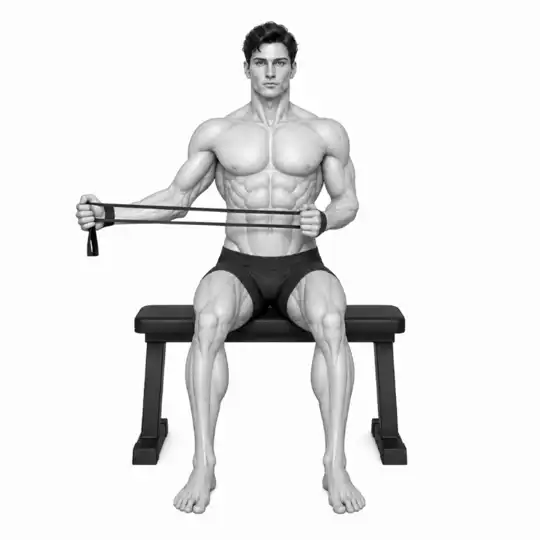
BAND EXTERNAL ROTATION
Train controlled shoulder external rotation with a light band and a stable upper arm.
Anchor a light band near elbow height. Keep the elbow bent about 90 degrees and close to the torso, rotate the forearm outward without twisting the trunk, and return slowly.
- Primary muscles
- Infraspinatus · Teres Minor (Rotator Cuff)
- Secondary muscles
- Rear Deltoid · Rhomboids
- Difficulty
- Beginner
- Movement type
- Shoulder External Rotation
Can I use dumbbells?
If you use dumbbells while standing, proper resistance is not applied to the rotator cuff due to the direction of gravity. It should be performed using bands or cables or while lying on your side.
STEP BY STEP
4 Steps for One Complete Rep
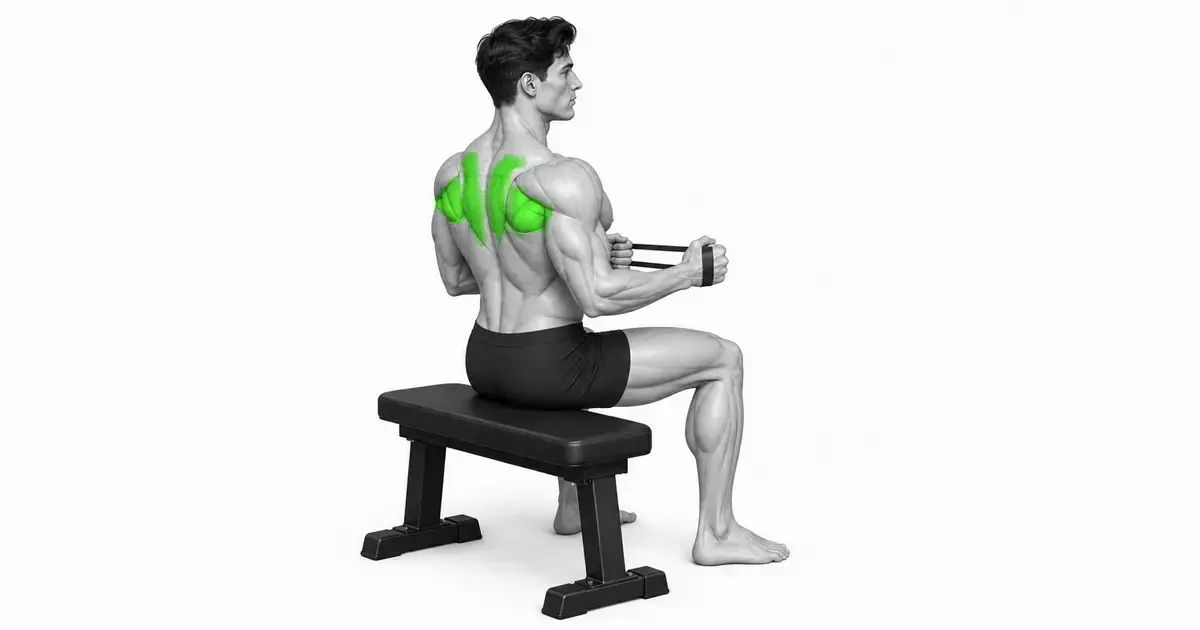
- 1
Ready posture
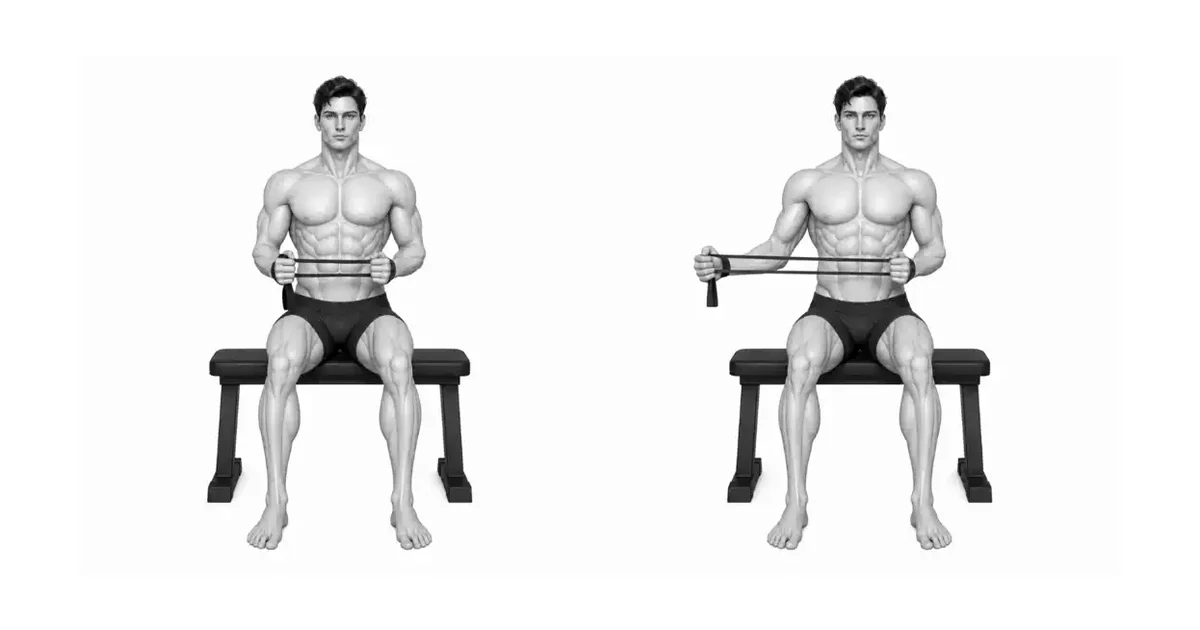
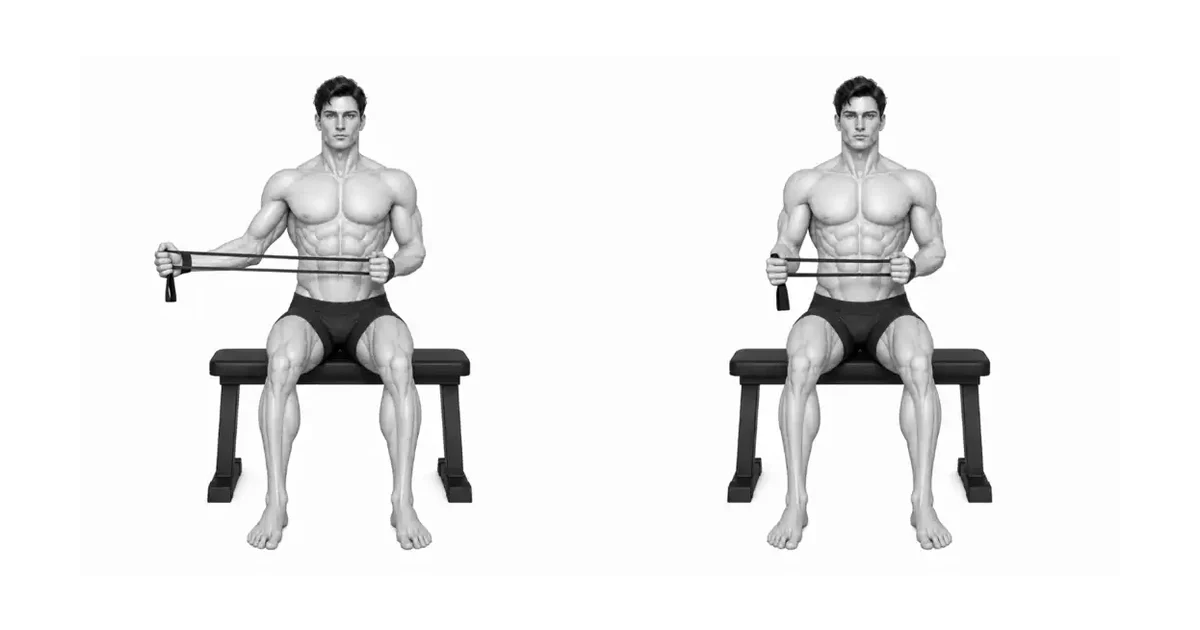
Hold the band and bend your elbows to 90 degrees. Keep your elbows pressed to your sides and stabilize your shoulder blades.
- 2
Rotate outward
Using your elbows as an axis, slowly open your hands outward. Focus on stimulating deep behind the shoulder.
- 3
Apex Contraction
Pause briefly as you feel your rotator cuff tightening at full range of motion.
- 4
Return slowly
Resist the elasticity of the band and slowly return to the starting position. Don't relax.
ROTATOR CUFF STABILITY
Protector of the shoulder, rotator cuff
The rotator cuff is four small muscles surrounding the shoulder joint and plays a key role in maintaining shoulder stability. Band external rotation specifically targets the infraspinatus and teres minor muscles, preventing the shoulders from rolling forward and securing space inside the joint.
If the rotator cuff is weak compared to the strong external muscles (deltoids), the risk of shoulder impingement syndrome or rotator cuff tear increases. Therefore, performing it as a warm-up before heavy pressing exercises or including it as a separate strengthening routine is very important for long-term shoulder health.
RANGE, LOAD & TEMPO
Choose a range and load that keep the Band External Rotation repeatable
The useful range of motion ends before your torso or working joints have to change position to move the load. Keep the infraspinatus · teres minor (rotator cuff) producing the movement while the rear deltoid · rhomboids support the same alignment from the first repetition to the last.
Use a controlled lowering phase of about two to three seconds and avoid bouncing through the transition. If the final repetitions become shorter, faster, or visibly different from the first, reduce the load or stop the set before technique breaks down.
Key point: Progress the Band External Rotation only after every repetition follows the same path without joint pain.
TROUBLESHOOTING
Fix the cause of a mistake, not just its appearance
Elbows away from body
- What you see
- The movement of the elbow moving away from the side when the hand is opened.
- Likely cause
- Deltoid muscle involvement increases and rotator cuff isolation fails.
- How to correct it
- Keep your elbows firmly at your sides or place a towel between them to keep them from falling.
Rotation of the torso
- What you see
- A posture in which the entire torso is turned to open the hands.
- Likely cause
- Lack of rotator cuff strength or excessive band resistance.
- How to correct it
- Keep your core locked and use only shoulder joint rotation. We recommend lowering the band intensity.
REGRESSION & PROGRESSION
Match the difficulty before adding load
Side Lying Dumbbell External Rotation
Lie on your side and use dumbbells to resist gravity and strengthen your rotator cuff.
90/90 band external rotation
Perform external rotation with arms raised 90 degrees to the side to train stability closer to sporting situations.
BEGINNER PROGRAM
A practical starting framework
Choose light resistance and stop the set when the elbow drifts away from the torso or the shoulder rolls forward.
Frequency
3-4 times a week or during each warm-up
We strongly recommend performing 1-2 sets as a warm-up before shoulder exercises.
Volume
2~3 sets, 15~20 times
This is a muscle that requires endurance, so perform it at low intensity and high repetitions.
- Keep the wrist holding the band neutral so as not to bend it.
- Perform the movements very slowly to feel the stimulation.
- The basics are to straighten your chest and maintain good posture.
Frequently asked questions
I think the band is too weak.
The rotator cuff is a very small muscle. Correct isolation and number of repetitions are much more important than strong resistance.