BENT-OVER LATERAL RAISE
Isolation exercise that lowers the upper body to precisely hit the back of the shoulder and create a balanced shoulder development.
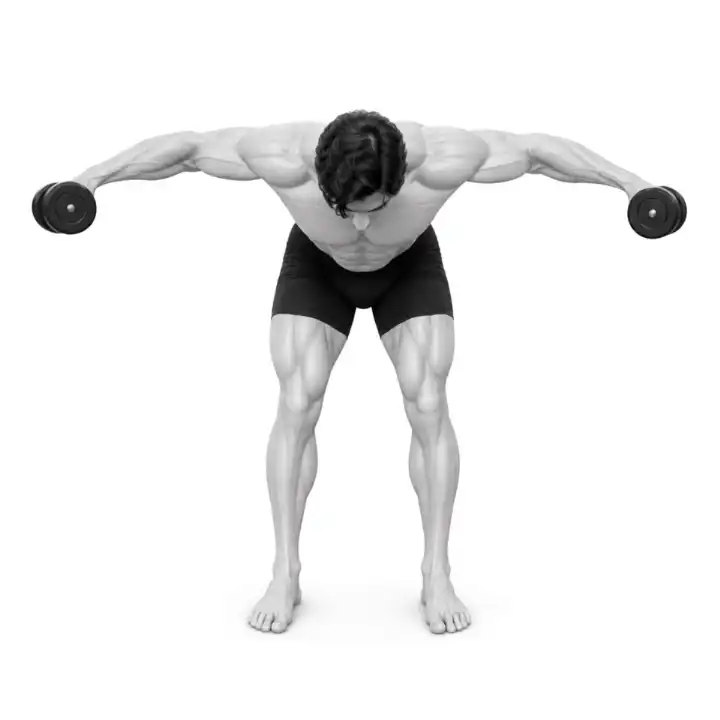
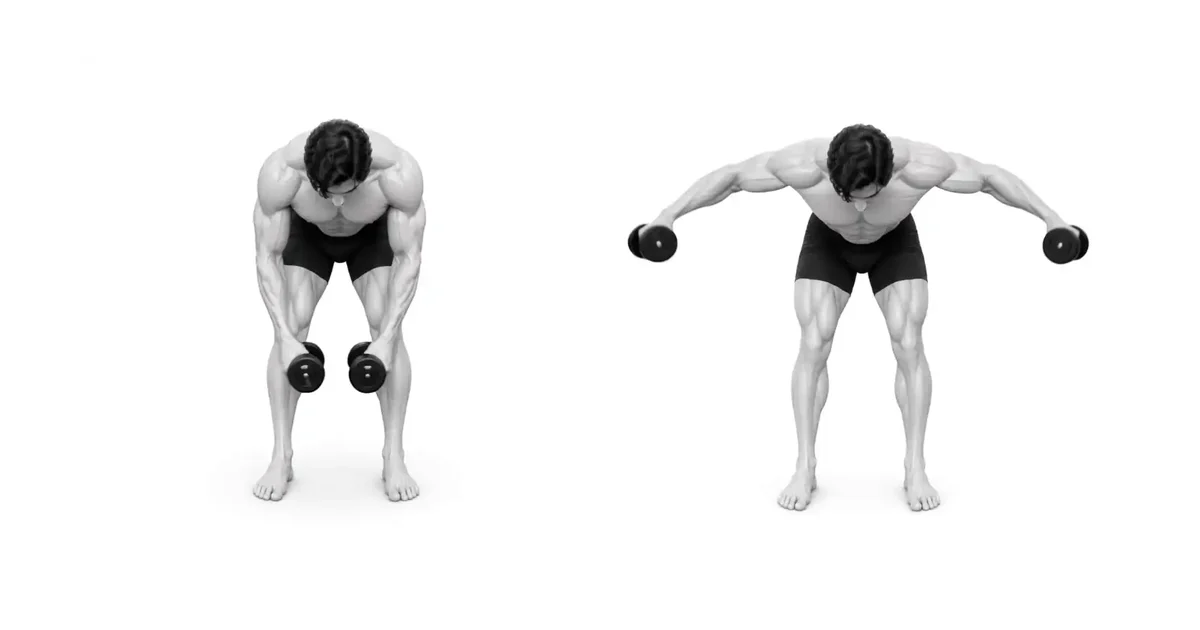
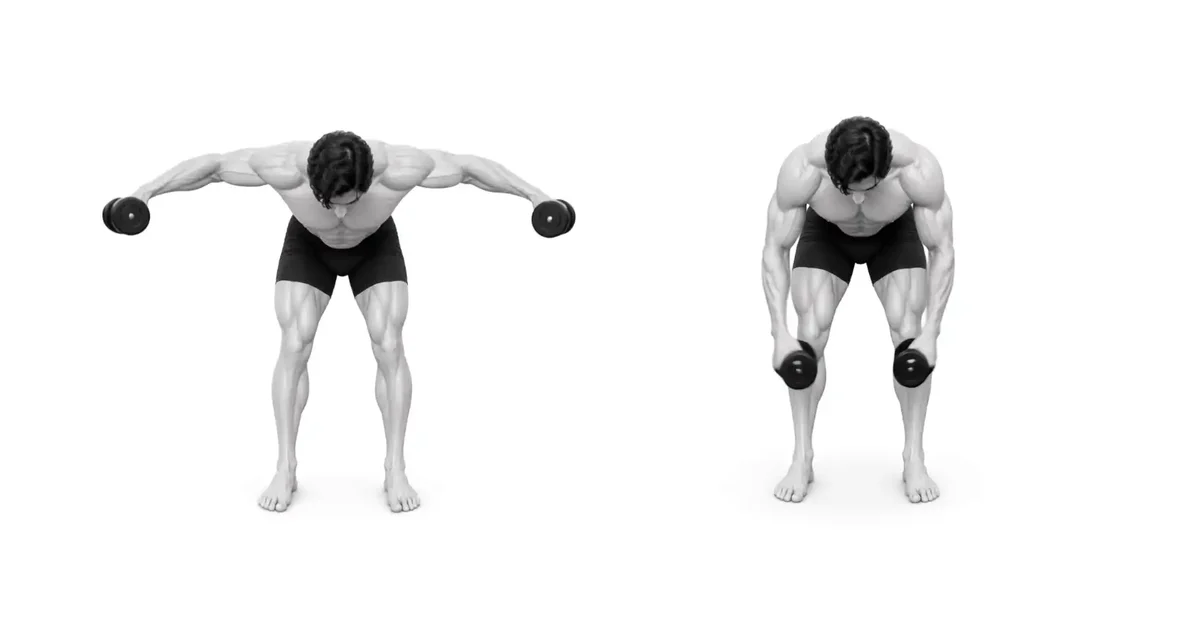
Hold a dumbbell in both hands, slightly bend your knees, and lower your upper body close to parallel with the floor. Straighten your back and look towards the floor. With your elbows very slightly bent, lift the dumbbells as if you are throwing them far to the sides. At this time, focus on raising your shoulder blades with the strength of the muscles behind your shoulders rather than bringing them together. Pause briefly at the top, then slowly and controlledly return to the starting position.
- Primary muscles
- Rear Deltoid
- Secondary muscles
- Middle Trapezius · Rhomboids · Lateral Deltoid
- Difficulty
- Intermediate
- Movement type
- Shoulder Horizontal Abduction
How should I orient my palm?
You can have your palms facing each other (neutral) or facing the floor (overhand). When using an overhand grip, raising your little finger slightly is beneficial for stimulating the rear deltoid muscles.
STEP BY STEP
4 Steps for One Complete Rep
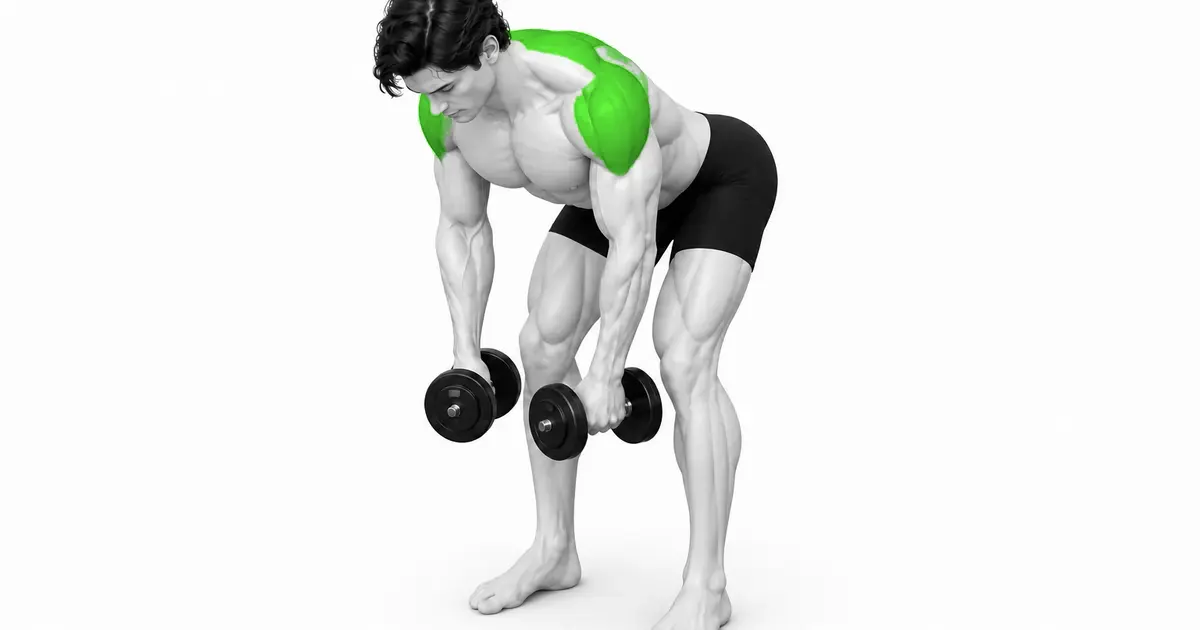
- 1
Ready posture
Place your feet hip-width apart and slightly bend your knees. Assume a hip hinge position, lower your upper body and hang the dumbbells below your shoulders.
- 2
Side Lift
Keeping your elbows fixed, lift the dumbbells to both sides in a large arc. Stimulation is better when the little finger faces upward.
- 3
Apex Contraction
When your arms are raised to shoulder height, you feel a strong contraction of your rear deltoid muscles.
- 4
Slow down
Feel the weight of the dumbbells and slowly lower them to the starting position. Keep your shoulders relaxed.
HINGE STABILITY
Stable hip hinge determines your posture
The most important thing in bent over posture is lower back stability. If the 'hip hinge' posture, which involves pushing your hips back and keeping your back flat, is disrupted, it can cause back pain.
Strengthen your core to keep your upper body steady and, if necessary, lean your forehead against the bench to stabilize your upper body to better isolate your rear deltoids.
RANGE, LOAD & TEMPO
Choose a range and load that keep the Bent-Over Lateral Raise repeatable
The useful range of motion ends before your torso or working joints have to change position to move the load. Keep the rear deltoid producing the movement while the middle trapezius · rhomboids · lateral deltoid support the same alignment from the first repetition to the last.
Use a controlled lowering phase of about two to three seconds and avoid bouncing through the transition. If the final repetitions become shorter, faster, or visibly different from the first, reduce the load or stop the set before technique breaks down.
Key point: Progress the Bent-Over Lateral Raise only after every repetition follows the same path without joint pain.
TROUBLESHOOTING
Fix the cause of a mistake, not just its appearance
Excessive recoil (cheating)
- What you see
- Movement of lifting weight by shaking the upper body up and down.
- Likely cause
- The weight is too heavy to be controlled by the rear deltoids alone.
- How to correct it
- Lower the weight, keep your upper body completely still, and focus on moving only your arms.
Excessive retraction of the scapula
- What you see
- A condition in which the muscles in the middle of the back are used more than the muscles behind the shoulders.
- Likely cause
- Trying to put your arms back too far or fold your shoulder blades.
- How to correct it
- Reduce the involvement of your back muscles by performing with the feeling that your arms are moving far to the side rather than behind you.
REGRESSION & PROGRESSION
Match the difficulty before adding load
Seated Bent-Over Raise
Perform while sitting on the edge of a bench to completely block lower body recoil and reduce back strain.
Incline Bench Rear Delt Raise
Perform prone on an incline bench to improve upper body stability and isolate the rear delts.
BEGINNER PROGRAM
A practical starting framework
Bent-over lateral raise determines the completeness of the shoulder. Focus on the burning sensation in your rear delts with correct posture.
Frequency
2-3 times a week
Include this as an essential isolation exercise in your shoulder workout routine.
Volume
3~4 sets, 15~20 times
The rear delts respond well to stimulation-oriented, high-repetition training.
- Do not fully straighten your elbows, but keep them slightly bent.
- When coming down, keep the distance between the dumbbells so they don't hit each other.
- Keep your neck neutral with your gaze pointed toward the floor slightly in front of you, not straight ahead.
Frequently asked questions
How high should I raise my arms?
It is enough to raise your arms to the point where they are parallel to the floor. If you raise it any higher, the involvement of your back muscles increases.