CABLE REAR DELT FLY
Isolation exercise that isolates the rear deltoid muscles and completes the three-dimensional shape of the shoulders through continuous resistance of the cable.
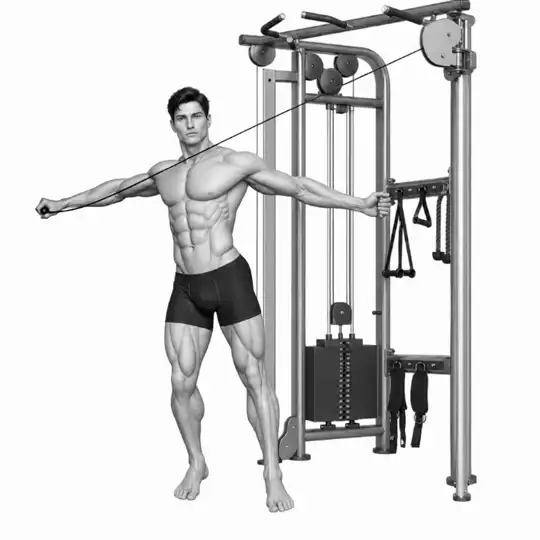
Set the cable machine's pulley at eye level or slightly higher. Remove the handle and hold the end of the cable, or hold the opposite cable in a crossover fashion. Keeping your chest out and your core tense, extend your arms out to the sides and pull them back. At this time, keep your elbows slightly bent and focus on contracting the muscles behind your shoulders. Pause at the top for a moment, then slowly return to the starting position, feeling the resistance of the cable.
- Primary muscles
- Rear Deltoid
- Secondary muscles
- Middle Trapezius · Rhomboids · Infraspinatus
- Difficulty
- Intermediate
- Movement type
- Shoulder Horizontal Abduction
Do I have to use the handle?
Performing without a handle and holding the round end of the cable may allow for more wrist freedom, making it easier to find posterior deltoid stimulation.
STEP BY STEP
4 Steps for One Complete Rep
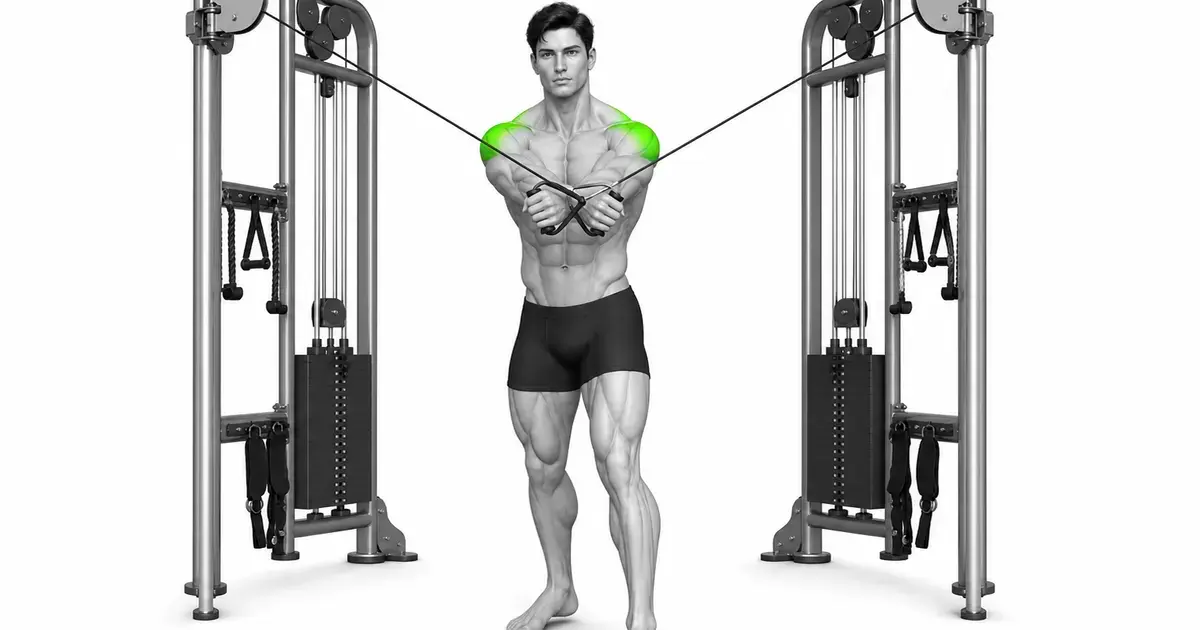
- 1
Cable Settings and Grips
Align the pulley at the top and cross the left cable with your right hand and the right cable with your left hand.
- 2
Open back
Keeping your elbows fixed, spread your arms wide to the sides and pull them back. Focus on feeling the muscles behind your shoulders being squeezed.
- 3
Apex Contraction
Pause while feeling a strong contraction of the rear deltoid muscle at the point where both arms are parallel to the torso.
- 4
Resist and return
Maintain the cable tension all the way and slowly return to the starting position. Extend your arms until they are fully crossed and relax your muscles.
CONSTANT TENSION PATH
Continuous resistance throughout operating range
The biggest advantage of the cable rear delt fly is that, unlike dumbbells, strong resistance is applied even at the starting point of the movement (when the muscles are stretched).
If you start with your arms crossed, your rear deltoids will begin to receive resistance while at maximum stretch, which will place greater metabolic stress on the muscles, which will in turn lead to effective muscle growth.
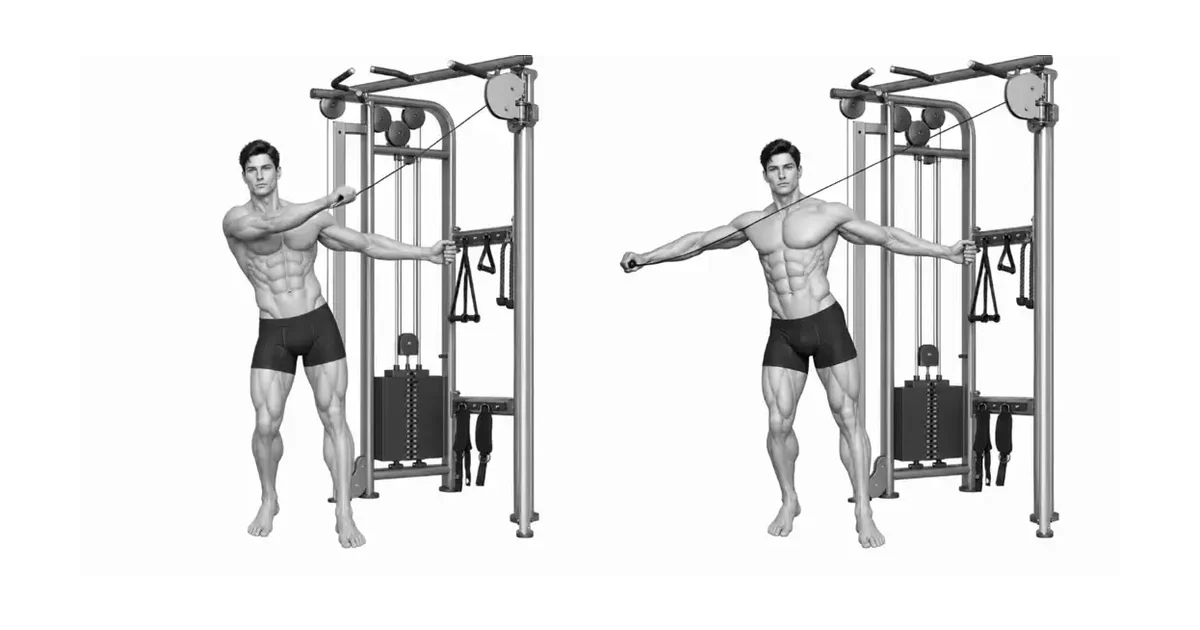
RANGE, LOAD & TEMPO
Choose a range and load that keep the Cable Rear Delt Fly repeatable
The useful range of motion ends before your torso or working joints have to change position to move the load. Keep the rear deltoid producing the movement while the middle trapezius · rhomboids · infraspinatus support the same alignment from the first repetition to the last.
Use a controlled lowering phase of about two to three seconds and avoid bouncing through the transition. If the final repetitions become shorter, faster, or visibly different from the first, reduce the load or stop the set before technique breaks down.
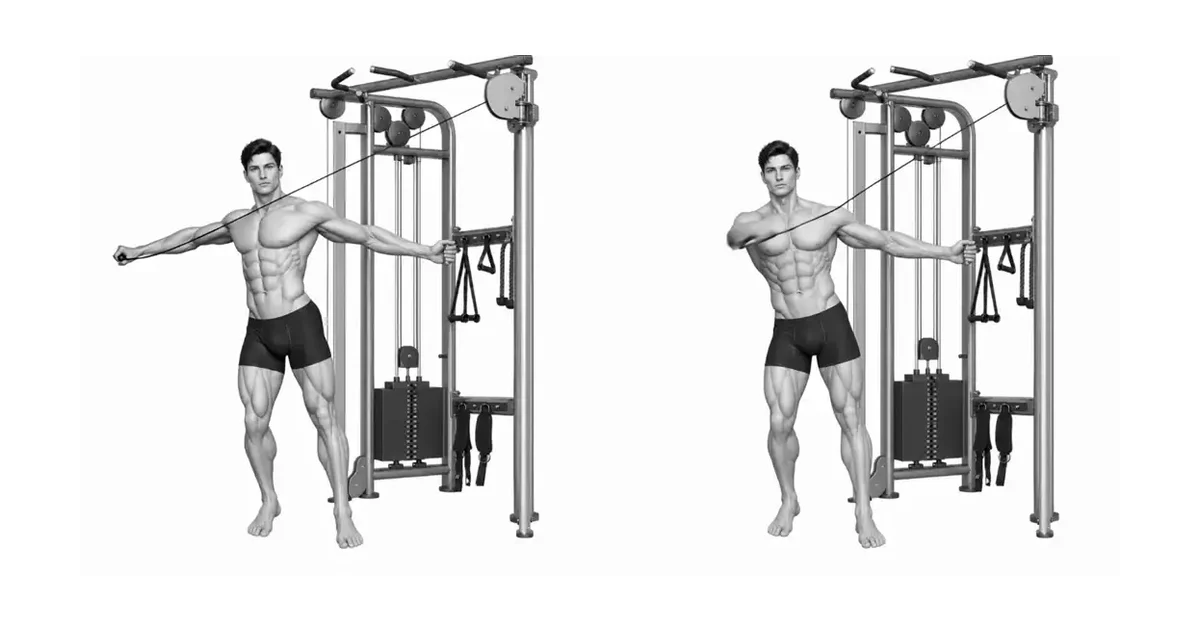
Key point: Progress the Cable Rear Delt Fly only after every repetition follows the same path without joint pain.
TROUBLESHOOTING
Fix the cause of a mistake, not just its appearance
Excessive involvement of back muscles
- What you see
- A condition in which the muscles between the shoulder blades are used more than the back of the shoulder.
- Likely cause
- Arms sent too far back or shoulder blades folded excessively.
- How to correct it
- Perform with the feeling of sending your arms far to the side rather than behind you, and minimize the movement of your shoulder blades.
Shrug
- What you see
- A phenomenon in which the shoulder rises toward the ear during a pulling motion.
- Likely cause
- Compensatory action of the upper trapezius muscle.
- How to correct it
- Keep your shoulders firmly pressed down and focus on moving only your arms.
REGRESSION & PROGRESSION
Match the difficulty before adding load
One Arm Cable Rear Delt Fly
Perform one arm at a time to improve rear deltoid isolation and increase focus.
Seated Cable Rear Delt Fly
Perform while sitting on a bench to prevent shaking of the lower body and torso and increase stability.
BEGINNER PROGRAM
A practical starting framework
Cable rear delt fly is a key exercise that improves shoulder perfection. The point is not to lose muscle tension.
Frequency
2-3 times a week
Great as an isolation exercise to finish off a shoulder or back workout.
Volume
3~4 sets, 15~20 times
Choose a number of repetitions that allows you to focus on correct trajectory and maintaining constant tension rather than weight.
- Do not fully straighten your elbows, but keep them slightly bent.
- Maintain a constant tempo throughout the movement and exclude recoil.
- Move the cable gently to avoid kinking it.
Frequently asked questions
What is the best pulley height?
Generally, the eye height is appropriate, but you can change the height by slightly adjusting it depending on the upper/middle/lower part of the back of the shoulder.