DUMBBELL SHOULDER PRESS
Dumbbell shoulder press is not a test of pushing a dumbbell over your head, but an exercise that repeats the path that your shoulders and torso can hold together.
Dumbbell shoulder press is a multi-joint exercise that involves pushing a dumbbell from near the shoulder toward the top of the head while sitting. The triceps is involved while the elbow is extended, and the front and lateral deltoids, trapezius, serratus anterior, and muscles around the torso cooperate while the upper arm and scapula move together. So the goal of this movement is not to send the dumbbells as far back as possible or to arch your back to lift a heavier weight, but to repeat the same path without significantly disrupting the position of the bench, ribs, pelvis, and wrists. In an electromyographic study comparing dumbbells and barbells, and sitting and standing positions, deltoid muscle activity and the maximum weight that could be lifted varied depending on the conditions. However, since this is a comparison of one performance in a limited sample of healthy adult men, it cannot be said that one variation is safer for everyone or will guarantee greater muscle hypertrophy in the long term. This guide uses the standard of first stabilizing the torso using a bench with a backrest, and then repeating the mutually supported positions of the dumbbells, wrists, and elbows in a pain-free path.
- Primary muscles
- Front deltoid
- Secondary muscles
- Lateral deltoid, triceps, upper trapezius, serratus anterior
- Difficulty
- Intermediate
- Movement type
- Vertical Push
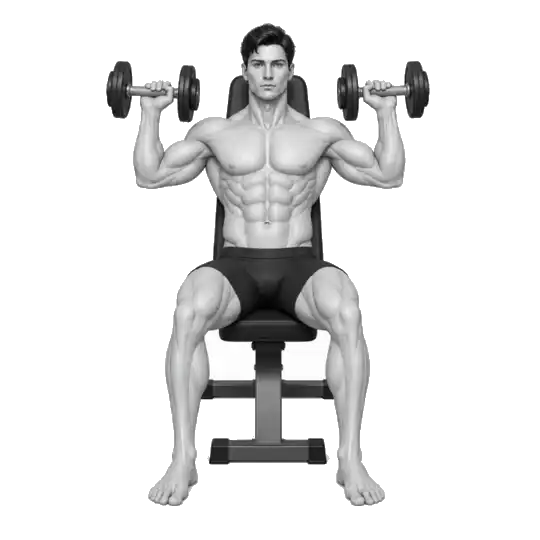
Do I need to position the bench completely vertical?
Not necessarily. The goal is not the most vertical angle, but an angle at which the pelvis and upper back are stable and the wrists, elbows, and shoulders can repeat the same path without pain. If you need to change the angle of the bench to reduce back or shoulder discomfort, start with lighter weight and a more comfortable angle.
STEP BY STEP
6 Steps for One Complete Rep
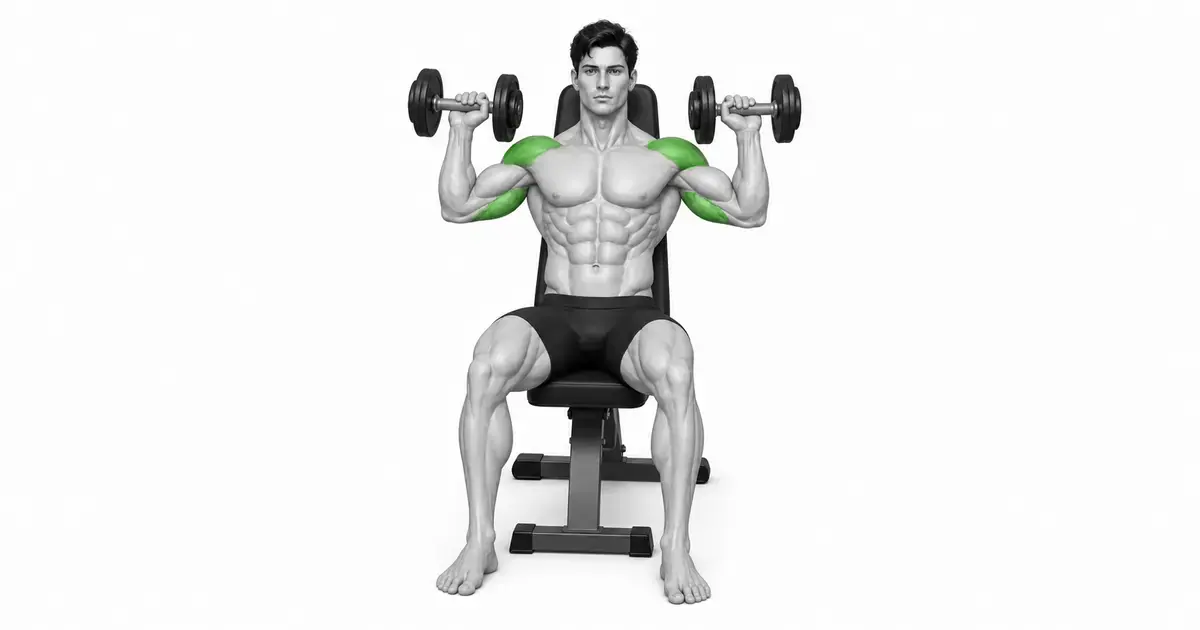
- 1
Check the backrest and dumbbells first
Stand the bench almost vertically, but do not raise the backrest so much that you have to bend your back excessively and push it. Check that the bench is secure and the floor is slippery, and create space on both sides and in front to safely lower the dumbbells. Start your first working set with a light weight that doesn't force you to change your elbow and torso position in the last few reps.
- 2
Creating a reference point on the bench with your feet, pelvis, and back
Place the soles of your feet comfortably on the floor and find a position where your pelvis and upper back are in contact with the backrest. Exhale lightly, allowing your ribs to rest comfortably on top of your pelvis, and create light tension in your stomach and buttocks. Do not move your hips forward or lift your lower back too far away from the backrest to make room to raise the dumbbells.
- 3
Place dumbbells in supported starting position next to shoulders
Instead of throwing the dumbbells up at once, bring them one by one to the side of your shoulders using your knees or an assistant. Place your wrists in line with your forearms and your elbows directly under the dumbbells or slightly ahead of you, whichever is comfortable for you. Send your elbows too far behind your torso or bend your wrists back to prevent the dumbbells from rolling toward your fingers.
- 4
Push the dumbbell upward and slightly inward at the same speed
Exhale and gently push both dumbbells upward. The dumbbells don't necessarily have to be held completely vertically, but make sure your elbows don't fall back or one side goes forward first. Your head can move naturally under the dumbbells, but do not overextend your chin or arch your back to create a path to avoid the dumbbells.
- 5
Pick the end position before the body changes
The end range of elbow extension may vary depending on the individual's shoulder range of motion and current weight. If your hands are stable above your head, your neck is not shortened, and your ribs are not protruding forward, take a moment to check that position. If you experience sharp pain in the front of your shoulder, tingling that spreads to your arms or hands, or discomfort in your lower back, do not push higher and reduce the range or weight.
- 6
Controlled lowering to starting position next to shoulder
Do not drop the dumbbells or suddenly open your elbows to the sides, but slowly lower them in a similar path as when you raised them. If your wrists buckle or your back begins to lift off the bench while coming down, it may be a sign that the repetition is already beyond your current control. Make sure the dumbbells are stable next to your shoulders before the next repetition, and don't kick back and push them right back up.
BENCH & START
The backrest is not a device to freeze the torso, but rather a reference point to return the dumbbells to the same starting position.
In the dumbbell shoulder press, the bench backrest is not a device that prevents the lower back and shoulder blades from moving at all. When your arms are raised overhead, your scapulae naturally rotate upward and tilt over your ribcage. The important thing is not to press the shoulder blades down, but to use the backrest as a reference point so that the positions of the pelvis, ribs, and head do not change significantly from repetition to repetition.
If the dumbbells are not supported on your wrists or elbows in the starting position, it is easy to compensate by bending your wrists or sending your elbows back before the first push. The study protocol used standardized wrist and elbow positions, a near-neutral spine, and constant speed, but that doesn't mean one position is right for everyone. Pick a position where the dumbbells are stable without pain and both sides start similarly, then maintain that standard throughout the set.
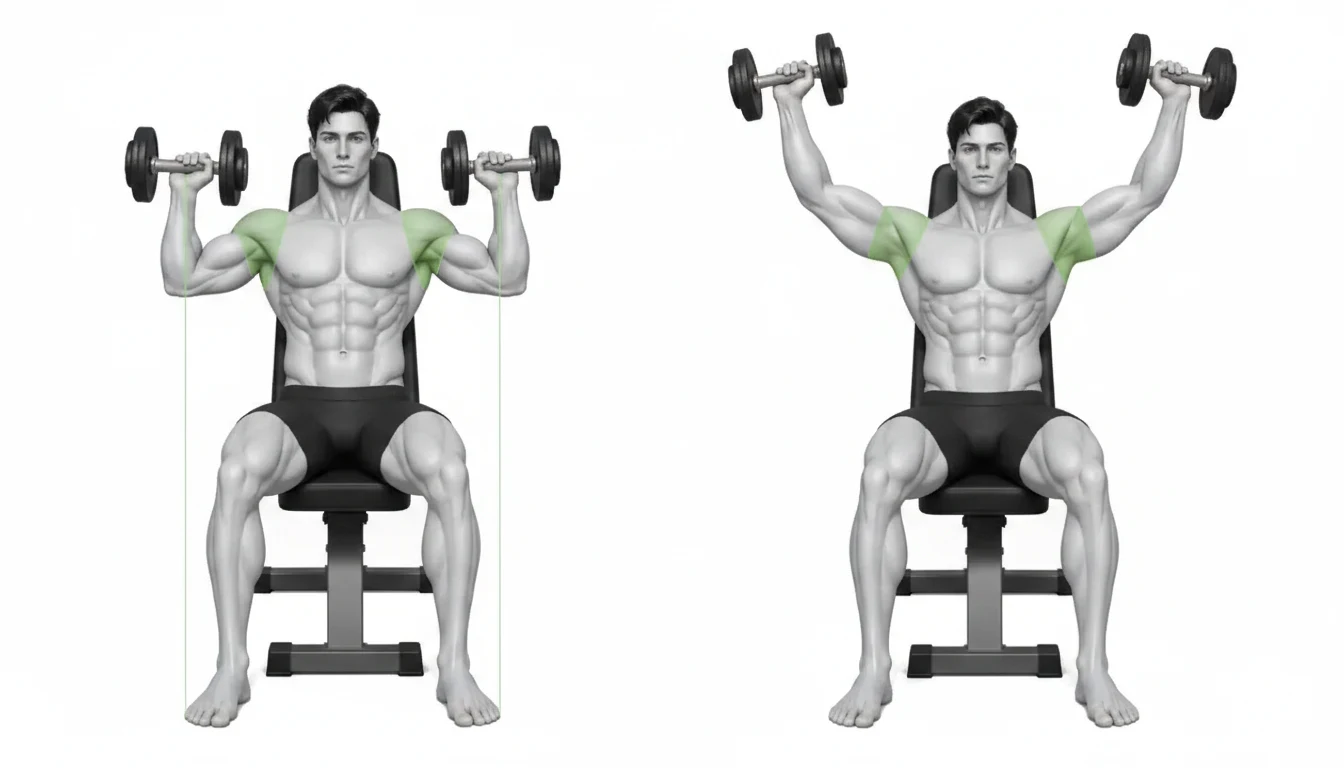
Key point: Check now: Feet are on the floor · Pelvis and upper back are in contact with the bench · Wrists are parallel to forearms · Dumbbells are supported above the elbows
SCAPULA & PATH
What you need above your head is not a fixed scapula, but a still path for your neck and ribs instead.
In the overhead press, as the upper arm rises, the scapula and collarbone move as well. If you try to pull down or push your shoulder blades back all the way, the area around your shoulders and neck may become unnecessarily stiff. Conversely, if your shoulders are rising quickly toward your ears, your neck is short, or only one dumbbell is ahead of your head, your current weight, range, or path may be beyond what you can control.
Dumbbells allow each hand to move independently, allowing some room to adjust the direction and width of the hands. This degree of freedom does not make a particular palm orientation safer for everyone. Muscle activity results from small studies comparing dumbbells and other overhead tools were also inconsistent across conditions. Therefore, as a standard, first make sure that both dumbbells pass a similar path within a range that does not cause discomfort in the wrist, elbow, or front of the shoulder, and that the ribs do not open forward.
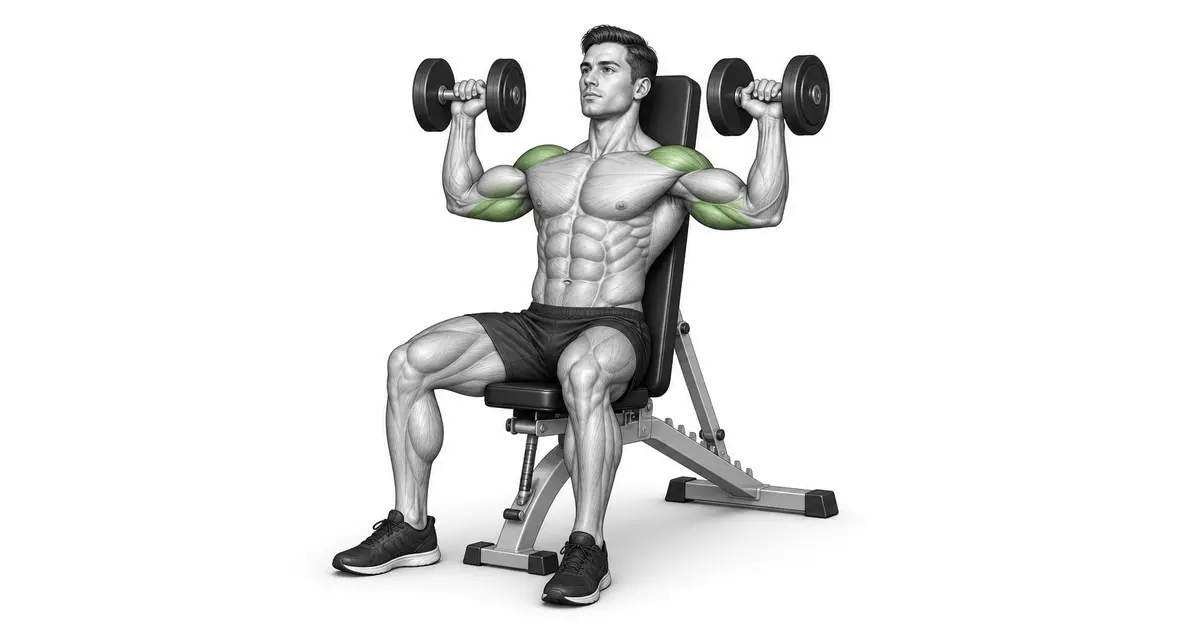
LOAD & CONTROL
Heavier dumbbells are not evidence of better reps, it's a new condition to check if you can stay on the same path
In a study comparing standing dumbbell press and barbell press, the dumbbell/standing condition showed higher deltoid muscle activity and lower 1RM. However, these results are an acute measurement from a single test of 15 healthy adult men, and do not conclusively suggest that dumbbells are better or safer for all goals. Because the demands of stabilizing a pair of dumbbells can vary, it is safer not to expect the same number of repetitions as a barbell or machine.
If your hips are pushing forward and your lower back is off the backrest in the last few reps, or the dumbbells are swinging from side to side and one elbow starts to lock in first, it may not be time to add more weight. First, perform the same number of reps for every set, then increase the weight in smallest increments. If you cannot control the descending section, it is difficult to view the record of the ascending section as a record of the same movement.
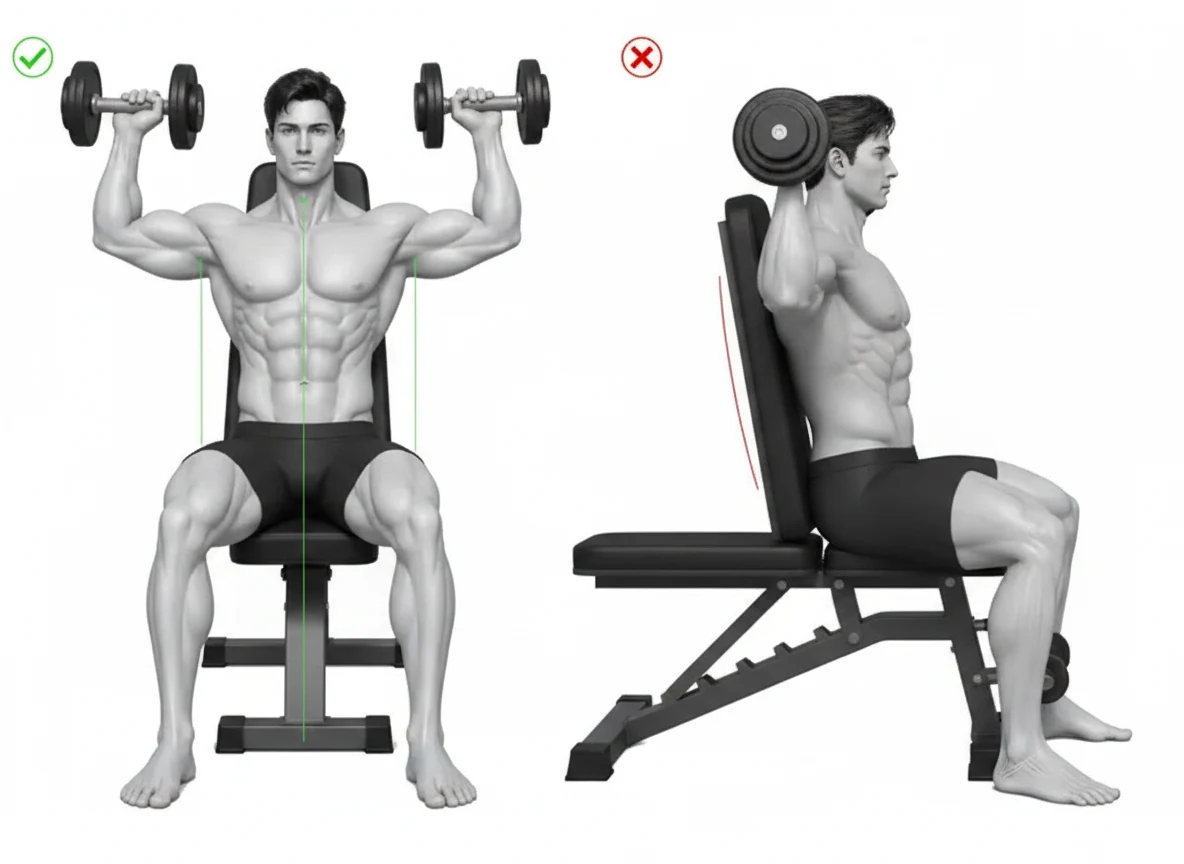
TROUBLESHOOTING
Fix the cause of a mistake, not just its appearance
Lower back lifts off bench from first repetition
- What you see
- Before pushing the dumbbells, open your ribs forward, let your hips slide forward or lower your lower back significantly off the backrest.
- Likely cause
- Rather than having your torso and shoulders jointly controlling the weight or starting position, you are arching your back to create space under the dumbbells.
- How to correct it
- Place your feet back on the floor and touch your hips and upper back to the bench. Lower the dumbbells to a weight and end range that you can maintain with your ribs resting comfortably on your pelvis.
Dumbbell moves towards fingers and wrist is bent
- What you see
- At the start or end position, the backs of the hands are excessively rolled back, and the dumbbell handles roll away from the center of the palms and toward the fingers.
- Likely cause
- The dumbbells are not supported above the elbows, or the weight is heavier than the grip and forearms can support.
- How to correct it
- Hold the handle steady with the inside of your palm and place your wrist in line with your forearm. Lower the dumbbells and return to the starting position with your elbows and wrists supported in the same direction.
Elbows are pulled back excessively behind the torso
- What you see
- When lowering the dumbbells, the elbows go far behind the side line, and the front of the shoulders feel tight or uncomfortable.
- Likely cause
- You may be thinking that lowering deeper is a better repetition, or you are lowering the dumbbells to a position lower than your individual shoulder range of motion.
- How to correct it
- Lower only to a position where your elbows are comfortably supported next to your shoulders. Don't force yourself to expand your pain-free range, but if you want to lower the dumbbells further, check the weight and bench angle again first.
One dumbbell is locked first and the torso is tilted
- What you see
- In the end position, one arm is extended first, the opposite dumbbell lags behind, and the head or ribs are tilted to one side.
- Likely cause
- Rather than controlling the path of both shoulders and elbows at the same speed, the dumbbell is pushed up toward the stronger side.
- How to correct it
- Start both dumbbells at the same height and raise them at the same speed. If the difference continues, lower the dumbbells and return to checking the path with lighter dumbbells on each side.
Move chin forward to avoid dumbbells
- What you see
- When the dumbbell goes up, the neck falls forward, the chin is lifted, and the head moves quickly under the dumbbell.
- Likely cause
- The dumbbell path is too close to the body, or the shoulder and thoracic spine are beyond the comfortable range of movement.
- How to correct it
- Keep your gaze straight ahead and your neck long. Find a comfortable path for the dumbbells to pass around your head, and lower the weight or range if you have to jut your chin out of the way.
Drop the dumbbells down and use them as a kickback for the next repetition.
- What you see
- At the end of straight elbows, the dumbbells are quickly lowered to the sides of the shoulders, and the next repetition begins with a bounce from the torso, not the shoulders.
- Likely cause
- You are only considering the push up portion of the exercise, or you are currently losing control of the weight in the second half of the set.
- How to correct it
- Slow down until the dumbbells return to a stable starting position next to your shoulders. If you can't get into that position quietly, end the set or lower the weight.
REGRESSION & PROGRESSION
Match the difficulty before adding load
Arm and scapula path exercises on bench without weight
Sit on your back, start with your hands next to your shoulders, raise them above your head, and then lower them. First, make sure both arms are moving at the same speed, without shortening your neck or opening your ribs forward.
Partial range press with very light dumbbells
Push and lower the dumbbells only as far as your wrists and elbows are stable. Do not force the end position, but do 8–12 repetitions while keeping your hips and upper back in contact with the bench.
Seated two-hand dumbbell shoulder press
Push both dumbbells from the sides of your shoulders to overhead at the same speed. Use the dumbbells to the end range where the positions of your elbows, wrists, and torso are maintained, and control the dumbbells even on the way down.
Dumbbell shoulder press performed on one side
Check torso position by pushing a light dumbbell with one hand and placing the other hand on a bench or thigh. If your pelvis rotates or your ribs open to one side, return to the two-handed version or light dumbbells.
BEGINNER PROGRAM
A practical starting framework
Can be used 1–3 times per week at the beginning of an upper body push workout or as an accessory exercise after a chest workout. Use the first set to check the path of the dumbbells and wrists and elbows, and for the working set, start with the weight you have left for the last 2-3 reps. If you do a lot of exercises that place a heavy load on your front shoulders and triceps, such as bench presses, push-ups, and dips, in the same week, you should also monitor the fatigue and pain response of your shoulders and neck before adding sets of dumbbell shoulder presses.
Count
6–12 times
Range within which the wrist, elbow, and rib positions are maintained
Set
2–4 sets
90–150 seconds recovery between same shoulder push exercises
Speed
1–2 seconds up, 2 seconds down
Do not use the bounce of the descending dumbbell for the next repetition
- Once your pelvis and upper back are in contact with the bench and your wrists and elbows are stable for all repetitions, first increase the number of repetitions to the top of the target range.
- Increase dumbbell weight in smallest increments only after you have achieved the top of your reps in the same position for all sets. Do not increase the weight and number of repetitions simultaneously on the same day.
- If your neck shortens or your lower back lifts off the backrest, and the speed of both dumbbells begins to vary, return to the previous weight or previous range. Repeating the same path takes precedence over the number of dumbbells.
Frequently asked questions
Should dumbbells hit each other at the ends?
No. Having your arms fully together or slamming the dumbbells together is not a requirement for the end position. You can stop within the range where both hands are stable above your head and the position of your neck, ribs, and wrists is maintained.
Should I keep my palms facing completely forward?
One palm orientation is not the answer for everyone. Dumbbells allow you to slightly adjust the direction of each hand, so choose a direction where your wrists are parallel to your forearms and don't cause discomfort in front of your shoulders, and keep it consistent throughout the set. No particular grip guarantees pain prevention or long-term results.
Are standing presses better than seated presses?
Depends on your goals and current control capabilities. The study observed a combination of higher deltoid activity and lower 1RM during standing dumbbell performance, but this was an acute measurement with limited participants and conditions. If standing requires you to swing your torso or arch your back, it may be more appropriate to learn the route while sitting.
I have shoulder pain. Can I recover from dumbbell shoulder presses?
Dumbbell Shoulder Press is a general resistance exercise and is not intended to diagnose or treat the cause of an individual's pain. If pain persists, hurts at night, or causes weakness, numbness, or decreased range of motion, seek evaluation from a medical professional rather than increasing the load on your own.
Evidence and references
- 1. Saeterbakken·Fimland — Shoulder press muscle activity and strength according to posture and dumbbell/barbell conditions
- 2. Dicus et al. — Front deltoid muscle activity of dumbbell/kettlebell overhead press
- 3. Błażkiewicz·Hadamus — Shoulder and back muscle activity of dumbbell/kettlebell overhead press