LATERAL RAISE
The lateral raise is not a test of lifting dumbbells high, but an exercise that maintains the path that your shoulders can support until the end.
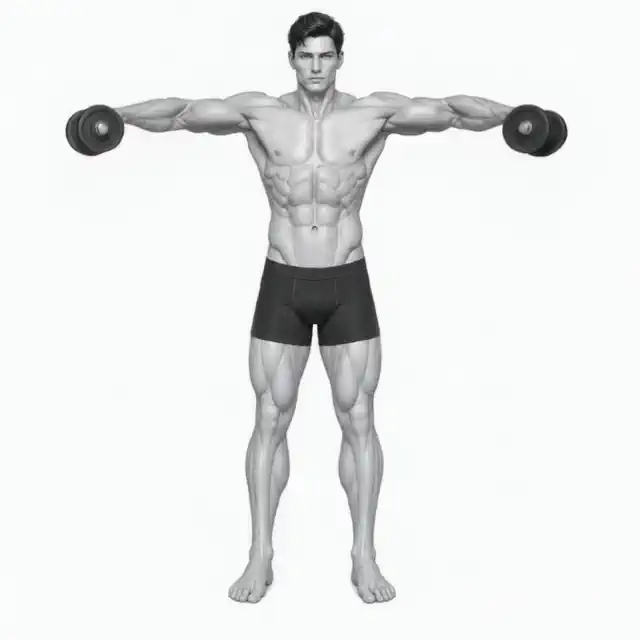
Dumbbell lateral raises are a shoulder abduction exercise that involves raising your arms outward next to your torso. The goal is not to send the dumbbells as far as possible or lock your arms, but to maintain the position of your wrists, elbows, and torso and use the same amount of tension that the lateral deltoids can create for each repetition. Dumbbells create greater rotational demands on the shoulders when the arms are closer to horizontal than when the arms are next to the torso. So, even if the weight is the same, it is easy to compensate by shaking your torso or shrugging your shoulders in the upper section. There is no way to determine which direction of the back of the hand or side of the arm is best for everyone. Electromyographic studies comparing lateral raise variations are brief experiments with a limited number of healthy trainees, so they only show muscle activation patterns and do not guarantee long-term hypertrophy or pain treatment. This guide first uses the criteria of keeping the wrist parallel to the forearm within a pain-free range, moving the arm comfortably between the front and side of the torso, and not recoiling with the torso.
- Primary muscles
- Lateral deltoid
- Secondary muscles
- Anterior deltoid · Upper trapezius · Rotator cuff
- Difficulty
- Beginner to Intermediate
- Movement type
- Shoulder abduction
Do I have to raise the dumbbells higher than shoulder height?
No. The priority is not a particular arm height; it is maintaining neck, torso, and wrist position without pain. Use the range before your shoulders rise or your back arches.
STEP BY STEP
6 Steps for One Complete Rep
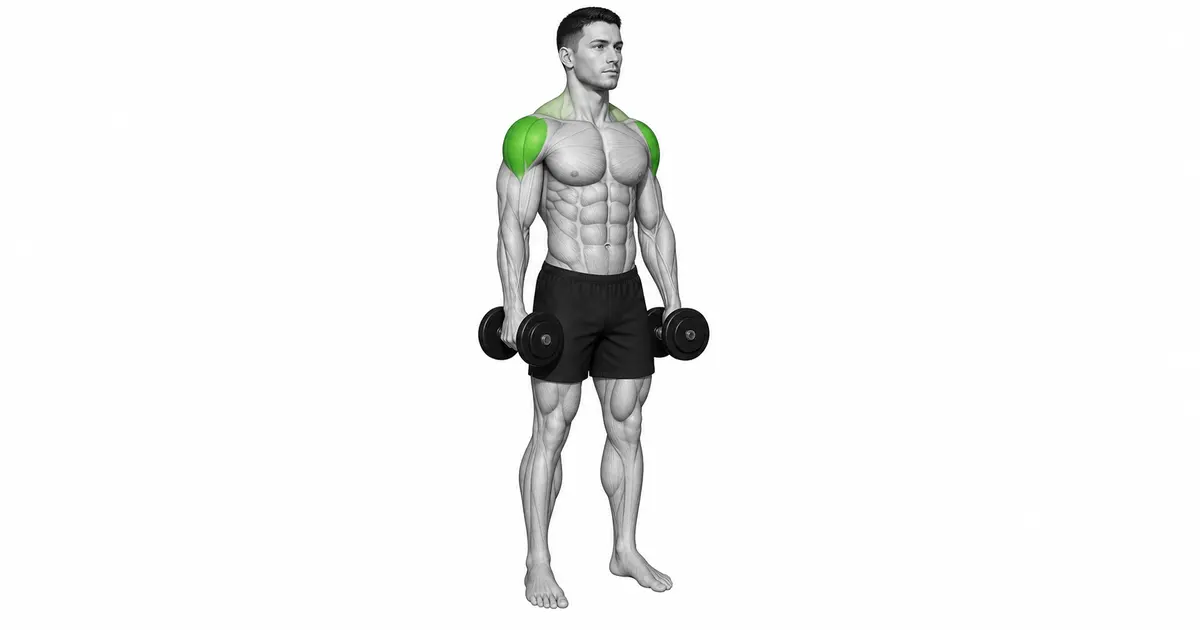
- 1
Choose light dumbbells and an empty space first.
Start your first set with a weight that doesn't force you to change form in the last few reps. Make space for the dumbbells to pass on both sides, and if the floor is slippery or there are objects under your feet, remove them first. The heaviest dumbbell you can lift once is not the starting weight for this movement.
- 2
Set a quiet torso position with your feet and pelvis
Place your feet about hip-width apart and do not lock your knees. Exhale until your ribs rest comfortably over your pelvis, creating light tension through your hips and abdomen. Do not lean back to make room to raise the dumbbells, and keep your gaze straight ahead without pushing your chin forward.
- 3
Keep your wrists aligned with your forearms and your elbows soft.
Place the dumbbells next to your thighs and make sure your wrists are not bent in or out. The elbows can be held in a very small bend rather than fully locked. That small bend is not a kickback to make the dumbbells easier, but a starting point to keep your wrists and elbows steady in the end range.
- 4
Open your arms together between the front and sides of your torso
Exhale gently as you raise both arms to the sides. You do not have to move exactly in the frontal plane. If a slightly forward path between the front and side of the torso can be repeated without discomfort at the front of the shoulder, use that path. Keep both hands moving to a similar height so that one dumbbell does not jump forward first or an elbow drift back.
- 5
Find the end range before the shoulder rises
Your arms may approach parallel with the floor, but that height is a result, not the goal. If your neck starts to shorten, your ribs lift, or your wrists buckle, stop at a lower point. Do not turn the movement into an overhead press; repeat only to the end point where shoulder and torso position remain controlled within a pain-free range.
- 6
Slowly return to the dumbbells before they start swinging.
After briefly checking the position at the end, lower the dumbbells controlled down to the sides of your thighs. While coming down, do not intentionally pull your shoulders down or bump the dumbbells against your thighs. If the dumbbells bounce forward when you start the next repetition, slow down or lower the weight.
GRIP & PATH
More important than hand direction is whether the wrist, elbow, and arm path create the same repetition.
In lateral raises, the dumbbells are suspended from the hands, and the further apart the arms are, the greater the rotational demands the shoulders must endure. So, if you bend your wrists excessively or straighten your elbows differently for each repetition, the feeling delivered to your shoulders and the compensation to your torso will be different even if you lift the same dumbbell. Whether the backs of your hands are facing up or your thumbs are slightly forward, first make sure your wrists are an extension of your forearms and the dumbbells are not too far ahead of your elbows.
In electromyography studies, neutral, external rotation, and internal rotation lateral raises showed different muscle activation patterns. However, the results are the result of experiments performed by a small number of competitive bodybuilders at set ranges and speeds. Therefore, rather than using a specific hand direction as a pain prevention or guarantee of muscle hypertrophy, it is more practical to choose a hand direction and arm side that can be repeated without pain and then maintain that condition throughout the set.
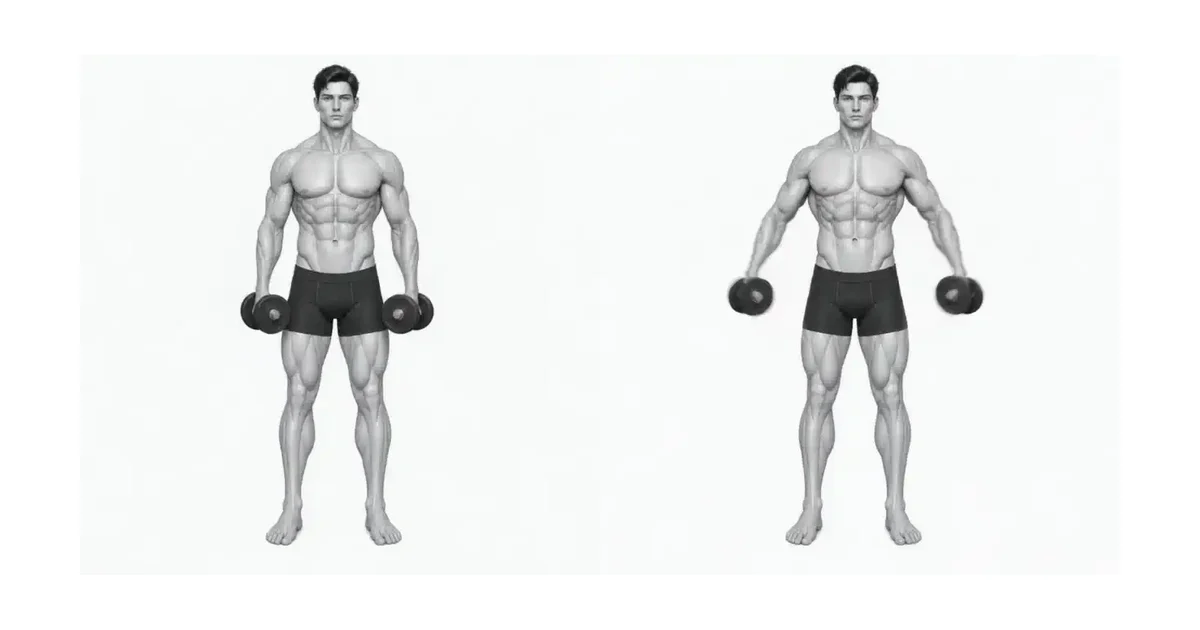
Key point: Check now: wrists in line with forearms · the same small elbow bend on every repetition · dumbbells travel the same path without pushing the torso out of position
SCAPULA & RANGE
Don't freeze your shoulder blades, instead choose a range where you can keep your torso still.
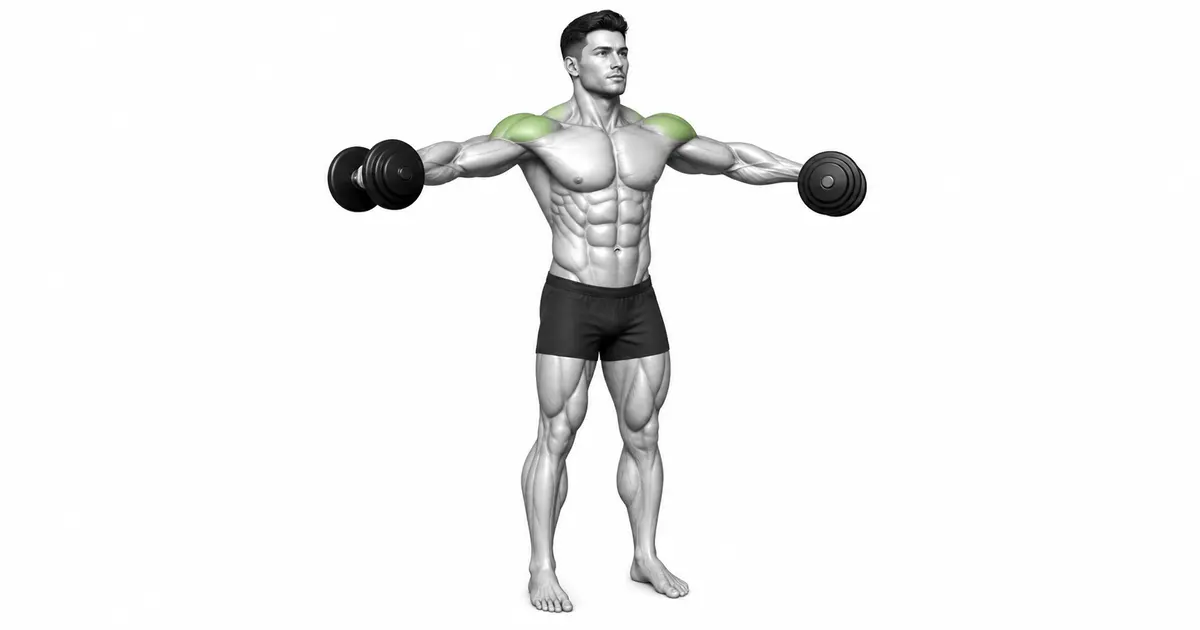
When the arms are raised, the scapulae naturally move over the ribcage. Trying to push your shoulder blades all the way down or back can cause unnecessary stiffness around your neck and shoulders. Conversely, if your shoulders quickly rise toward your ears and your neck shortens, it is likely that your current weight or range is beyond what your torso and shoulders can handle.
You'll often see your arms raised close to parallel with the floor, but that height doesn't have to be everyone's goal. A recent dumbbell/cable comparison study also compared the two conditions within a set shoulder abduction range. Your individual pain-free range may differ from the range determined by the study. The moment you lean back or lean forward to raise your arms, prioritize posture over height to reduce range or weight.
LOAD & CONTROL
A load you can hold only at the top tests momentum and the trapezius before it tests the lateral deltoids.
Dumbbell lateral raises tend to become more difficult the further your arms leave your torso. Therefore, even if you can do one or two high repetitions, if you rock your torso from side to side or straighten and bend your knees to create a rebound in the last few repetitions, it is difficult to say that you are training the same movement. By picking a weight that is controlled both as you go up and as you come down, it will be easier to see what variables are broken down from set to set.
In one study comparing dumbbell and cable lateral raises over an 8-week period, both methods were associated with increased lateral deltoid thickness in the ranged condition, with no clear advantage between the conditions. This does not mean that dumbbells are inferior or that cables are unnecessary. Rather than the name of the equipment, your primary criteria for selection should be whether you can maintain a pain-free range, consistent route, and recoverable weekly volume.
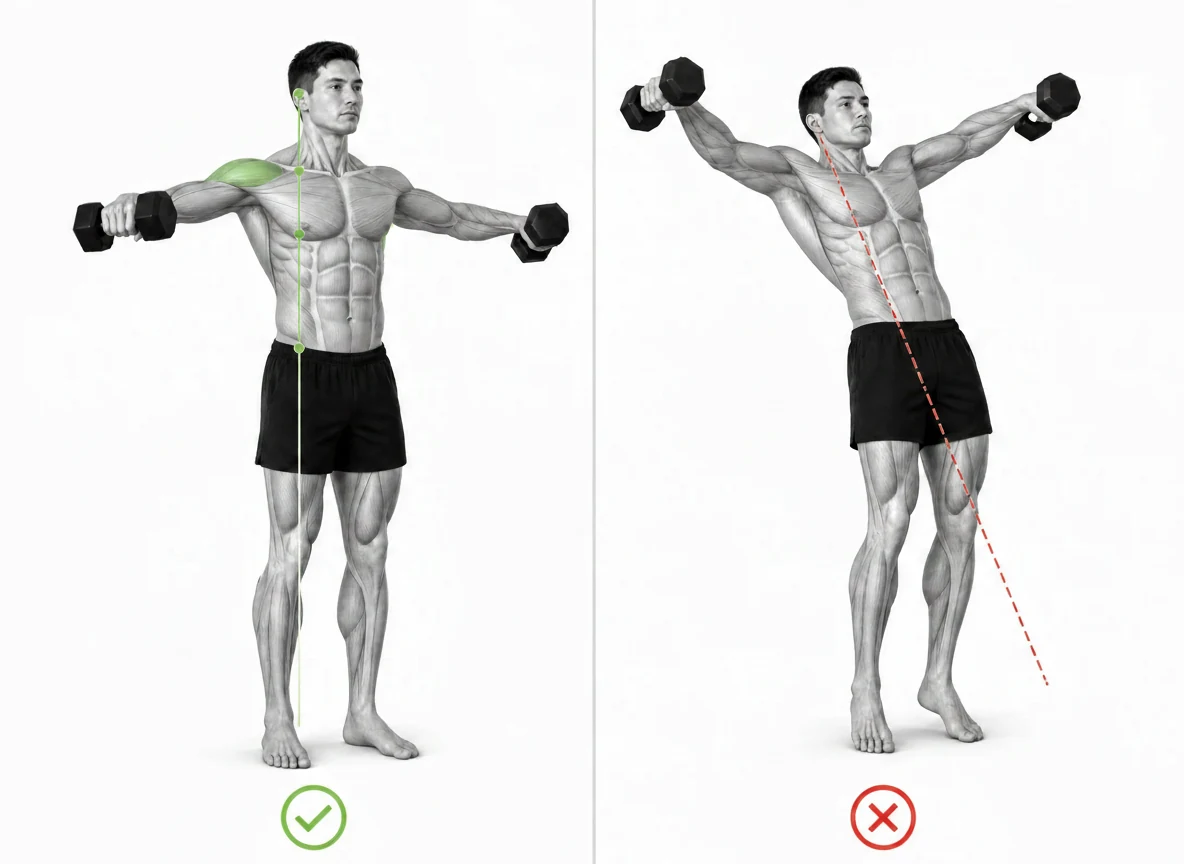
TROUBLESHOOTING
Fix the cause of a mistake, not just its appearance
Dumbbells protrude forward from the first repetition.
- What you see
- The dumbbells go out in front of your body first instead of to the side, and it feels like a front raise rather than an arm extension.
- Likely cause
- At the start, your shoulders are rolled forward, or you're using your wrists and elbows first to shift the weight.
- How to correct it
- Pause the dumbbells next to your thighs for a moment, then spread both hands outward at the same time. Do not start with your wrists raised or the dumbbells thrown in front of your body.
Shoulders rise toward ears
- What you see
- When the arms pass mid-height, the neck shortens and the upper back tenses first.
- Likely cause
- Either your current weight or end range is beyond your shoulder and torso control, or you are shrugging your shoulders to push the dumbbells higher with each repetition.
- How to correct it
- Lower the dumbbells and use them only to a height that maintains your neck length. Rather than forcing your shoulders down, first make sure your ribs and pelvis are overlapped.
Locking elbows or bending them significantly each time
- What you see
- The arms are straight in one repetition and the elbows are noticeably folded in the next, varying the dumbbell height and path.
- Likely cause
- You're switching levers mid-set to get the weight to the end point.
- How to correct it
- Pick a comfortable small elbow bend to start with and maintain that position until the end. If you can't maintain that shape, lower the weight.
Arching the back to create momentum
- What you see
- As the dumbbells rise, the ribs open forward, the pelvis pushes forward, or the torso swings from side to side.
- Likely cause
- Either your arms are pushing beyond what they can do, or the dumbbells are too heavy, so you're compensating with torso movement.
- How to correct it
- Keep your knees soft and place your ribs back over your pelvis. Lower the dumbbells and end the set before the swinging begins.
Lift the dumbbells by bending your wrists
- What you see
- At the end, the back of the hand is tilted upward excessively, or the dumbbell handle rolls in the palm.
- Likely cause
- If your grip is shallow or you are supporting the dumbbells with your fingertips, your wrists will get tired before your arms.
- How to correct it
- Hold the handle steady with the inside of your palm and place your wrist in line with your forearm. If you experience wrist pain, recheck your dumbbell weight and grip.
Dropping the descending section
- What you see
- The dumbbells are quickly dropped behind the end point, swung in front of the thighs, and then bounced back to begin the next repetition.
- Likely cause
- Either you only consider the lifting section as an exercise, or you are losing control of the dumbbell path in the last few reps due to fatigue.
- How to correct it
- Quietly hold the dumbbells next to your body before beginning the next repetition. If that stop isn't possible, end the set or lower the weight.
REGRESSION & PROGRESSION
Match the difficulty before adding load
Practice arm path in front of a wall without weight.
Stand one step away from the wall and make sure the backs of your hands and elbows are at the same level. Open and lower your arms within a range where your lower back is not excessively bent toward the wall.
Partial range with light dumbbells
Repeat 12–20 reps only to mid-range, maintaining neck and torso position. Do not rock your torso to create higher range.
Standing full range dumbbell lateral raise
Raise to the end range where you can maintain arm path and torso position without pain, then lower the dumbbells under control before they begin to swing.
Lateral raises performed on one side at a time
Hold a light dumbbell in only one hand and use the other hand to check your torso position. If your pelvis is pushed to the side or your torso is tilted, return to the two-handed version or light dumbbells.
BEGINNER PROGRAM
A practical starting framework
Use this exercise 2–3 times per week as an accessory after upper-body pushing or pulling work, or begin a shoulder session with light sets. Use the first set to check your form, then start working sets with a load that leaves about 2–3 repetitions in reserve. If your week already includes substantial shoulder-pressing or chest-training volume, monitor fatigue and pain responses from the other shoulder exercises before adding lateral-raise sets.
Reps
12–20 reps
Range where neck length and wrist/elbow shape are maintained
Sets
2–4 sets
60–90 second recovery between same shoulder exercises
Tempo
1–2 s up · 1 s down
When coming down, don't use the dumbbell bounce for the next repetition.
- Once your torso is still and your wrists and elbows are maintained through all repetitions, begin by increasing the number of repetitions to the top of your target range.
- Increase the dumbbell weight in smallest increments only after you have achieved the top of your reps in the same position for all sets. Do not increase weight and reach simultaneously on the same day.
- If your end range decreases with each set or your shoulders begin to shrug and your back arches, return to the previous weight or previous range. Repeating the same path takes precedence over the number of dumbbells.
Frequently asked questions
Should your thumb point up or down?
No one hand direction is right for everyone. Lateral raise variations may produce different muscle activation patterns, but the results do not guarantee pain prevention or long-term results. Choose a direction that stabilizes your wrists and elbows without causing pain, and remain consistent throughout the set.
Should I fully straighten my elbows?
There is no need to forcefully lock your elbows. It is more important to keep the small bend you set at the beginning similar throughout the repetition. If you begin to bend your elbows significantly at end range and send the dumbbells higher, lower the weight or range.
Are cables better than dumbbells?
Although the resistance felt during the range of motion varies depending on the equipment, studies comparing different ranges showed that both dumbbells and cables were associated with increased lateral deltoid thickness, with no clear superiority of one over the other. The first priority is whether the available equipment can maintain pain-free routes and controllable loads.
I have shoulder pain, can I recover with lateral raises?
Lateral raises are a general resistance exercise and are not intended to diagnose or treat the cause of individual pain. If pain persists, hurts at night, or causes weakness or numbness, seek evaluation by a healthcare professional rather than increasing the load on your own.