LEANING LATERAL RAISE
A tilted isolation movement that improves tension at the peak of the contraction to build superior shoulder width
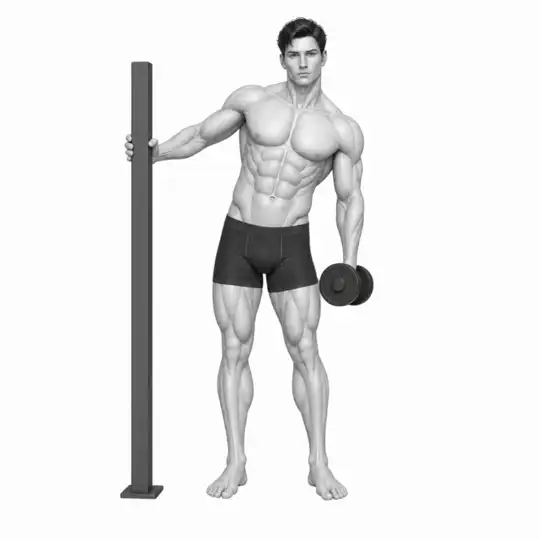
Hold onto a sturdy post or rack with one hand and place your feet close to the base. Lean your body outward until your arm is hanging vertically toward the floor. Hold a dumbbell in your outside hand with a slight bend in your elbow. Exhale as you raise the dumbbell out to the side until it reaches shoulder level. Because of the lean, you will feel a much stronger contraction at the top of the arc. Pause briefly, then slowly lower the weight back toward your body under control.
- Primary muscles
- Lateral Deltoid
- Secondary muscles
- Anterior Deltoid · Upper Trapezius
- Difficulty
- Intermediate
- Movement type
- Shoulder Abduction
Is it better than standing raises?
It targets a different part of the resistance curve. Both should be used to ensure complete development of the lateral deltoid.
STEP BY STEP
4 Steps for One Complete Rep
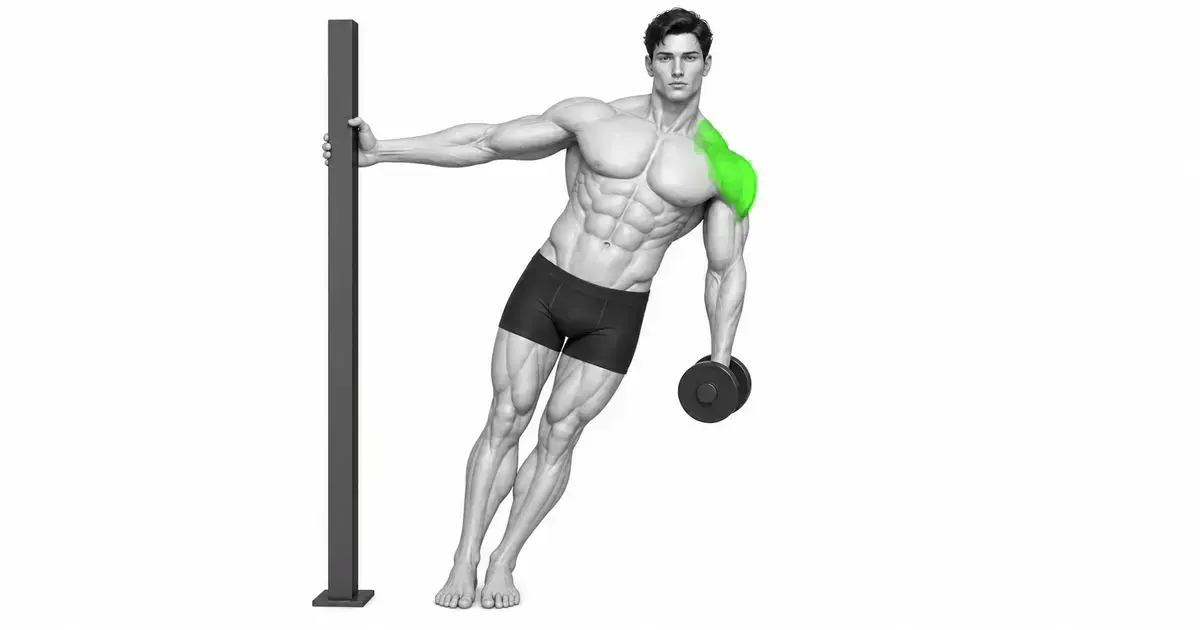
- 1
Setup and lean
Grasp a post and lean your torso away from it. Let the dumbbell hang naturally, ensuring your arm is perpendicular to the floor.
- 2
Raise to the side
Lift the dumbbell in a wide arc out to your side. Focus on leading with your elbow and keeping your wrist firm.
- 3
Peak contraction
Feel the intense squeeze in the lateral deltoid as the arm reaches shoulder height (which is a greater angle relative to your torso).
- 4
Controlled descent
Slowly lower the dumbbell back toward your hip, maintaining tension. Stop just before it touches your leg.
ALTERED RESISTANCE CURVE
Fill the 'dead zone' of the standard raise
In a standard standing lateral raise, the resistance drops off as you reach the very top. By leaning, you shift the point of maximum mechanical tension higher up in the range of motion. This challenges the lateral deltoid in its most shortened state, which is often undertrained in traditional movements.
Holding onto a post also eliminates the possibility of using torso momentum (cheating), forcing the lateral deltoid to handle 100% of the load. This makes the leaning version a superior choice for pure hypertrophy and muscle definition.
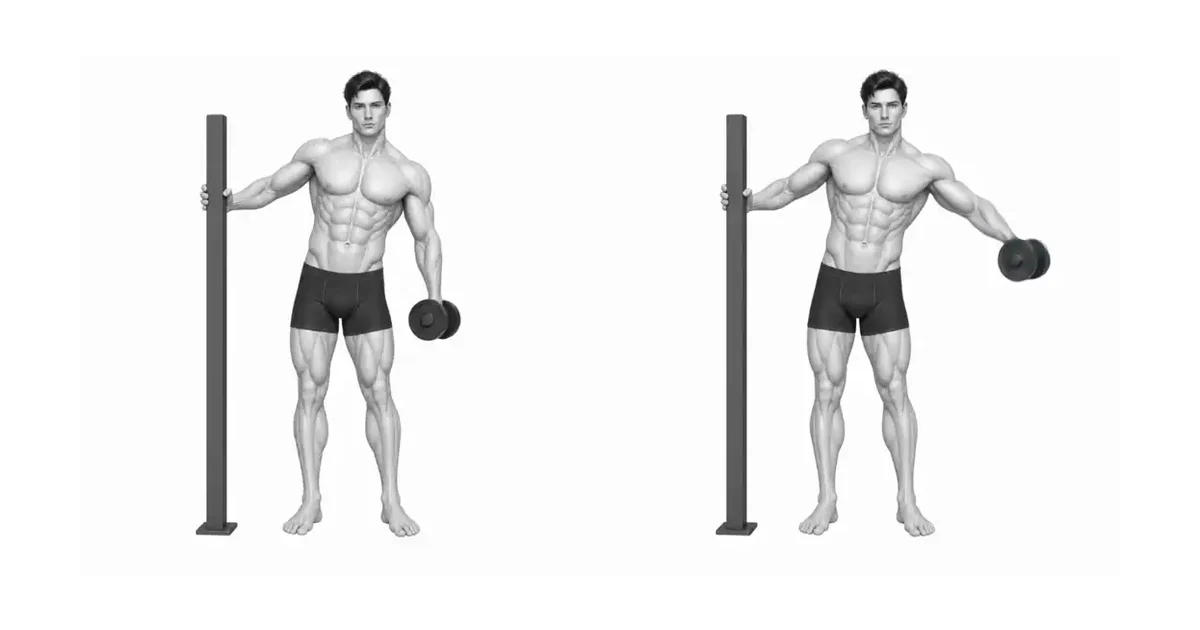
RANGE, LOAD & TEMPO
Choose a range and load that keep the Leaning Lateral Raise repeatable
The useful range of motion ends before your torso or working joints have to change position to move the load. Keep the lateral deltoid producing the movement while the anterior deltoid · upper trapezius support the same alignment from the first repetition to the last.
Use a controlled lowering phase of about two to three seconds and avoid bouncing through the transition. If the final repetitions become shorter, faster, or visibly different from the first, reduce the load or stop the set before technique breaks down.
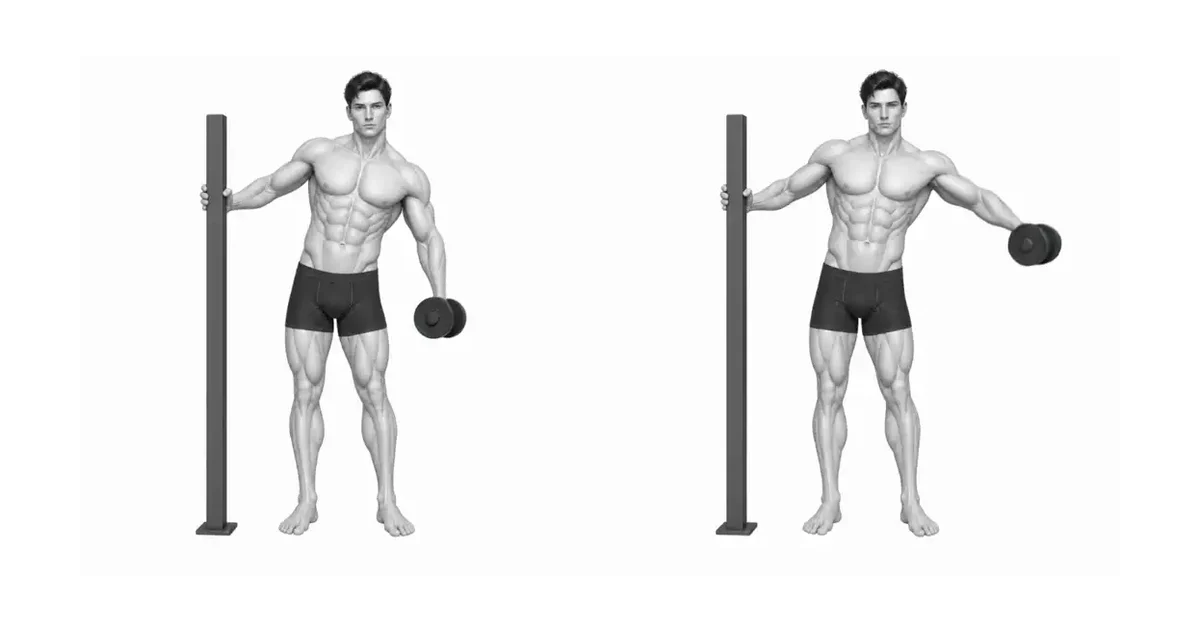
Key point: Progress the Leaning Lateral Raise only after every repetition follows the same path without joint pain.
TROUBLESHOOTING
Fix the cause of a mistake, not just its appearance
Using the post for momentum
- What you see
- Pulling or pushing against the post to help swing the weight up.
- Likely cause
- Using a weight that is too heavy for the deltoid to move strictly.
- How to correct it
- Use the post only for stabilization. Keep your body angle constant throughout the entire set.
Shrugging the shoulders
- What you see
- The shoulder rises toward the ear during the raise.
- Likely cause
- Overactive upper trapezius or poor scapular control.
- How to correct it
- Keep your shoulder 'packed' down and focus on reaching 'wide' to the side rather than just 'up'.
REGRESSION & PROGRESSION
Match the difficulty before adding load
Paused Leaning Raise
Hold the top position for 2-3 seconds to improve the time under tension in the fully contracted state.
Cable Leaning Raise
Perform the leaning raise using a cable machine to provide even more consistent tension through the entire arc.
BEGINNER PROGRAM
A practical starting framework
Leaning lateral raises take your shoulder development to the next level. Prioritize strict form and a controlled tempo.
Frequency
2-3 times per week
A perfect high-intensity finisher for any shoulder or upper-body workout.
Volume
3-4 sets of 15-20 reps
Focus on the 'burn' and high-quality repetitions rather than maximum loading.
- Keep a soft bend in the elbows; do not lock them out.
- Don't let the dumbbell touch your body at the bottom to maintain constant tension.
- Ensure you train both arms with equal intensity.
Frequently asked questions
How much should I lean?
A lean of about 15 to 30 degrees is usually sufficient to significantly alter the tension on the muscle.