PISTOL SQUAT
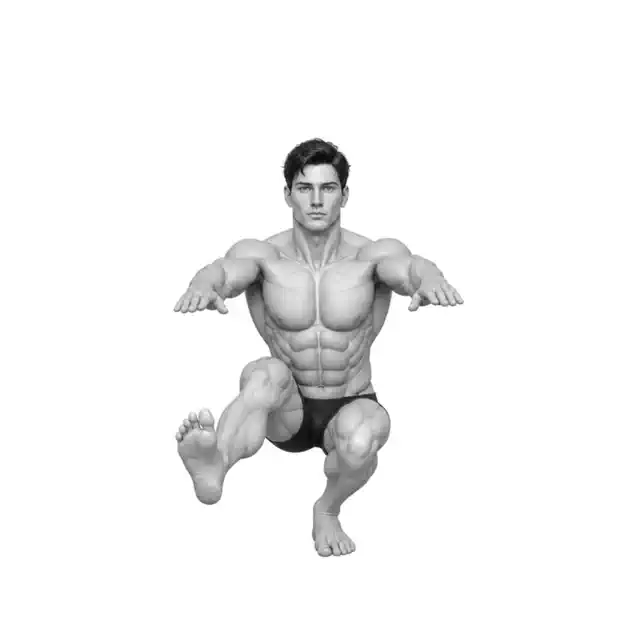
The pistol squat is not a trick that only imitates depth, but is an advanced squat that fully controls the ankle, knee, and hip joints on one foot.
Pistol squats, which involve lowering deeply with one leg and extending the other leg forward, require large ankle range of motion, unilateral strength, and balance. Don't rush to full depth, but use supports and a high box to extend from a range where your knees stay pointed toward your toes and your entire foot remains on the floor.
- Primary muscles
- Quadriceps, gluteus maximus
- Secondary muscles
- Hamstrings, gluteus medius, calves, core
- Difficulty
- Intermediate
- Movement type
- One-sided deep squat
Can I place a disc under my heel?
Smaller wedges can help with practice by reducing ankle range of motion demands. Secure it so it doesn't slip, and do high box and ankle mobility training at the same time.
STEP BY STEP
4 Steps for One Complete Rep
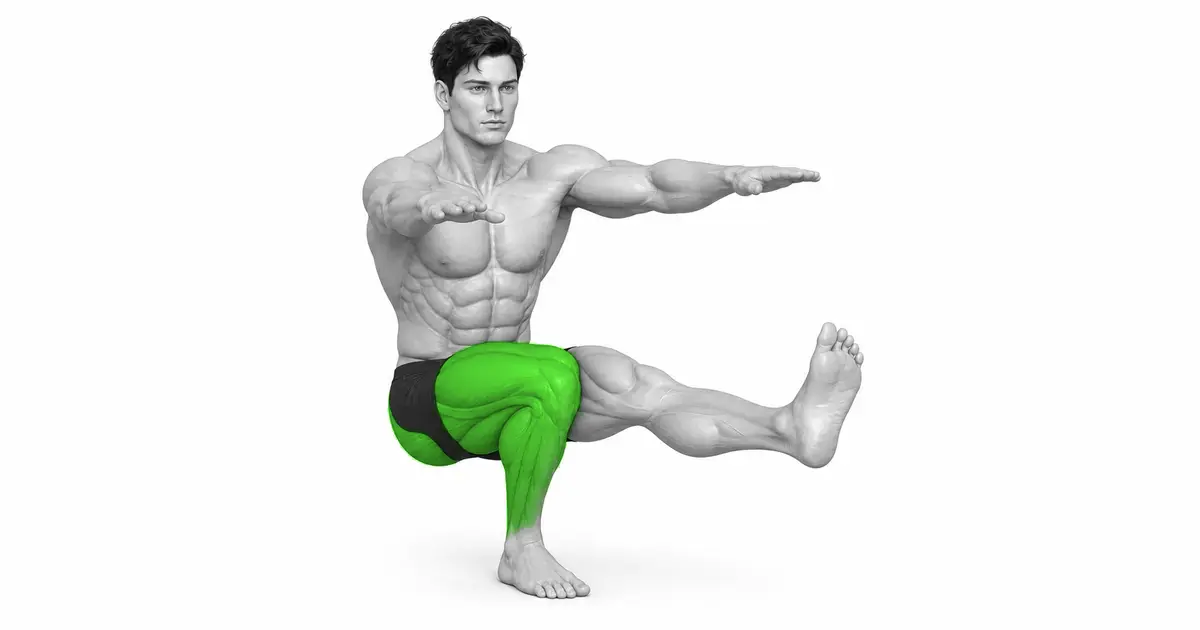
- 1
Determining one foot support and assistance
Hold lightly on the wall or rack, or place a tall box behind it. Place the base of the big toe and heel of the supporting foot on the floor and slightly lift the opposite foot.
- 2
Create balance with arm and opposite leg
Extend both arms forward and straighten the lifted leg as much as possible. Instead of trying to raise your chest too much, tilt your upper body as much as you can to balance on the center of your feet.
- 3
Lower while maintaining support knee orientation
Inhale and bend your supporting knee and hip joint to lower yourself to the box or to a controllable depth. Stop before your heels pop or your knees bend inward.
- 4
Push with whole foot and stand up on one foot
Push the floor with your entire foot and straighten your knees and hip joints together. Without bouncing off the box or placing your lifted foot on the floor due to a rebound, regain your balance and begin the next repetition.
ANKLE & FOOT
Depth is achieved only when the knees can move forward with the heels together.
In pistol squats, it is common for the supporting knee to move forward over the toes. The problem is that in the process, the heel lifts or the inside of the foot collapses.
If you don't have enough depth with bodyweight, you can use a small wedge temporarily, but at the same time train ankle range of motion and high box variations to increase your range of control.
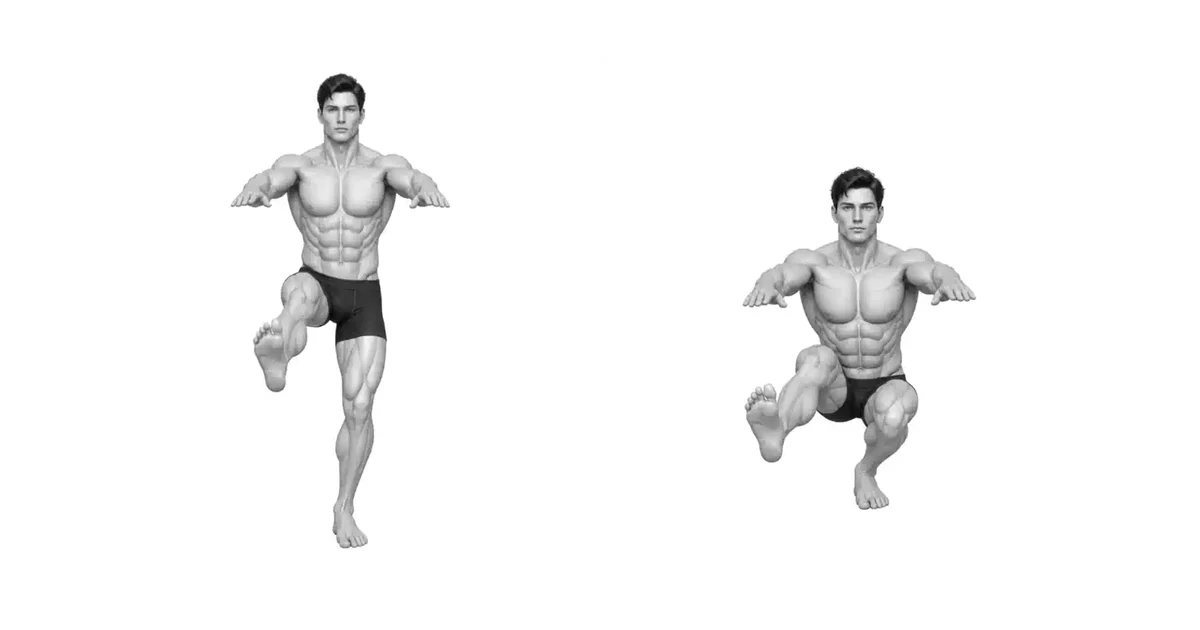
Key point: Cue to use right away: “Press your feet into the tripod and point your knees toward your toes.”
EARN THE DEPTH
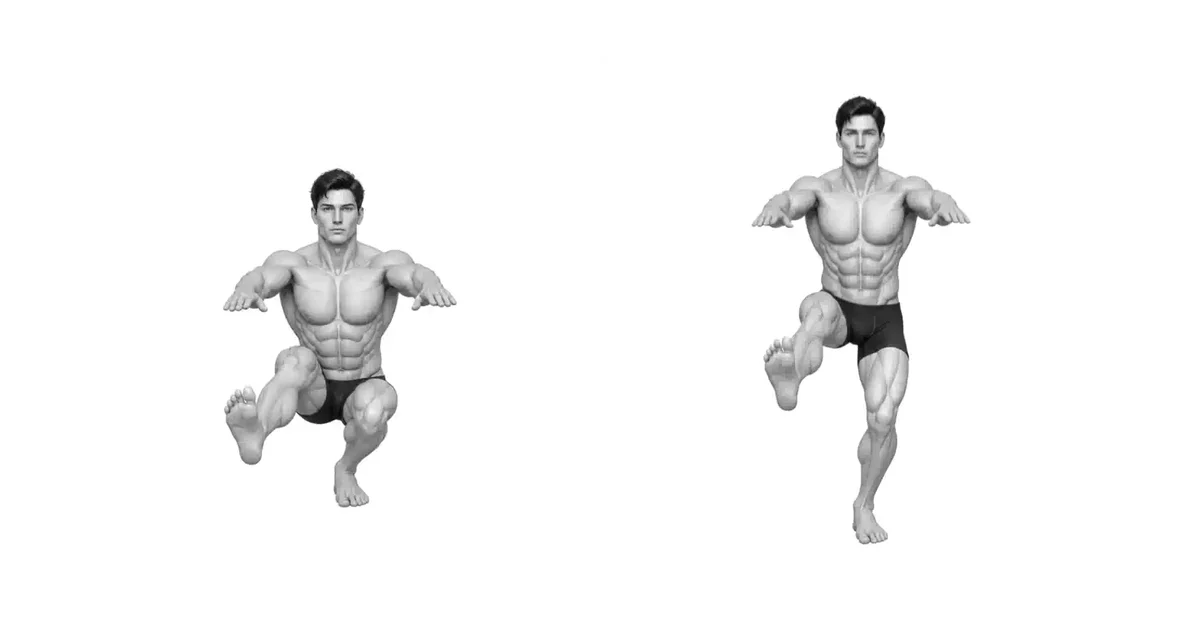
Complete depth must be obtained in steps greater than number of iterations
Start with a high box and gradually lower the box height once stable. By gradually reducing the strength of the hand holding the support, you can improve balance and muscle strength separately.
If it is difficult to fully straighten the opposite leg, you can bend your knee for a moment. Aligning the supporting leg is a priority rather than arching your back sharply and forcing your toes to rise.
TROUBLESHOOTING
Fix the cause of a mistake, not just its appearance
Supporting knee collapses inward
- What you see
- My knees bend inward toward my big toes when going down or coming up.
- Likely cause
- Unilateral control of hip and foot is lacking at current depth.
- How to correct it
- Raise the box and use support to return the knee to the range where it maintains the direction of the second toe.
Heel lifted, toes supported
- What you see
- The heel rises at the bottom and the body leans forward sharply.
- Likely cause
- Ankle range of motion is exceeded or descent speed is fast.
- How to correct it
- Decrease depth, use 3-second descent, and adjust range with small wedges if necessary.
Bouncing back from box
- What you see
- After the buttocks hit the box, the body shakes and rises.
- Likely cause
- Box is too low or the rise is difficult to control with current unilateral strength.
- How to correct it
- Raise the box, gently touch the floor, pause for 1 second, and then come up on your support foot.
REGRESSION & PROGRESSION
Match the difficulty before adding load
Supported Single Leg Squat
Assist with balance with hands and learn knee path.
High Box Pistol
Sit down slowly on one leg and stand up on the same leg.
Counterweight Pistol
Lifts a light weight forward to aid balance.
Bodyweight pistol squat
Performs the entire controlled range equally left and right.
BEGINNER PROGRAM
A practical starting framework
Choose a box height that is currently feasible for success rather than a full pistol, and start with the weaker side, equalizing the number of reps and depth on both sides.
Count
3–8 times each
Descent 3 seconds, use box if necessary
Set
2–4 sets each
90–150 seconds recovery after both sides
Frequency
1–2 times a week
Unilateral lower body training and volume control
- Keeping the same depth and knee path on both sides lowers the box a bit.
- If heel lift or knee collapse occurs, immediately return to the previous step.
- Finish your set before you lose your balance from fatigue and leave space around you to fall.
Frequently asked questions
Should the other leg be fully extended?
You can straighten your knees during the completion movement, but slightly bend your knees during the learning phase. Don't sacrifice supporting leg alignment and lower back position to maintain a lifted foot.
If I can only do one side, can I continue with only the side that is possible?
Keep the capable side, but train based on the box height and assistance level that allows the weaker side to succeed. If pain or significant differences persist, it may be a good idea to get evaluated.