PUSH-UP
The push-up is not just bending your arms—it is the skill of moving your whole body as one plank
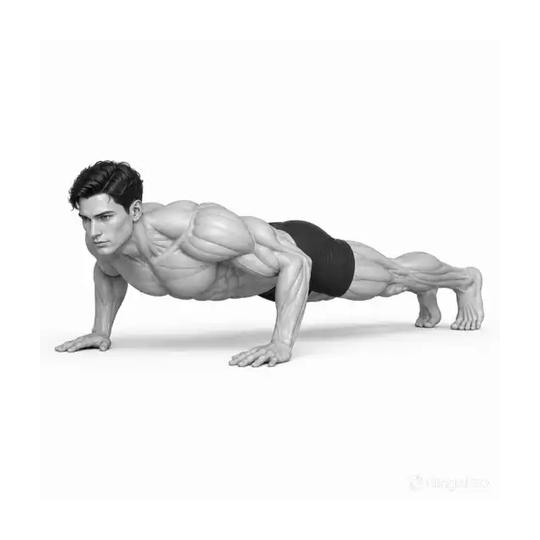
The push-up is a bodyweight compound exercise in which the pectoralis major, triceps, and anterior deltoids press the body away from the floor while the serratus anterior and trunk muscles stabilize the shoulder blades and spine. A good repetition is not one where only the chest nears the floor; it is one where the whole body descends and rises together with the relationship between the ears, shoulders, hips, knees, and ankles intact. Rather than fixing hand spacing or elbow angle to a single number, find the position where your wrists and shoulders feel comfortable and you can repeat the same path.
- Primary muscles
- Pectoralis major
- Secondary muscles
- Triceps · anterior deltoids · serratus anterior · core
- Difficulty
- Beginner
- Movement type
- Horizontal press
Does my chest have to touch the floor in a push-up?
It does not have to. Start with the range where the chest nears the floor or the elbows bend to about 90 degrees while trunk alignment and shoulder comfort hold. If you need to shorten the range, raising your hands lets you practice a more complete repetition.
STEP BY STEP
5 Steps for One Complete Rep
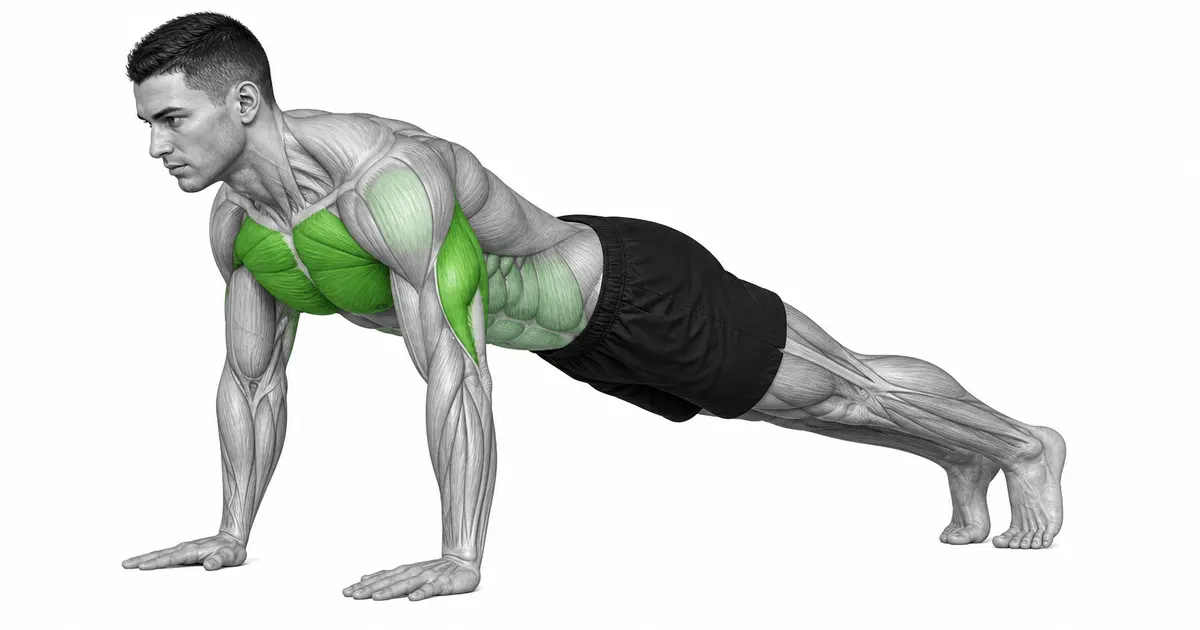
- 1
Build your hand and foot contact points
Place the palms at shoulder width or slightly wider with the fingers pointing forward or turned out a little. Spread the fingers so the thumb side, the little-finger side, and the heel of the palm all press into the floor, and set the feet about hip-width apart.
- 2
Complete a long plank alignment
Stack the shoulders over the hands, straighten the knees, and lengthen from the crown of the head to the heels. Brace the abdomen and glutes so the ribs do not flare forward and the low back does not sag, without tucking the chin hard or lifting the head.
- 3
Lower the whole body together
Inhale and bend the elbows somewhere between backward and outward. Let the upper arms travel roughly 30–60 degrees from the torso, and control the descent so the chest, hips, and thighs approach the floor at nearly the same speed.
- 4
Change direction at a pain-free depth
Stop at whichever comes first while you can still hold your position: the chest nearly touching the floor, or the elbows bending to about 90 degrees. If the front of the shoulder pinches or the hips reach the floor first, reduce the depth or place your hands on an elevated surface.
- 5
Push the floor away and rise as one piece
Exhale and push the floor away through the whole palm as you extend the elbows. The entire body should rise at once—do not lift the chest first and let the hips follow late. At the top, keep pushing the floor away without shrugging so the shoulder blades can move naturally on the rib cage.
PLANK LINE
The line from ears to ankles travels together on every repetition
A push-up is a moving plank. When you stack the ribs over the pelvis in the start position and brace the glutes and thighs, the trunk can transfer the force from your arms all the way to your feet. If the chest drops first on the way down, or the shoulders rise first on the way up, that connection has broken.
Film from the side and check the ears, shoulders, hips, knees, and ankles. A slight curve in the low back matters less than whether that shape suddenly changes mid-rep. If the hips sag or pike, cut the reps and practice the same alignment with your hands on a bench or wall first.

Key point: Practical cue: “Lock the abs and glutes → lower chest and hips together → push the floor away.”
ELBOW PATH
The elbows fold backward rather than spreading out to the sides
Keep the palms at shoulder width or slightly wider, and do not pin the elbows to the torso or flare them to 90 degrees at shoulder height. When the elbows travel backward in roughly a 30–60 degree range, it is easier to keep the forearms close to perpendicular to the floor at the bottom with the elbows over the wrists.
Changing hand spacing can change the relative demand on the muscles. Some studies have found higher pectoralis major and triceps activity with a narrow hand position than with a wide one, but that does not mean a narrow stance is better for everyone. Learn the standard width first—the one where the wrists, elbows, and shoulders feel comfortable and trunk alignment holds.
SCAPULA & RANGE
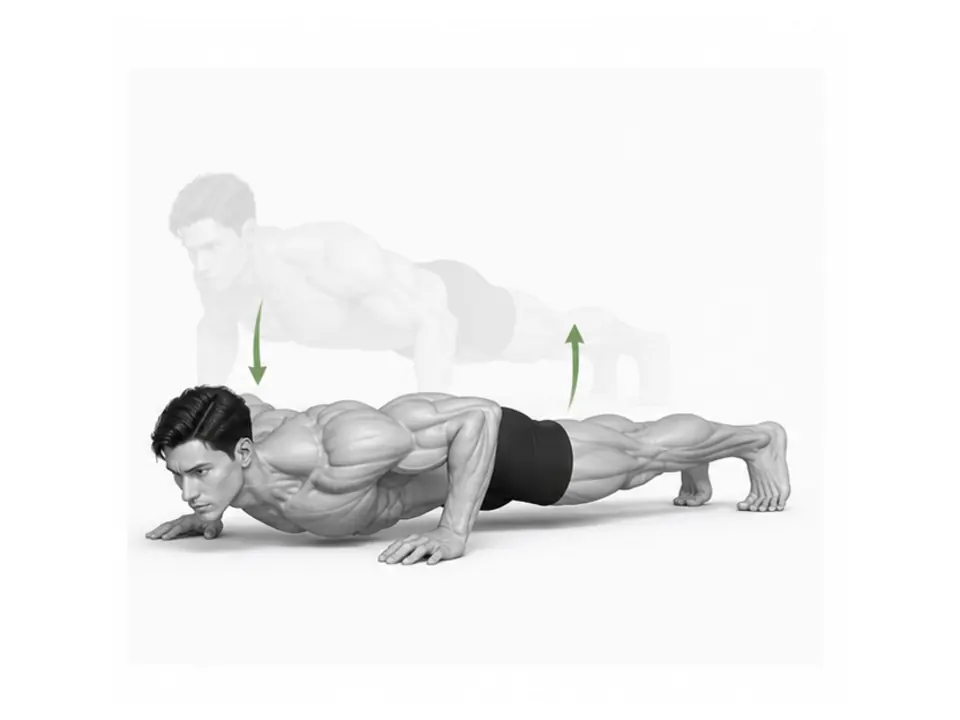
The shoulder blades are not fixed—they move naturally on the rib cage
Unlike the bench press, the push-up does not pin the shoulder blades against a bench. As you descend they draw closer together, and as you rise they spread naturally around the rib cage. Do not shrug toward the ears, and do not force them fully retracted for every repetition.
Depth is not decided solely by whether the chest touches the floor. Your current range is whatever lets you hold trunk alignment and wrist and elbow position without pain at the front of the shoulder. Knee push-ups and incline push-ups are valid steps: they reduce the bodyweight carried by the upper limbs so you can practice a full range.
TROUBLESHOOTING
Fix the cause of a mistake, not just its appearance
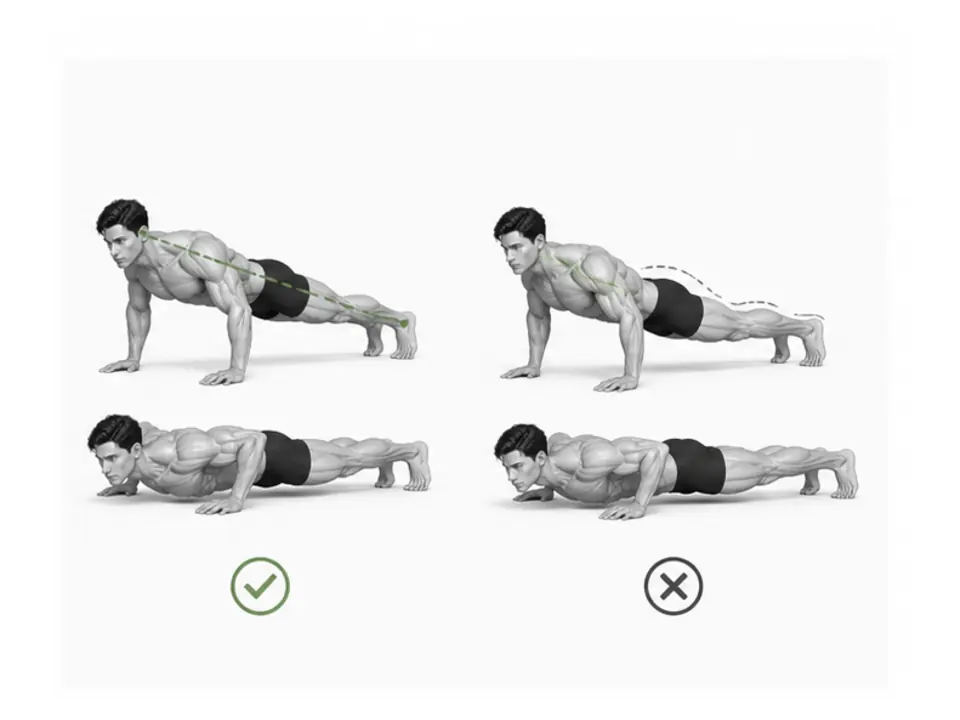
The hips and low back sag
- What you see
- The stomach drops toward the floor before the descent even starts, and the chest rises first on the way up.
- Likely cause
- The difficulty may exceed your current trunk control, or you may be pushing reps while fatigued.
- How to correct it
- Draw the ribs toward the pelvis and squeeze the glutes. If alignment still breaks down, put your hands on a bench or wall.
The hips pike up into a peak
- What you see
- The hips sit higher than the shoulders and only the head drops between the hands, closer to a pike than a push-up.
- Likely cause
- Often an unconscious shift of bodyweight toward the feet to unload the chest and triceps.
- How to correct it
- Move the shoulders over the hands and lengthen from the crown to the heels. Use an incline variation to lower the whole body together.
The elbows flare far out to the sides
- What you see
- From above, the upper arms extend out at shoulder height and the elbows sit well outside the wrists.
- Likely cause
- The hands may be too high or too wide, and you may be lowering only the chest while shrugging.
- How to correct it
- Bring the hands under the shoulder line and point the elbows backward. Find the 30–60 degree range where the shoulders feel comfortable.
Leading with the chin and craning the neck
- What you see
- The chin or forehead nears the floor before the chest and the gaze points straight ahead.
- Likely cause
- You may be making the rep look deeper than it is, or lifting the head to check the floor.
- How to correct it
- Look at the floor slightly ahead of your hands and keep the back of the neck long. Let the chest descend between the hands.
Rushing through a short range
- What you see
- The elbows barely bend and the body bounces quickly off the floor.
- Likely cause
- Prioritizing a target rep count or speed at the expense of a controlled descent and your actual available depth.
- How to correct it
- Take two seconds to descend and pause briefly just above the floor. Choose a variation and rep count that let you repeat the same range.
REGRESSION & PROGRESSION
Match the difficulty before adding load
Wall push-up
Place the hands on a wall and move the whole body as one line to learn the pressing pattern.
Incline push-up
Put the hands on a sturdy bench or box to reduce the load and practice the full range of motion.
Knee push-up
Hold alignment from the knees to the head while adapting to the floor position and the wrist demand.
Standard push-up
Support on the toes and build repetitions with the same depth and trunk alignment.
BEGINNER PROGRAM
A practical starting framework
Practice two or three times per week with at least one day of recovery between sessions. In your current variation, leave two or three repetitions in reserve while holding the same trunk alignment and depth through the last rep. Accumulating complete repetitions on an elevated surface teaches the skill better than forcing out one or two floor push-ups.
Reps
6–12
Within the range where the chest and hips move together
Sets
2–4
Rest 90–150 seconds between sets
Progression
+1–2 reps
Add only when every repetition looks the same
- Once you finish 12 reps for all three sets at the same depth and alignment in your chosen variation, lower the support one step.
- End the set on the first repetition where the hips sag or the elbow path changes substantially, and reduce the reps on the next set.
- If your wrists are uncomfortable, handles or push-up bars can give you a neutral wrist—just use non-slip equipment and flooring.
Frequently asked questions
Do knee push-ups still count as a chest exercise?
They do. Research has reported that the knee variation reduces the bodyweight carried by the upper limbs while the relative contribution of the main muscles is not dramatically different from the standard push-up. Hold alignment from the knees to the head and practice the full range.
Does a wider hand position work the chest more?
Not necessarily. Some EMG studies actually found higher pectoralis major and triceps activity with a narrow hand position. EMG alone cannot settle questions about muscle growth, so prioritize a standard width where the wrists and shoulders are comfortable and the elbows stay stable.
Evidence and references
- 1. NASM — Push-Up Exercise Library
- 2. ACE — Push-Up Exercise Library
- 3. Cogley et al. — Push-up muscle activity by hand spacing
- 4. Suprak et al. — Bodyweight supported in standard and knee push-ups
- 5. Gottschall et al. — Muscle activation patterns in push-ups and the bench press
- 6. Youdas et al. — Upper-limb and serratus anterior activity in the standard push-up