SMITH MACHINE SQUAT
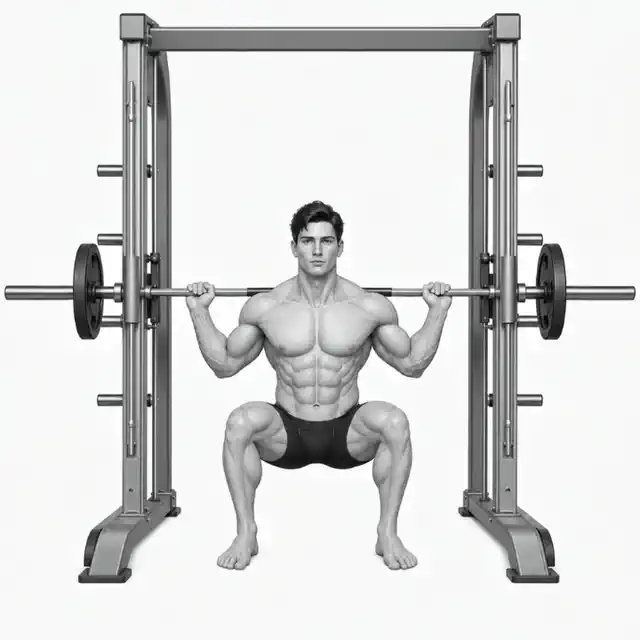
The Smith Machine Squat is not an exercise in which the rail automatically corrects your posture, but rather a squat that requires you to position your feet precisely on the fixed bar path.
The Smith machine has the bar move along a rail, reducing the demand for side-to-side balance, but if the rail angle and foot placement are incorrect, the body can follow the forced path and become uncomfortable. Check the direction of hook rotation and safety height with an empty bar, and find a point where the bar position is stable across your feet and over your back throughout the descent.
- Primary muscles
- Quadriceps, gluteus maximus
- Secondary muscles
- Hamstrings, adductors, calves, core
- Difficulty
- Intermediate
- Movement type
- Fixed Rail Squat
Should I put my feet in front of my body?
Depends on machine rail and body type. At the bottom, find a position with an empty bar that maintains full foot and spine alignment.
STEP BY STEP
4 Steps for One Complete Rep
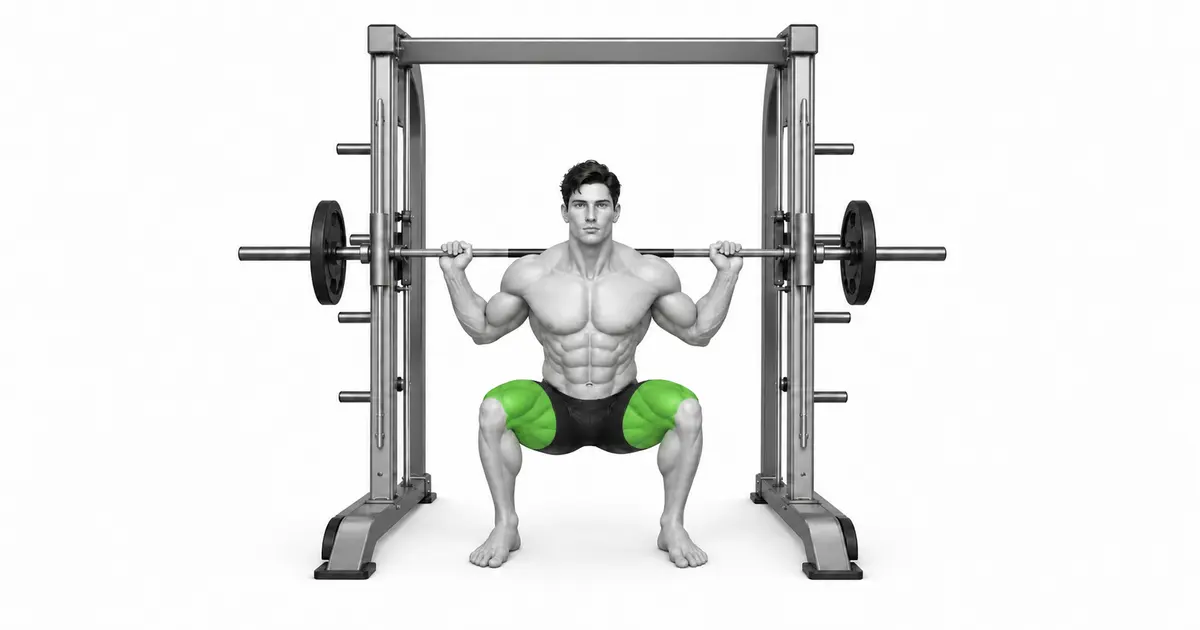
- 1
Check rail, hook, and safety
On an empty bar, check whether the rail is vertical or tilted and practice the direction of releasing the hook and hanging it with your wrist. Set the safety stop just below the lowest controllable depth.
- 2
Align bar and foot position
Place the bar in a comfortable position over your trapezius muscles and hold both hands equally wide. Adjust your feet to a position that naturally fits your torso and the rail path, at or around shoulder width.
- 3
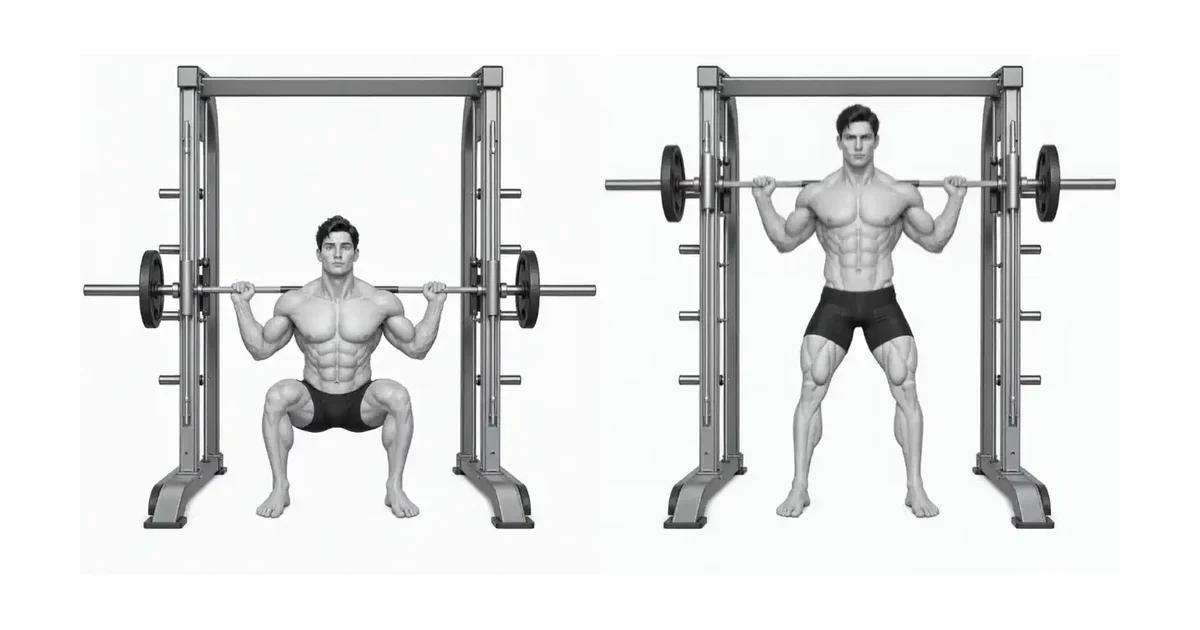
Controlled sitting within fixed path
Create abdominal pressure, release the hook, and bend your knees and hip joints together. Your knees follow the direction of your toes and your entire foot remains on the floor.
- 4
Stand up and securely hang both hooks
Push your feet into the floor and straighten your knees and hips together. After standing completely, turn your wrists to make sure both hooks are at the same height and release pressure on the bar.
MATCH THE RAIL
Foot position must match rail path and individual body type
If you place your feet too far forward, your back will push up against the bar. If you place your feet too far back, your heels may lift or your body may drag on the rail. Experiment with different positions on an empty bar.
The standard is where the entire foot and spine are aligned at the bottom and the knees follow the direction of the toes.
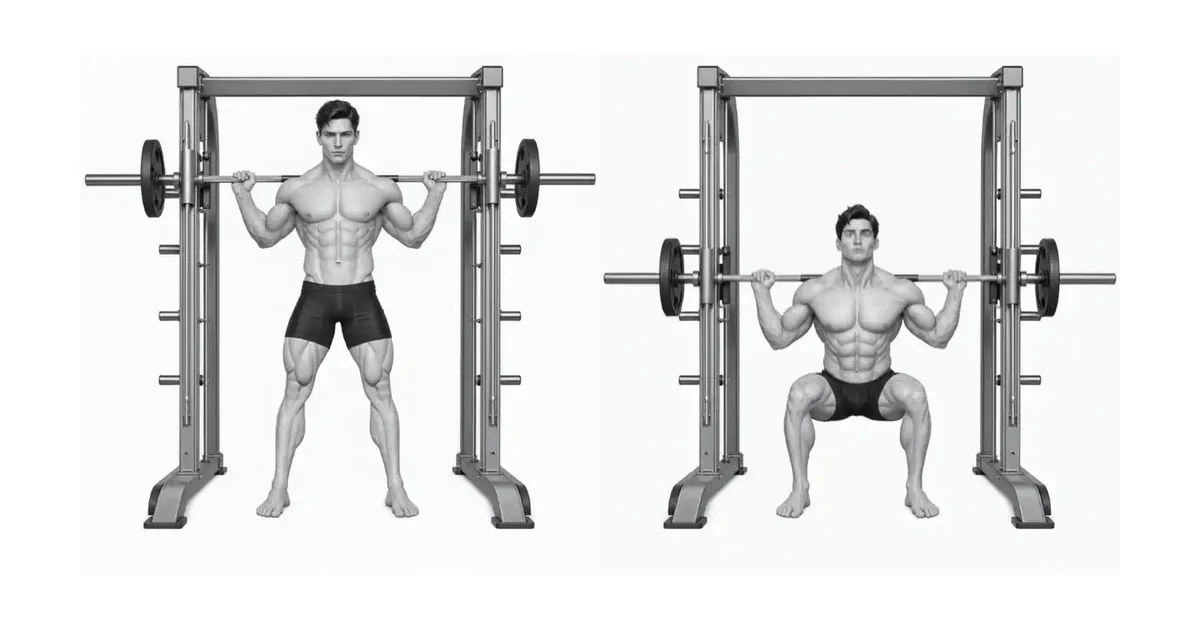
Key point: Cue to try right away: “Check the rail and place your feet on the path.”
HOOKS & SAFETIES
Safety and reliable rack return are required even on Smith machines
One hook or lack of wrist rotation can cause the bar to fall again. Before setting, get a feel for both hooks with an empty bar.
If you are unable to stand due to fatigue, set the bar at a height so that the safety receives it and do not try to change direction during the set.
TROUBLESHOOTING
Fix the cause of a mistake, not just its appearance
Fix foot position without checking rail
- What you see
- As you descend, your body pushes back and forth and your heels rise.
- Likely cause
- I used the settings from another machine.
- How to correct it
- Check the rail angle with an empty bar and move your feet little by little to find a natural path.
Knees collapse inward
- What you see
- When rising, both knees move inward towards the toes.
- Likely cause
- The load is too heavy or the foot width and toe angle do not match.
- How to correct it
- Lower the weight and keep your knee toward your second toe.
Hook only one side and place the bar
- What you see
- Bar tilts or moves back down.
- Likely cause
- The wrist was turned before fully standing, or the left and right hand positions were different.
- How to correct it
- Check the sound and location of both hooks being caught simultaneously at the top, then release the force.
REGRESSION & PROGRESSION
Match the difficulty before adding load
Bodyweight box squat
Learn foot pressure and depth.
Empty Bar Smith Squat
Practice rail and hook operation.
Tempo Smith Squat
Apply 3 second descent and bottom control.
Progressive Smith Squat
Increase when the same foot position is reproduced.
BEGINNER PROGRAM
A practical starting framework
Check the machine's own bar weight and start with an empty bar. Recording your foot placement and safety height makes it easy to replicate the same route in subsequent sessions.
Count
6–12 times
Lower 2-3 seconds, hold full foot
Set
3–4 sets
90–180 seconds recovery between sets
Frequency
1–2 times a week
Different squats and volume control
- If the same foot position and depth are maintained, increase the number of repetitions first.
- If you find yourself dragging on the rail or your knees give in, adjust your weight and foot position.
- Do not use the machine if the hook or safety does not work properly.
Frequently asked questions
Is there no need for safety if it is a Smith machine?
No. Be sure to set the bottom stopper as you may miss or fail the hook.
Is it safer than free weight squats?
Balance requirements may be low, but there are other risks: fixed routes and settings errors. Choose according to your goals and joint comfort.