TURKISH GET-UP
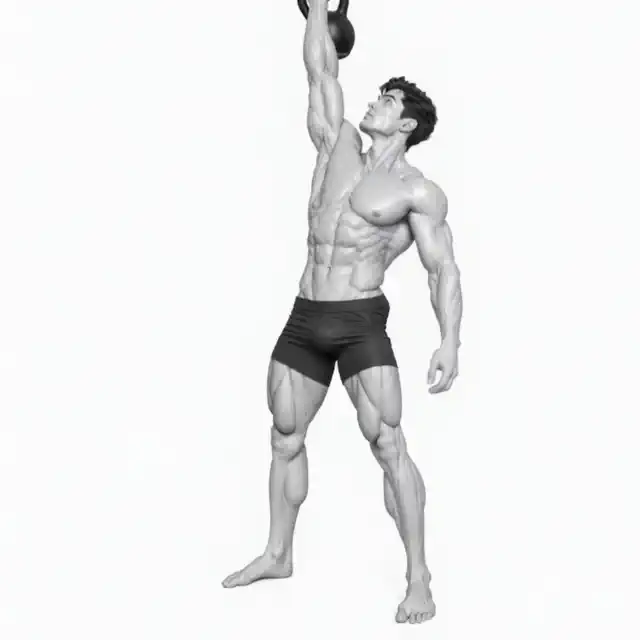
The Turkish Get-Up is not a quick exercise with a kettlebell, but rather a full-body technique that accurately connects six transitions while stabilizing the upper arms vertically.
The Turkish get-up starts from a lying position with elbow support, hand support, hip lift, leg sweep, and half kneeling, then stands up and returns the same way. With each step, the kettlebell must be stacked on your shoulders, and your gaze and point of support will change. At first, learn to split the movement with your shoes or empty fists up, then control both directions and then use a very light kettlebell.
- Primary muscles
- Full Body Coordination, Core, Deltoids
- Secondary muscles
- Gluteus, quadriceps, serratus anterior, rotator cuff
- Difficulty
- Advanced
- Movement type
- Step-by-step transition from lying down to standing position
Can I start with kettlebells?
First, use your empty fist or shoe to learn the order and overhead sorting. Then proceed with the lightest bell.
STEP BY STEP
4 Steps for One Complete Rep
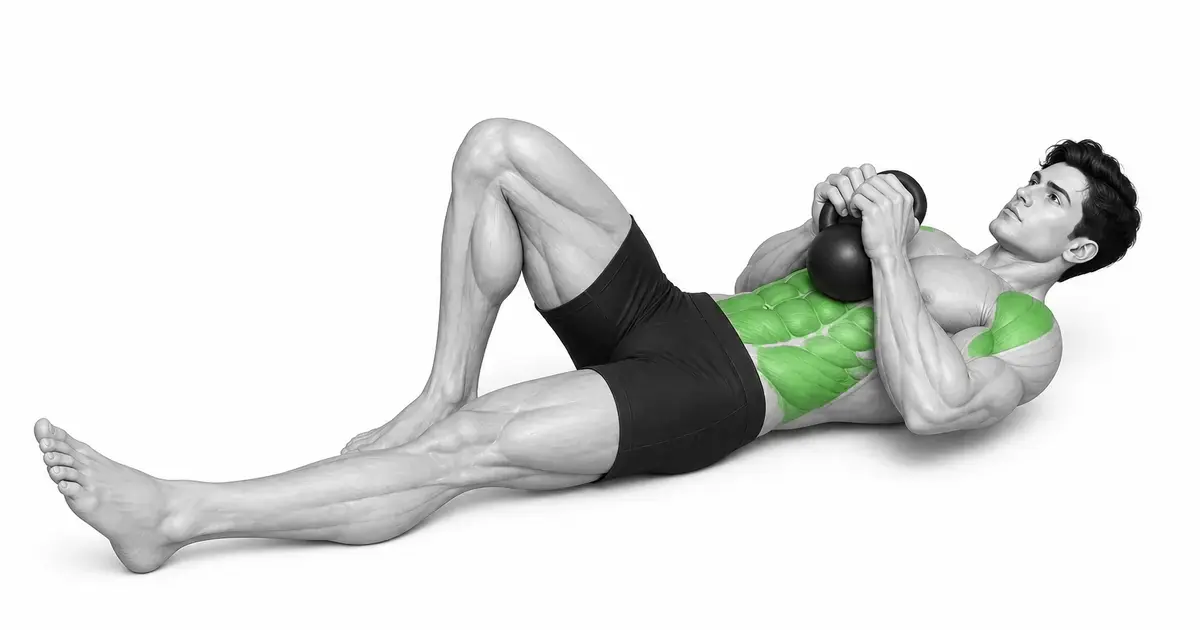
- 1
Raising a Kettlebell Safely with Roll to Press
Lie on your side, hold the bell with both hands and roll it toward your back. After pressing with your working arm, straighten your elbow and stack your wrist, elbow, and shoulder vertically.
- 2
Torso upright with elbow and hand support
Push off the floor with your working foot and roll up with your opposite elbow, then support it with your palm. Keep the kettlebell pointed towards the ceiling.
- 3
Raise pelvis and sweep legs back
Press your support foot and hand into the floor to lift your pelvis, then send your extended leg under your body and place your knee on it. Create a stable triangle of support between your hands and knees.
- 4
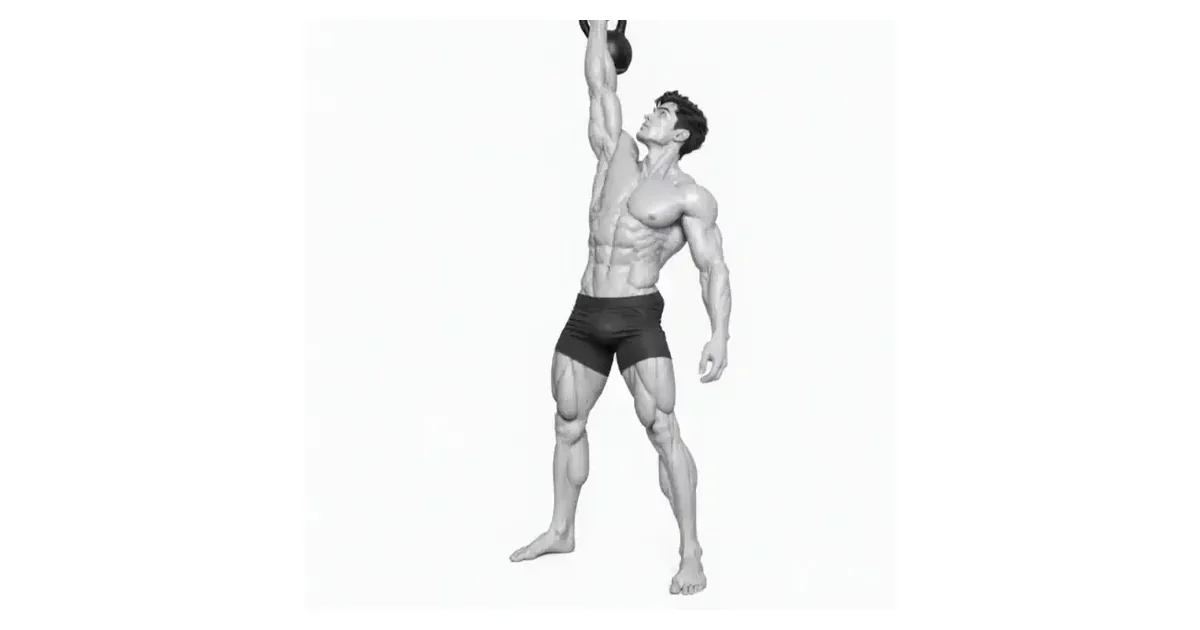
Standing up from half kneeling and returning in reverse order
Raise your torso to make a half kneeling, then stand up on your front foot. Check your balance at the top and slowly return to lunges, hand support, leg sweep, and elbow support.
OWN THE OVERHEAD
Kettlebells must be stacked stably on shoulders prior to any transition
If the bell deviates from the front or back of your body, do not move to the next step. Return your wrist, elbow, and shoulder to a vertical position as much as possible.
At first, practicing putting your shoe on your empty fist and not dropping it is good feedback.
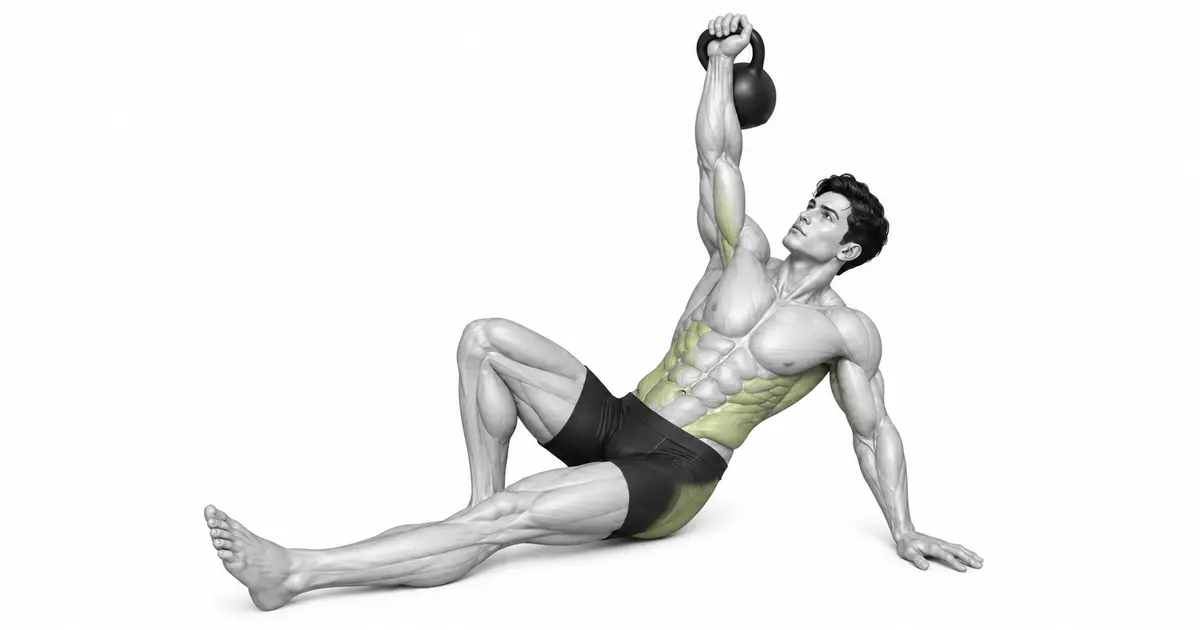
Key point: Cue to try right now: “Stack joints under the bell, pause one step at a time.”
REVERSE THE PATH
When going down, step on the same support points as when going up, in reverse order.
When you jump from the top to the bottom, you lose your hands and knees position. Check each half kneeling, hand support, and leg sweep.
Pausing 1 second at each step makes it easy to spot alignment errors and wobble of the bell.
TROUBLESHOOTING
Fix the cause of a mistake, not just its appearance
Bell tilts back and forth over shoulder
- What you see
- Arms are out of alignment, wrists and shoulders are shaking.
- Likely cause
- Heavy weight or hurried transition.
- How to correct it
- Immediately return to the previous support position and lower into shoes or a lighter bell.
Pelvis falls to the floor during leg sweep
- What you see
- Legs hang over hands and knees are not under the body.
- Likely cause
- Low hip lift or narrow support hand-to-foot spacing.
- How to correct it
- Lift your pelvis fully and place your legs in a wide semicircle.
Skipping descending sequence
- What you see
- Sitting down quickly from a standing position and the bell shakes.
- Likely cause
- Reverse path was not practiced separately.
- How to correct it
- With empty hands, just stop at each support point and repeat the descending sequence.
REGRESSION & PROGRESSION
Match the difficulty before adding load
Increased load and strength
Increase intensity by gradually increasing weight or shortening rest periods.
Complex Variant Behavior
Increase the difficulty level by combining it with other exercises or adding unstable environments.
BEGINNER PROGRAM
A practical starting framework
Memorize both sequences with your shoes or free hand, then use low repetitions. Do not repeat techniques while fatigued or perform them in a race against time.
Frequency
2-3 times a week
Place it appropriately in your whole body or relevant area routine.
Volume
3~5 sets, 8~15 times
Adjust the number of reps and sets according to your goals.
- Always put safety first and listen to your joint pain.
- Perform the entire operation within the scope of your control.
Frequently asked questions
Should I keep looking at kettlebells?
It is better to look at the bell in the lying/hand-supported section, and in half-kneeling and standing positions, you can switch to looking forward. Prioritize stability.
How many times is enough at a time?
Since this is a technical exercise, 1 to 3 perfect repetitions on each side are usually sufficient. Finish before fatigue gets you out of order.