CALF RAISE
Calf raises are not an exercise where you bounce your body on your toes, but rather an exercise where you control your ankles vertically all the way.
The calf muscles produce ankle plantar flexion, which raises the heel. Holding the wall or support lightly, distribute the pressure between the roots of your big toe and little toe, and only raise and lower your heels without shaking your knees or pelvis.
- Primary muscles
- Gastrocnemius / Soleus
- Secondary muscles
- Plantar muscle · Ankle stabilizer muscle
- Difficulty
- Beginner
- Movement type
- Ankle plantar flexion
Should I turn my toes in or out?
The default is to keep your feet parallel. Large turns can throw your ankles and knees out of alignment, so make sure you have enough range and load in a neutral position first.
STEP BY STEP
4 Steps for One Complete Rep
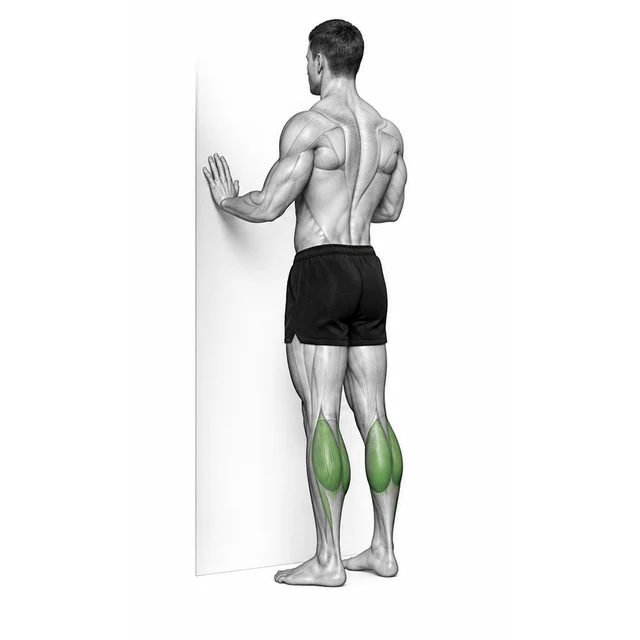
- 1
Aligning feet and torso
Place your feet parallel and hip-width apart and lightly press against the wall. Keep your ribs and pelvis stacked and your knees comfortably straight but not excessively locked.
- 2
Push to two points in front of foot
Place the roots of your big toes and little toes on the floor, exhale and raise your heels vertically. Do not allow your ankles to bend outward or inward.
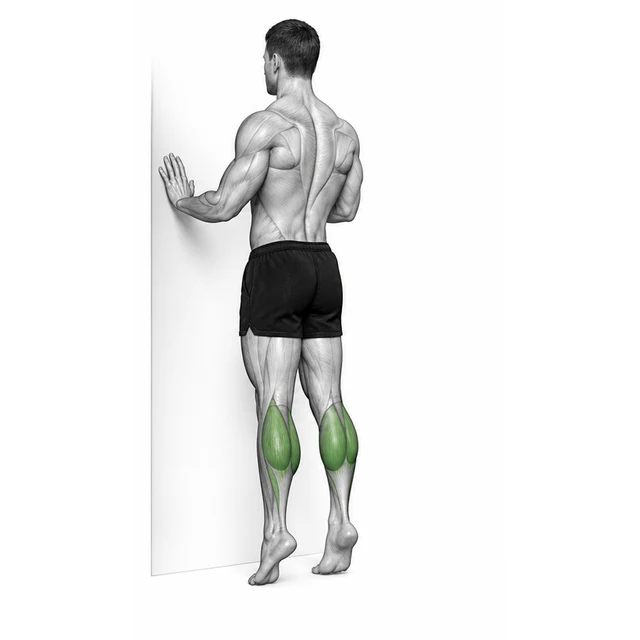
- 3
Contracting your calves at the top
Stop for 1 second at a height where your weight is not concentrated on the thumb or little toe. Do not lean your torso forward to gain height.
- 4
Slowly lower your heel
Inhale and lower your heels for 2 to 3 seconds. Instead of creating a kickback by hitting the floor, re-adjust foot pressure before the next repetition.
FOOT PRESSURE
Pressure on both sides of the forefoot guides the ankle vertically
If you press only the big toe side, the ankle can swing inward, and if you only press the little toe side, the ankle can swing outward. Leave both points on the floor at the same time.
It is more stable to raise the heel while extending the entire sole rather than clenching the toes.
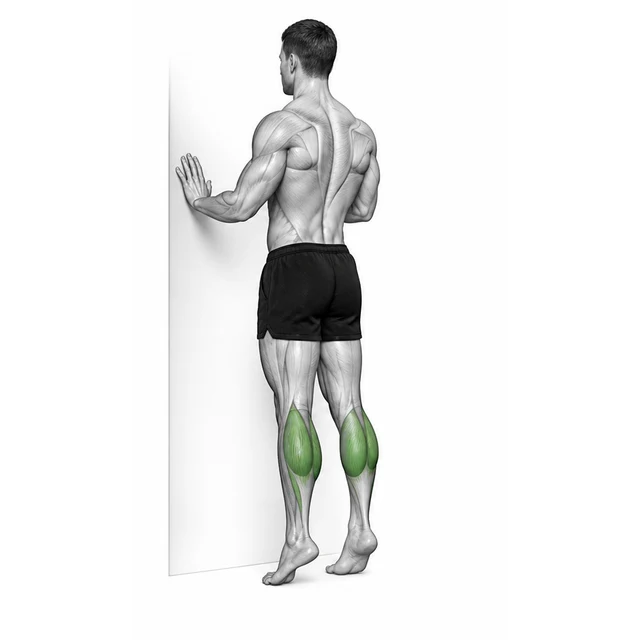
Key point: Cue to use right away: “Press the base of your thumb and little toe together.”
FULL CONTROL
Top stops and slow descents are more important than height
Bumping your knees or rocking your torso up and down reduces ankle range of motion. Notice how far your heels actually move with light weights.
When performing on stairs, lower your heels only to a pain-free range and ensure non-slip supports and handles.
TROUBLESHOOTING
Fix the cause of a mistake, not just its appearance
Ankles collapse outward
- What you see
- At the top, the weight shifts towards the little toe and the heel spreads.
- Likely cause
- Pressure in front of foot is concentrated on one side or obsessed with height.
- How to correct it
- Practice a vertical path as low as possible with the base of your big toe on the floor.
Use recoil with knees and torso
- What you see
- With each repetition, the knees bend and straighten and the head bounces significantly.
- Likely cause
- Speed or load that is difficult to control with the calf.
- How to correct it
- Fix the knee angle and repeat at a tempo of 1 second for the top and 3 seconds for the descent.
Heel taken from the bottom
- What you see
- Heel hits the floor and bounces right back into the next rep.
- Likely cause
- Unable to hold eccentric section or loss of control due to fatigue.
- How to correct it
- Just before bottom, slow down and briefly regain alignment before starting the next repetition.
REGRESSION & PROGRESSION
Match the difficulty before adding load
Two-foot wall calf raise
Gain balance and learn ankle path.
Tempo Calf Raise
Add top stop and 3 second lower.
Stair Calf Raise
Increase pain-free lower range from secure support.
Single Leg Calf Raise
Perform left and right with the same range and number of repetitions.
BEGINNER PROGRAM
A practical starting framework
Complete top stops and slow descents bodyweight first, then add dumbbells or machine loads when you can perform them reliably for 15 or more reps.
Count
10–20 times
1 second for top, 2~3 seconds for fall
Set
2–4 sets
45–90 seconds recovery between sets
Frequency
2–3 times a week
Confirmation of ankle and Achilles tendon recovery
- If both foot pressure and top stop are maintained, increase the number of repetitions first.
- If kickback or ankle bending occurs, reduce the height and load.
- Stop immediately if you experience sharp pain in your Achilles tendon or sole.
Frequently asked questions
Which calf is used more when the knee is straightened?
In the standing form with the knees straight, the gastrocnemius participates significantly, and in the seated form with the knees bent, the relative participation of the soleus muscle increases. Both forms can be used together.
Can I do it every day?
Light activity is possible, but space out heavy resistance training based on recovery status. If calf pain and Achilles tendon stiffness remain, reduce volume.