PRONE BENCH SCISSOR KICK
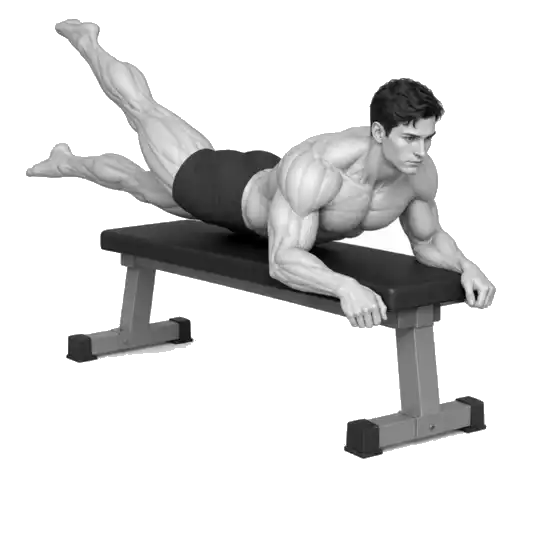
The rear scissor kick is not an exercise where you kick your legs high, but rather an exercise where you alternately straighten both hip joints while keeping your pelvis fixed.
This video is not a typical scissor kick where you lie on your back and train your abdominals. This is a rear scissor kick in which you lie face down on a flat bench, support your torso and pelvis, and alternately lift both legs with your knees almost straight. When one leg is raised, the gluteus maximus and hamstrings extend the hip joint, and trunk muscles, including the erector spinae and multifidus, work together to prevent the pelvis from tilting or rotating. In a study of prone hip extension, the activation of the gluteus maximus, hamstrings, and erector spinae muscles and pelvic movements varied depending on postural conditions, and the order in which the muscles were activated was not consistent even in healthy individuals. So rather than forcing yourself to feel certain muscles first, use belly-pelvis contact with the bench, small leg height, and equal side-to-side rhythm as your technique criteria.
- Primary muscles
- Gluteus maximus, hamstrings, erector spinae
- Secondary muscles
- Multifidus, gluteus medius, latissimus dorsi
- Difficulty
- Beginner to Intermediate
- Movement type
- Prone alternating hip extension
Is this the same abdominal exercise as a scissor kick?
no. Abdominal scissor kicks involve lying on your back and alternating legs to train hip flexion and torso locking. This movement involves lying face down on a bench and alternating your legs backwards, using your gluteus maximus, hamstrings, and stabilizers at the back of your torso.
STEP BY STEP
6 Steps for One Complete Rep
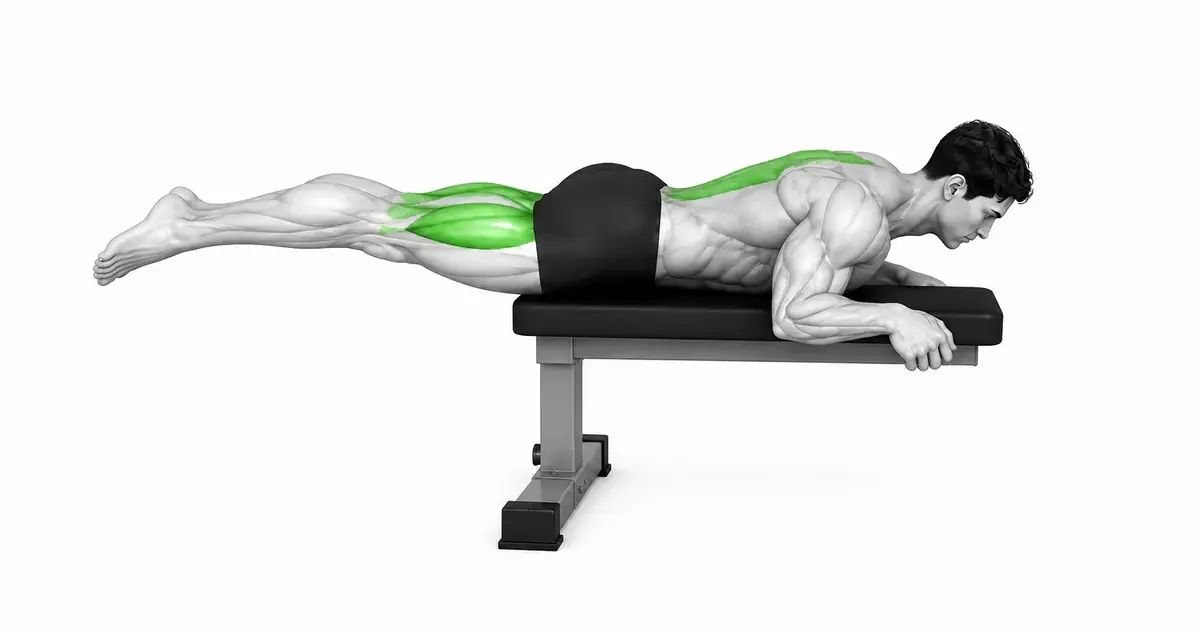
- 1
Make sure the bench doesn't wobble
Use an exercise bench that is flat and sufficiently long. Make sure the floor is not slippery, that all leg rubber touches, and that the pads are not wet or torn. Do not use light portable chairs or benches with wheels.
- 2
Place your pelvis near the end of the bench
Support your stomach and front of your pelvis on the pad, and extend your legs long beyond the end of the bench. If your pelvis is more than half in the air, it is easy to support it with your lower back, so move your hip joints but find a position where your left and right pelvic bones are stable on the pad.
- 3
Keep your arms and upper body comfortable
Place your elbows on the bench or hold the side edge with both hands. Do not lift your chest excessively, keep your neck an extension of your torso, and look down toward the front of the bench.
- 4
Extend both legs long and meet the starting line
Keep your knees almost straight, without locking them, and point your toes away. Lightly press your stomach to keep your ribs and pelvis off the bench, and make sure both thighs start at a similar height.
- 5
Raise small amounts on one side at a time
Exhale briefly and raise one leg just a few centimeters above the line of your torso while simultaneously lowering the other leg a little. Do not spread the space between your legs excessively and keep your left and right hips touching the bench with equal pressure.
- 6
alternating and stopping in a steady rhythm
Switch left and right at a controlled rate of about once per second. If your back arches further, your knees bend, or your pelvis begins to wobble, finish the set, return your legs to bench height, and slowly lower them.
PELVIC SUPPORT
The pelvis must remain on the bench to differentiate between hip movement and lumbar compensation.
If the front of the pelvis lifts off the pad to raise the leg higher, lumbar hyperextension and anterior pelvic tilt will be greater than hip extension. Maintain pressure on the left and right front pelvic bones and lower abdomen against the bench, and use only the range that does not lift the opposite pelvis as one leg rises.
In a study of prone hip extension, the gluteus maximus, hamstrings, and erector spinae muscles were active together, and muscle activity varied depending on posture conditions. Holding the pelvis tightly does not eliminate all back muscles, but it reduces unnecessary rotation and excessive back movement, making it easier to repeat hip extension.
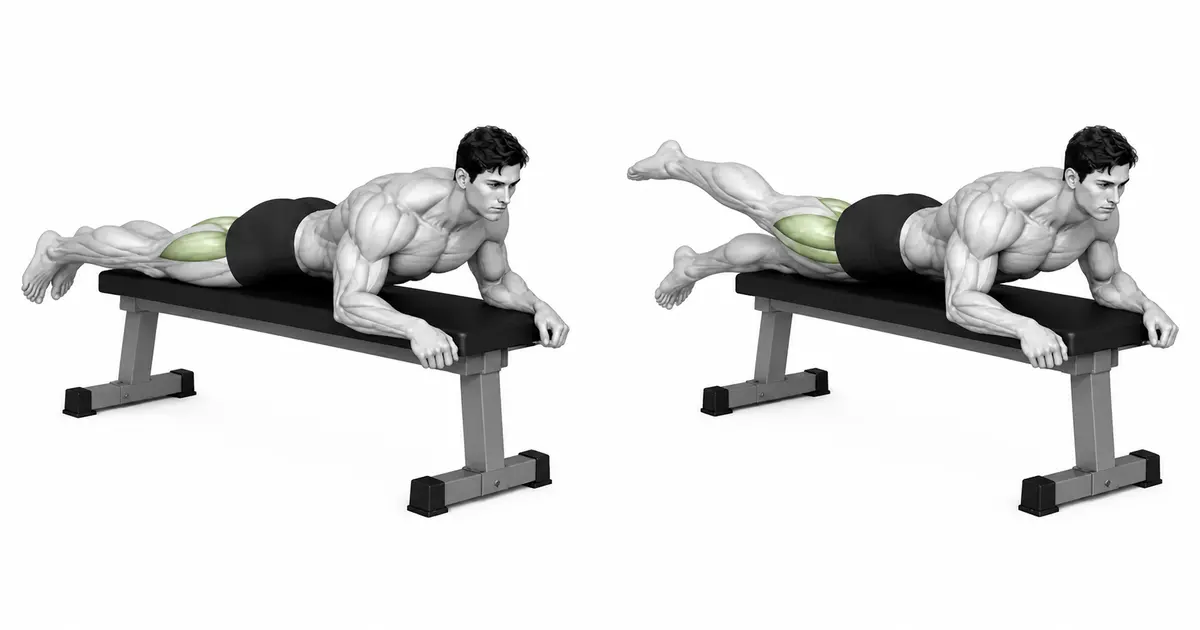
Key point: Standard to feel with your hands: Does the front of the left and right pelvis remain with the same pressure on the bench?
HEIGHT & RHYTHM
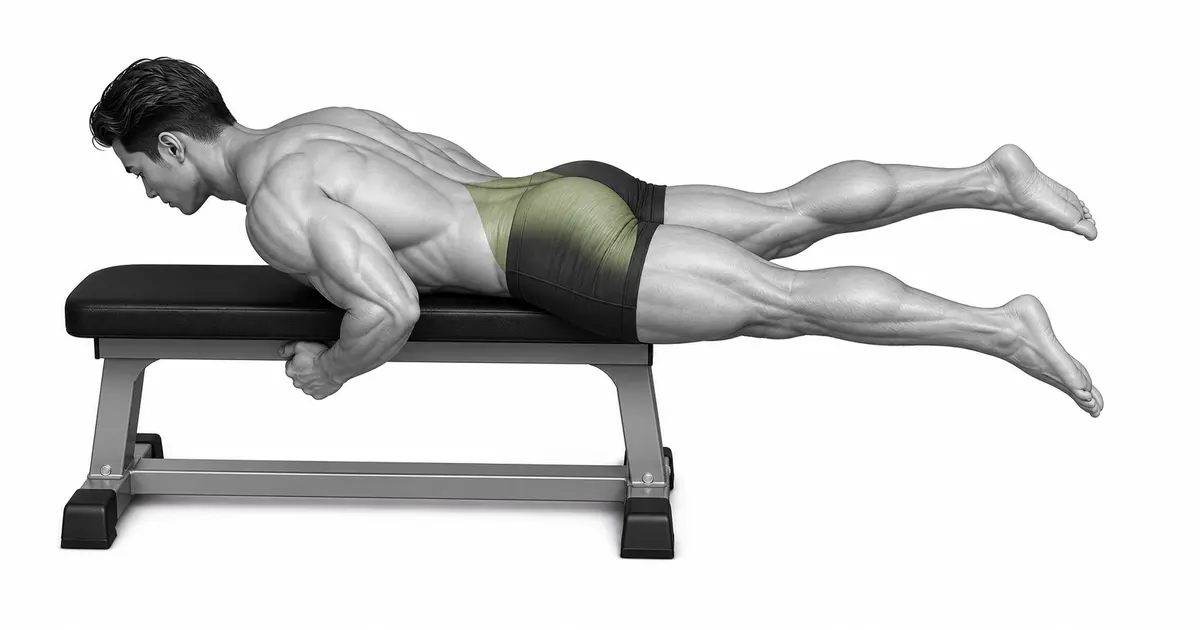
The leg height is small and the left and right shifts are quiet and consistent.
Legs with knees extended are long levers, so just a few centimeters of movement places ample demands on the pelvis and lower back. Your toes do not need to be much higher than your head. While one thigh is raised slightly above the torso line, the other is lowered to the same degree.
When you kick quickly, your legs move due to bench recoil and inertia, making it difficult to see the difference between left and right. At first, use 1 second for each shift and count 6–10 times. Increase the duration of the streak only after maintaining the same height and rhythm.
TROUBLESHOOTING
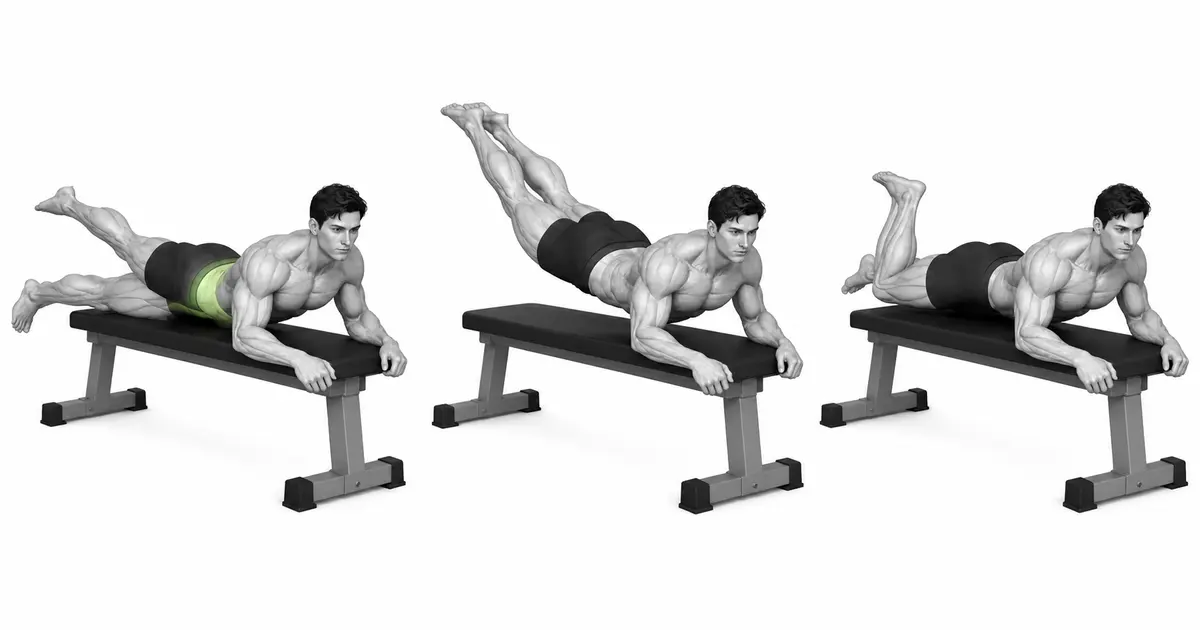
Back hyperextension, knee bending, and pelvic rotation are signals to lower your height and fatigue.
If you throw both legs high at the same time and lift your ribs and pelvis off the bench, it will be a big torso hyperextension move rather than a rear scissor kick. Lower your legs to the bench line and move again on one side, lightly pressing your lower abdomen into the pad.
If one knee is bent too much or the toes are turned outward and the pelvis is rolled together, it may be a compensation trying to match the height of the left and right legs. Reduce the number of repetitions, extend your toes out, and maintain leg length. Even if it is not pain but simple fatigue, if the standard of posture is broken, the set ends.
TROUBLESHOOTING
Fix the cause of a mistake, not just its appearance
I put my pelvis too far beyond the edge of the bench.
- What you see
- Your lower abdomen and pelvis are floating in the air, and your back is bent significantly even before you lift your legs.
- Likely cause
- The support area was excessively reduced to create space for movement of the hip joint.
- How to correct it
- Move your body slightly toward your head so that the front of your left and right pelvis touches the pad. The legs start with a small range.
Throwing both legs too high at the same time
- What you see
- Raise your feet above your head and lift your ribs and pelvis off the bench.
- Likely cause
- I think the greater the height, the more effective it is for the back muscles or the recoil you use.
- How to correct it
- Raise just a few centimeters above your torso line on each side and stop before the pressure on the bench disappears from your lower abdomen.
Bend your knees and kick up your heels
- What you see
- The height of the thighs rarely changes, but only the knees are folded and the feet bounce upward.
- Likely cause
- The hip joint extension strength was insufficient or the lever was shortened to meet the target speed.
- How to correct it
- Decrease the speed and height of your repetitions and keep your knees almost straight, with your toes pointing away.
Pelvis rolls left and right
- What you see
- As one leg rises, the lower back on the same side is lifted and the hip is turned to the side.
- Likely cause
- Leg height exceeds current pelvic stability capabilities or hand support is loose.
- How to correct it
- Hold the bench steady with your hands and lower your legs to half height. Only accept the range where the left and right pelvic pressures are the same.
Raise your neck and look straight ahead
- What you see
- The chin moves forward, the back of the neck folds, and the shoulders rise toward the ears.
- Likely cause
- Mirror your leg movements or try to keep your upper body higher.
- How to correct it
- Place your gaze down the front of the bench and lengthen the back of your neck. Place a thin towel under your forehead if necessary.
The speed is so fast that the bench shakes.
- What you see
- Every time you switch legs, the bench shakes, your feet bump into each other, or the height changes.
- Likely cause
- Alternating between reaction and inertia, focused on filling time.
- How to correct it
- Slow down to no more than once a second and count in increments of 1 to 6–10. If the bench moves, stop immediately.
REGRESSION & PROGRESSION
Match the difficulty before adding load
Lift one leg while lying on the mat
Lift only one leg slightly off the floor and learn hip extension without rotating the pelvis.
Bench one leg lift
Support your pelvis on the bench and adjust the height by repeatedly raising one leg for 1 second and then lowering it completely.
Slow rear scissor kick
Perform 6 to 10 times, using 1 second for each left and right shift, making sure to make contact with your lower abdomen and pelvis.
Consecutive rear scissor kicks
Maintain the side-to-side rhythm in the same small range for 15–30 seconds, but do not speed up.
ankle small resistance
Use very light ankle weights or bands only after the position has been held for 30 seconds. Do not increase height and resistance at the same time.
BEGINNER PROGRAM
A practical starting framework
Can be used 2–3 times a week as a posterior chain assistance exercise or as an activation movement before floor exercises. If you perform a lot of deadlifts, back extensions, and hyperextensions on the same day, consider the cumulative fatigue of your lower back and hamstrings and reduce them to one or two sets. At first, learn the technique based on the number of times, such as 6–10 reps on each side.
number
6–10 reps per side
Keep the same rhythm at a small height
set
2–3 sets
45–90 seconds recovery between sets
time type
15–30 seconds
Use after the number of repetitions is stable.
- Before the first set, check the condition of the bench and pad, and determine a body position where the pelvis is supported and a pain-free leg height.
- If you maintain an alternating rhythm of lower abdomen, left and right pelvis contact with the bench, and almost straight knees for all repetitions, add one left and one right in the next session.
- Only after you've achieved a controlled 10 reps on each side for every set do you increase the time or add very light resistance. Do not increase height, speed, and resistance at the same time.
Frequently asked questions
How high should I lift my legs?
It is enough for your thighs to rise a few centimeters above your torso line. Stop just before your lower abdomen or pelvis lifts off the bench or your lower back arches further.
Is it normal to feel irritation in your lower back?
Because the erector spinae muscles stabilize the pelvis and torso, some muscle fatigue may occur. However, if one point feels tight or sharply painful and the symptoms spread to the legs, you should stop immediately.
Should my knees be fully extended?
Do not straighten your legs excessively, but keep your long legs almost straight. If your knees keep bending, lower your leg height and speed and practice lifting one leg first.
How fast do you need to move?
Initially, use about 1 second per shift left and right. If the bench doesn't wobble or your pelvis doesn't roll, you can maintain the height and proceed with a more continuous rhythm.
If I don't have a bench, how do I replace it?
You can lie face down on the mat and use one-leg raises or bird dogs. Do not use as a replacement furniture that is not designed for exercise, such as sofa arms, tables, or chairs with wheels.
Evidence and references
- 1. Jeon et al. — Gluteus maximus and hamstring activation and pelvic movements in three prone hip extensions
- 2. Arab et al. — Prone hip extensor muscle activity according to the presence or absence of back pain.
- 3. Pierce & Lee — Initial sequence of muscle activation during prone hip extension
- 4. Lewis et al. — Prone hip extensor muscle activity and movement patterns in women.
- 5. Oh et al. — Onset of abdominal throw-in and muscle activation during hip extension.