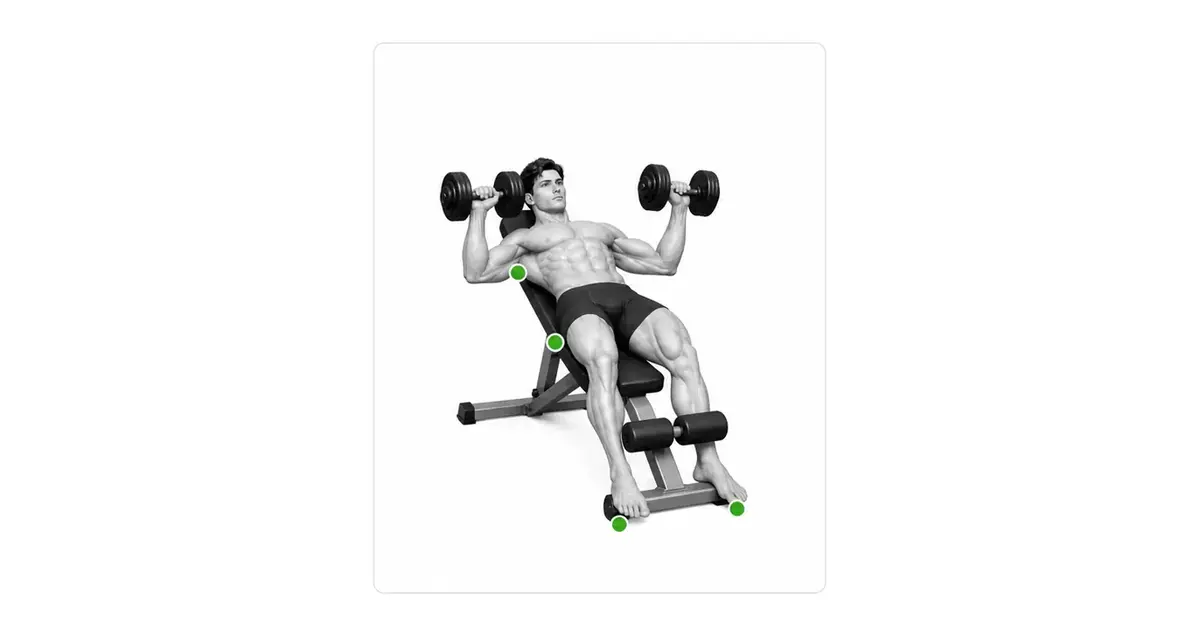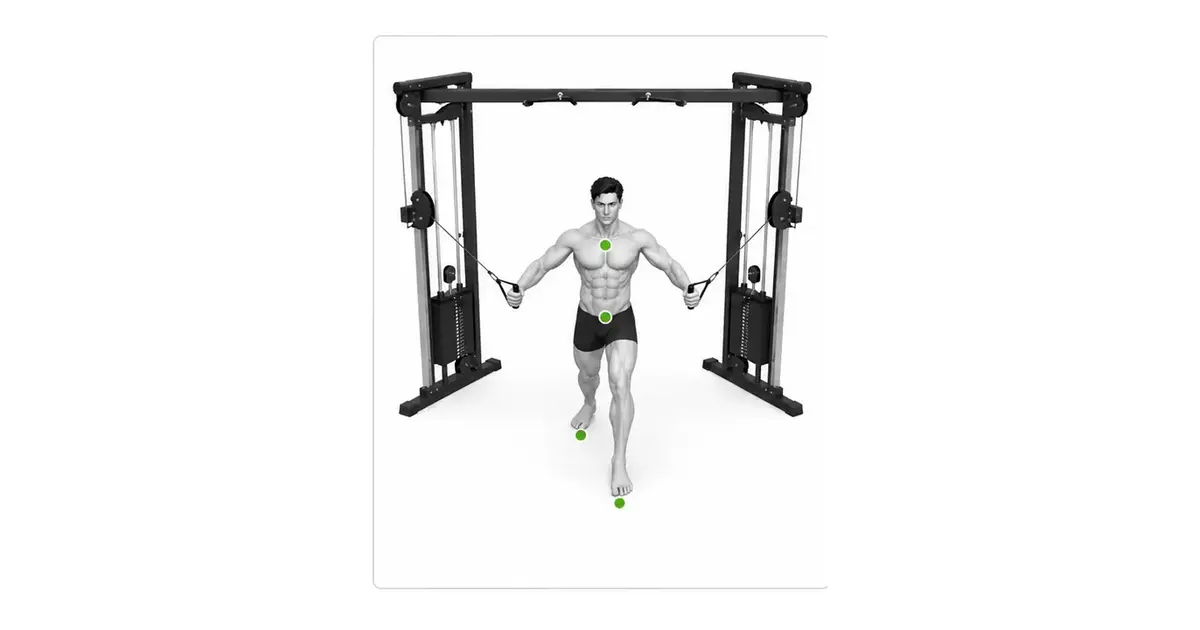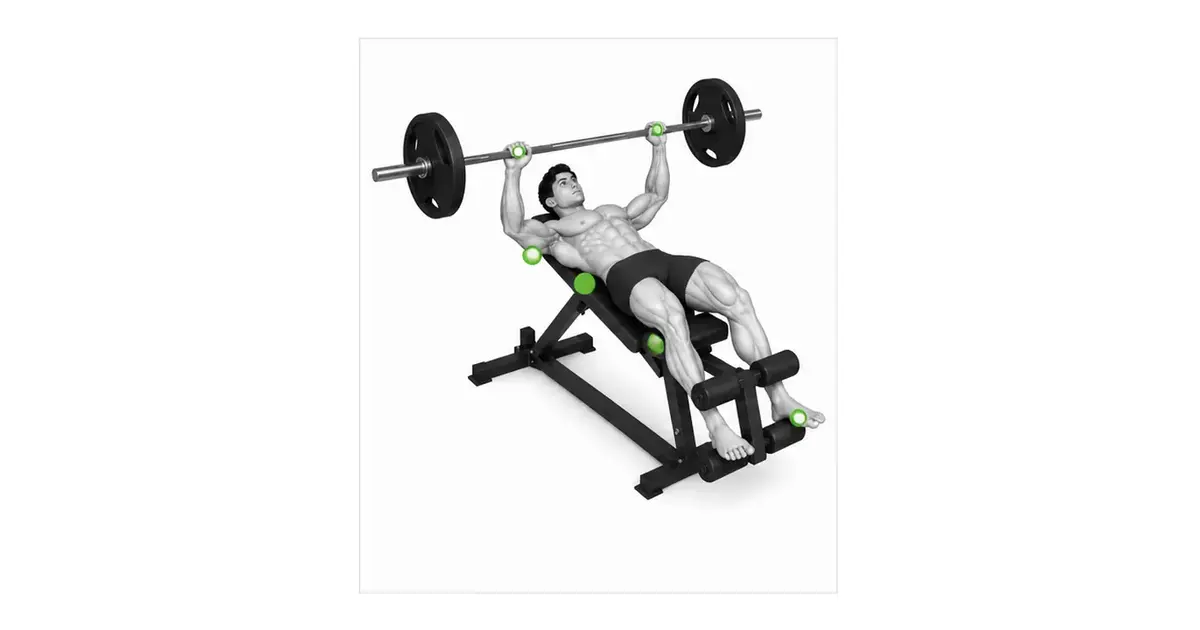
DECLINE SMITH MACHINE PRESS
The decline Smith press requires aligning the path of the bench and fixed bar before the angle.
The Decline Smith Press is an exercise where, as shown in the video, you sit on a bench with your feet fixed on a pad and your head lowered, and then lower and push a bar that moves along a rail toward your chest. In a study comparing the -15-degree decline, the involvement of the pectoralis major, thoracic ribs and triceps was similar to that of the flat press, and the involvement of the anterior deltoid was observed to be lower, but this cannot be interpreted as an exercise that isolates only the lower chest. Instead of reducing side-to-side wobble, the Smith Machine fixes the path of the bar, so instead of forcing your body to the bar, move the bench to find a natural place where your lower sternum meets the rail.
- Primary muscles
- Pectoralis major, triceps
- Secondary muscles
- Front deltoid, serratus anterior
- Difficulty
- Intermediate
- Movement type
- Decline horizontal push / fixed orbit
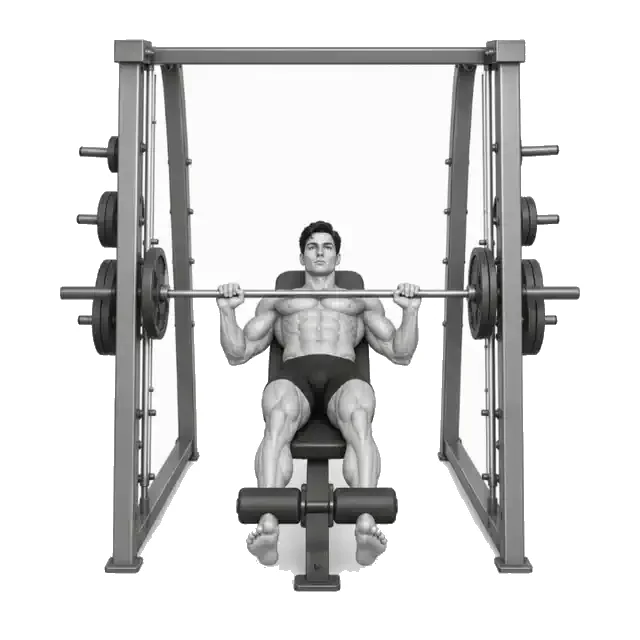
Where should the bar drop on the chest?
Between the lower sternum and the center of the chest is a practical starting point. The exact position will depend on your arm length and machine rails, so adjust your bench position to a point where your wrists are above your elbows and your shoulders are comfortable on an empty bar.
STEP BY STEP
5 Steps for One Complete Rep
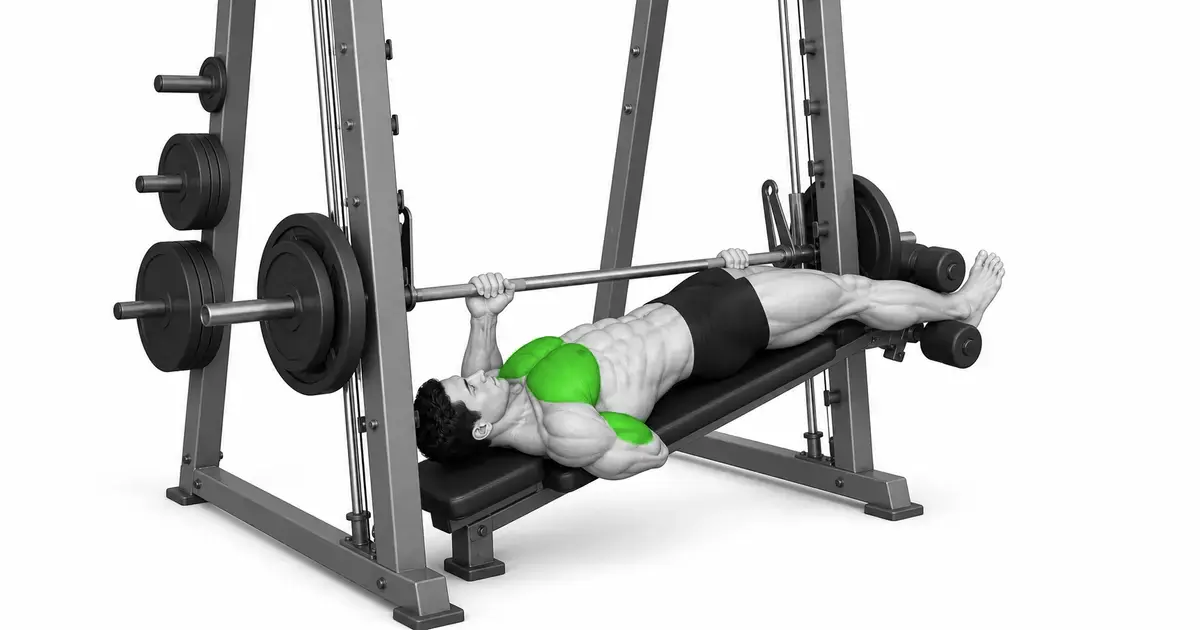
- 1
Check rail, hook, and safety stopper
Move the empty bar up and down to make sure there is no jamming and that the swivel hooks engage on both sides at the same time. Place the safety stopper slightly below the normal lower position and test first to prevent the bar from lowering to your neck or face.
- 2
Align the bench and lower sternum under the bar
When lying down with the center of the bench between the rails, find a position where the bar comes down between your lower sternum and the center of your chest. If you're facing towards your neck or stomach, don't twist your arm path and instead move the bench slightly towards your head or feet.
- 3
Fixing contact points between legs and upper body
Hook your ankles or shins securely under the roller and place your head, upper back, and pelvis on the bench. Bring your shoulder blades back and stabilize them, but do not arch your lower back excessively or allow your pelvis to rise off the bench.
- 4
Release and lower the bar with a closed grip.
Grab the bar by wrapping your thumbs around it and adjust the width of your grip so that your elbows are directly under your wrists. At the top where both arms are stable, rotate the bar to release the hook, inhale and lower it toward the lower sternum for 2–3 seconds.
- 5
Push it back on without bouncing it off your chest.
Turn with your elbows slightly below shoulder line and the front of your shoulders at a comfortable depth. Push the bar along the same rail, once your arms are stable, turn the hook fully to make sure both sides are engaged, then relax.
BENCH & BAR
With a fixed bar path, bench position determines the point of contact.
Free weight bench presses allow the bar to move gently toward the shoulders as it rises, but most Smith machine bars only follow the vertical or slightly angled line set by the rails. So, if you place the decline bench in any position, the bar will point towards your neck or stomach, and your wrists and elbows will be forced to move off the rail.
When you slowly lower the empty bar, find a point where it touches between your lower sternum and the center of your chest, keeping your wrists above your elbows at your sides. Since the rail angle and hook direction are different for each model, the bench position of the previous machine is not copied.
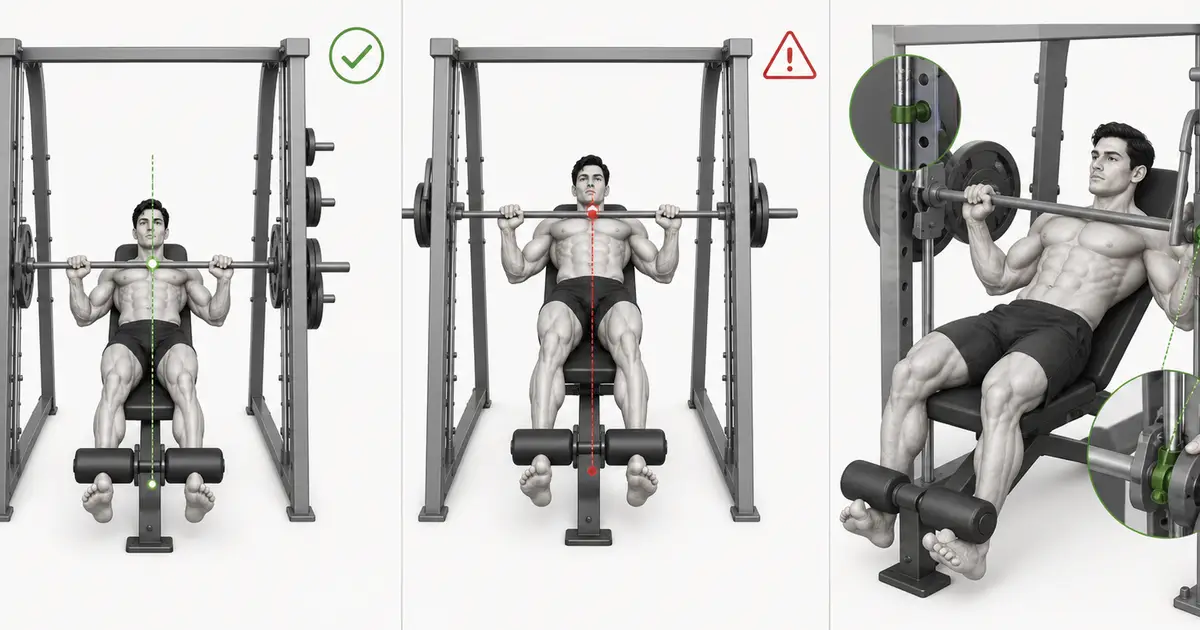
Key point: Record your settings: bench position + safety stopper height + chest contact point on bar.
DECLINE ANGLE
Decline angle does not mean ‘lower chest only’
In a study comparing -15 degree decline and flat press, the muscle excitation of the pectoralis major and thoracic ribs was similar, and the results showed that triceps involvement was high and anterior deltoid involvement was low in decline. In other angle studies, lower pectoralis muscle activity was similar at -15 degrees and flat.
Electromyography only shows one set of muscle excitations and does not directly guarantee long-term muscle growth. Don't view decline as the only solution for a particular area, but use it as one of the press variations that keeps your shoulders comfortable and allows you to reliably perform your target repetitions.
WRIST, ELBOW & HOOKS
Practice wrist and elbow alignment and hook manipulation as one movement.
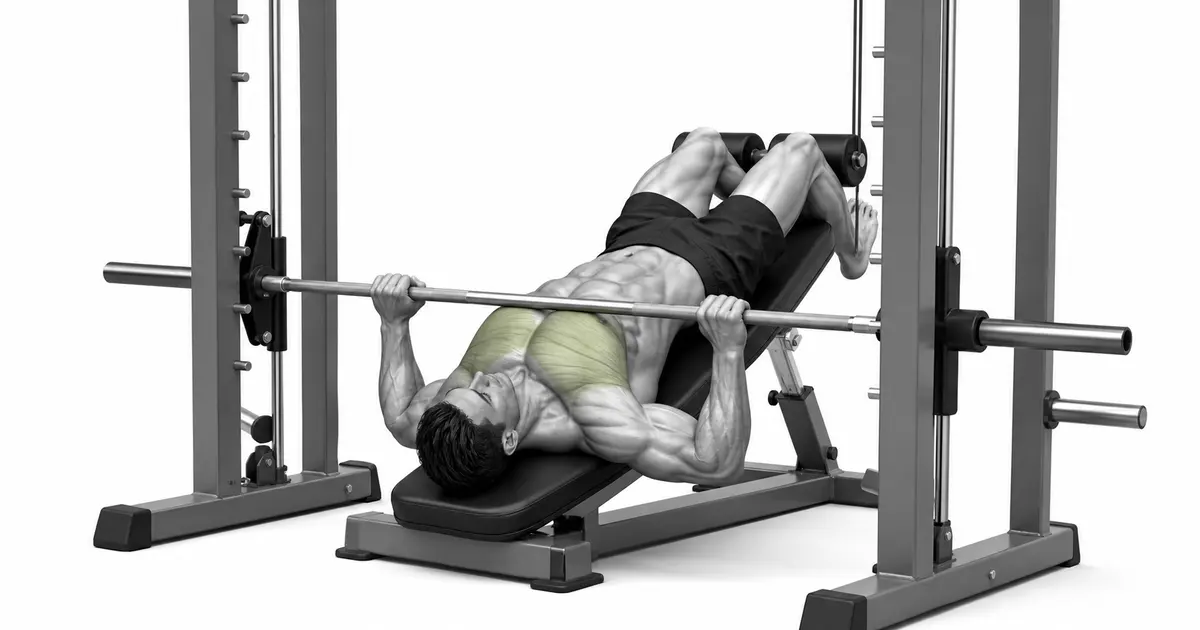
If you place the bar on your fingers, your wrists will bend backwards, and it will be easy for one hand to move first when turning the hook. Place the bar under your palms, wrap your thumbs around them, and keep your wrists and elbows overlapping in front of you.
In bench press biomechanics studies, overly wide grips and large shoulder abductions may increase some shoulder joint loads. If your wrists are pushing past your elbows or your elbows are up to shoulder line, narrow your grip a little and lower the weight. At the end of the set, with both arms stable, turn the hook all the way and check that it is actually hooked.
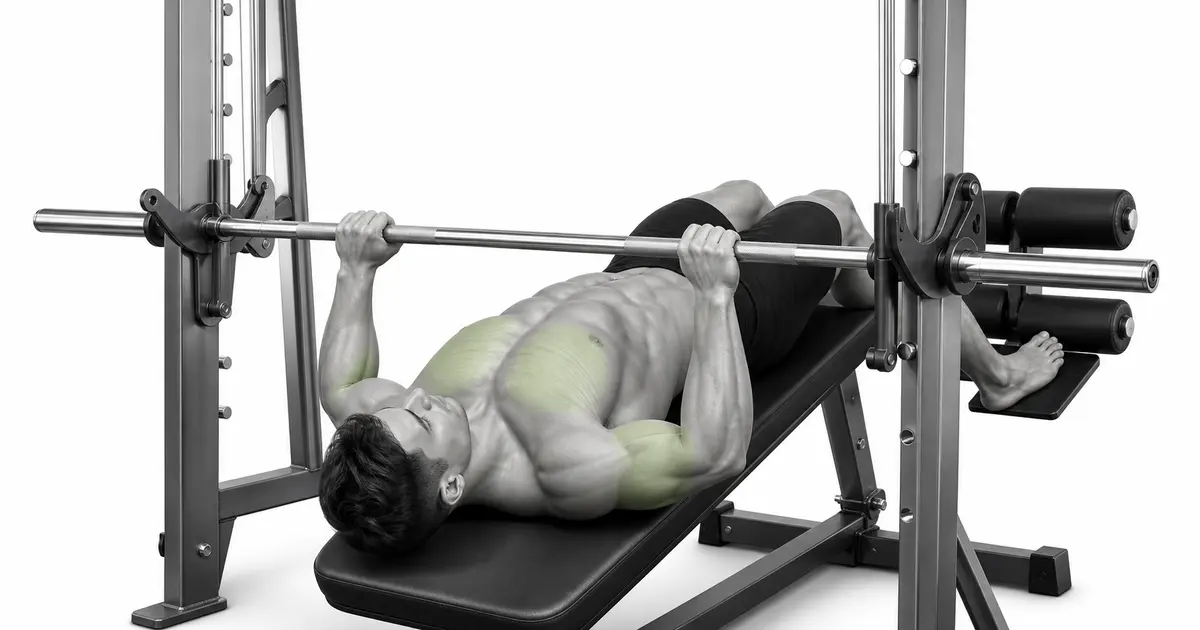
TROUBLESHOOTING
Fix the cause of a mistake, not just its appearance
The bench is out of position, causing the bar to go towards the neck.
- What you see
- At the bottom, the bar is near your collarbones or neck, and your elbows are spread out to shoulder line.
- Likely cause
- I only changed the arm path to align my body with the fixed rail and did not check the bench position.
- How to correct it
- With an empty bar, move the bench slightly toward your feet so the bar lowers to your lower sternum and recheck your wrist and elbow alignment.
Performed alone without safety stopper
- What you see
- If you fail the repetition, the bar may continue to come down towards your chest and neck and there is no escape route.
- Likely cause
- I thought I could rehang it at any time with just a rotating hook, or I omitted the stopper setting.
- How to correct it
- Check the lowest point of the empty bar first, set the stopper slightly below that, and at higher weights, signal with an assistant.
Bounce the bar off your chest
- What you see
- The last section of the descent suddenly becomes faster and the bar rises with a bounce against the chest.
- Likely cause
- I misunderstood that it was heavy or that the fixed rails controlled the bar for me.
- How to correct it
- Lower the weight and use a 2–3 second descent, changing direction with a light touch to the chest or control from just above.
Wrists are bent and elbows are excessively open
- What you see
- The bar is pushed toward the fingers and at the bottom, the elbows are raised to more than in line with the shoulders.
- Likely cause
- The grip is too wide or the bar contact points do not fit your body.
- How to correct it
- Close your thumbs, place the bar under your palms, and narrow your grip a little. The forearm regains contact near vertical.
Hook only one side and tense up
- What you see
- Immediately after completing the set, the bar returns to one side or comes back down from the rails.
- Likely cause
- I turned my wrist before my arm was stable, or I just heard the hook and didn't check.
- How to correct it
- Stabilize your arms, turn the bar all the way, visually check that both hooks are on the pins, and relax your hands.
REGRESSION & PROGRESSION
Match the difficulty before adding load
Empty bar setting practice
Repeat bench position, contact points, stopper, and both hook operations.
light symmetrical weight
With equal weight on each side, maintain the rate of descent and point of contact for 10–12 reps.
standard working set
Easily complete two rounds of 6–10 to 2 repetitions at full range without pain.
stop repeat
Lower the weight and stop for 1 second at the bottom to develop the ability to push without recoil.
BEGINNER PROGRAM
A practical starting framework
Use 1–2 times a week as the main movement of a chest exercise or as an auxiliary movement after a flat press. For the first set of each session, use an empty bar or light weight to recheck your bench position and hook direction.
number
6–10 times
Maintains same contact point and wrist alignment
set
2–4 sets
2–3 minutes recovery between sets
speed
2–3 second descent
Controlled pushing without chest recoil
- When the point of contact on the bar and the speed on both sides are the same for all repetitions, add a repetition to the next session.
- Add equal amounts of weight to each side only when you've achieved the top of your reps on every set and are stable through the hook.
- If your shoulders lift, your wrists buckle, and the bar moves toward your neck, immediately lower the weight and reset to the bench position.
Frequently asked questions
Is the decline press best for the lower chest?
There is insufficient evidence to make that conclusion. In the study, pectoralis major thoracic activation at a -15 degree decline was similar to the flat press, resulting in lower anterior deltoid involvement. Look at the pain-free performance, progressive loads and the entire program as well as stimulation positions.
Since it is a Smith machine, can I do it heavier without an assistant?
no. Fixed rails reduce side-to-side balance requirements, but in case of failure the bar comes down to a set line. Be sure to set the safety stopper, and have an assistant if the hook operation is unstable or the weight is heavy.
Should I do both the flat bench press?
Not required. Both exercises are presses that use the chest and triceps, so their roles overlap. Keep the one that allows your shoulders to develop comfortably and stably as the main movement, and if necessary, assist with the other in smaller sets.
Evidence and references
- 1. Krzysztofik et al. — Comparison of muscle excitation between decline, flat, and incline press and chest press machines
- 2. Lauver et al. — Comparison of upper extremity muscle activity at different bench angles, including -15 degrees.
- 3. Schick et al. — Comparison of muscle activity between Smith machine and free weight bench press
- 4. Noteboom et al. — Bench press technique changes and shoulder musculoskeletal loading
- 5. Saeterbakken et al. — Smith Machine Back Chest Press Training and Sticking Section