DUMBBELL BENCH PRESS
The dumbbell bench press is not about bringing two dumbbells together—it is about stabilizing two separate loads
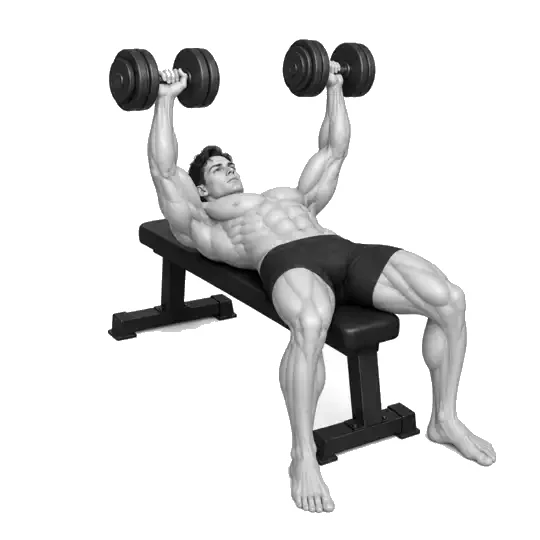
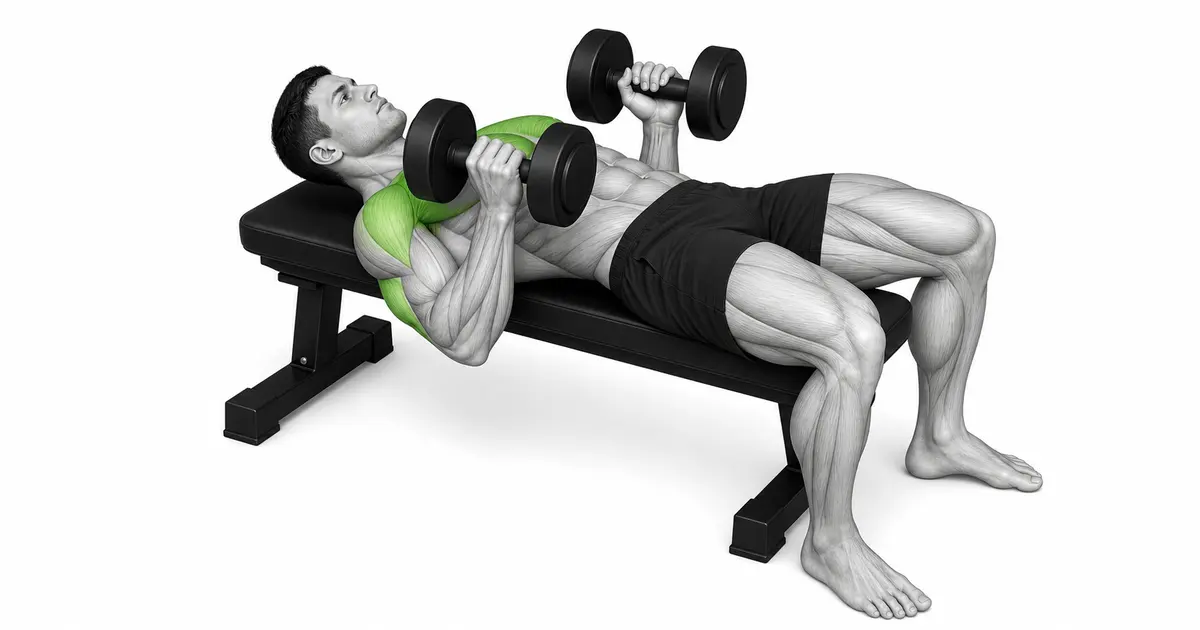
The dumbbell bench press is a horizontal pressing exercise performed lying on a flat bench, driving each dumbbell independently. In the movement demonstration, the head, upper back, and pelvis stay on the bench with both feet supported on the floor while the dumbbells travel from beside the chest toward a point over the shoulders. Dumbbells allow more freedom of movement than a barbell, but that does not automatically guarantee a wider or safer range of motion. The key is to stack the wrist and elbow under each dumbbell and repeat at the same speed within the personal range where both shoulders stay stable on the bench.
- Primary muscles
- Pectoralis major
- Secondary muscles
- Triceps · anterior deltoids
- Difficulty
- Intermediate
- Movement type
- Horizontal press
Is the dumbbell bench press better than the barbell bench press?
They serve different purposes. Dumbbells move independently, so path freedom and stabilization demands are higher, while a barbell links both hands and generally makes it easier to handle a larger absolute load. Choose based on your goal, your skill level, and a comfortable joint path rather than a single muscle-activity number.
STEP BY STEP
5 Steps for One Complete Rep
- 1
Inspect the bench and dumbbells first
Check that the bench sits on level ground without rocking and that the dumbbell plates and collars are secure. Start with dumbbells light enough that you can control the path on both sides through the final repetition.
- 2
Bring the dumbbells up from your thighs
Sit on the end of the bench with the dumbbells standing on your thighs. As you lie back, drive one knee at a time to guide each dumbbell beside your chest. Do not haul a heavy dumbbell into the start position by throwing your arm back.
- 3
Build five contact points and a wrist column
Keep the head, upper back, and pelvis on the bench with both feet flat on the floor. Stabilize the shoulder blades back and down, wrap your thumbs around the handles, and keep the elbow directly beneath the handle so the wrist cannot fold backward.
- 4
Lower both dumbbells beside the chest under control
Inhale and lower both dumbbells beside the chest over two to three seconds. Point the elbows slightly below the shoulder line and keep the forearms close to vertical from both the front and the side. Stop before the shoulders roll forward.
- 5
Press over the shoulders and finish on your thighs
Keep pressure through both feet and the upper back as you press the dumbbells up over the shoulders. Do not clash them at the top—check your balance instead. When the set ends, bring the dumbbells beside your chest, lift your knees to rest them on your thighs, and sit up with them.
SUPPORT & SETUP
Getting the dumbbells in and out comes before heavy repetitions
The dumbbell bench press has no rack, so starting and finishing the set are part of the technique. Standing the dumbbells on your thighs and using your knees together with the movement of your trunk keeps you from starting the lift by throwing your shoulders back. Reverse the same path at the end of the set, and never drop the dumbbells to the floor while lying down.
ACE recommends pressing while maintaining contact through the head, shoulders, hips, and both feet, with the shoulder blades stabilized. A natural curve in the low back can remain, but do not build an arch so large that the pelvis lifts or the feet slide as you begin to press. If the bench is high enough that your feet do not reach, use a stable platform.
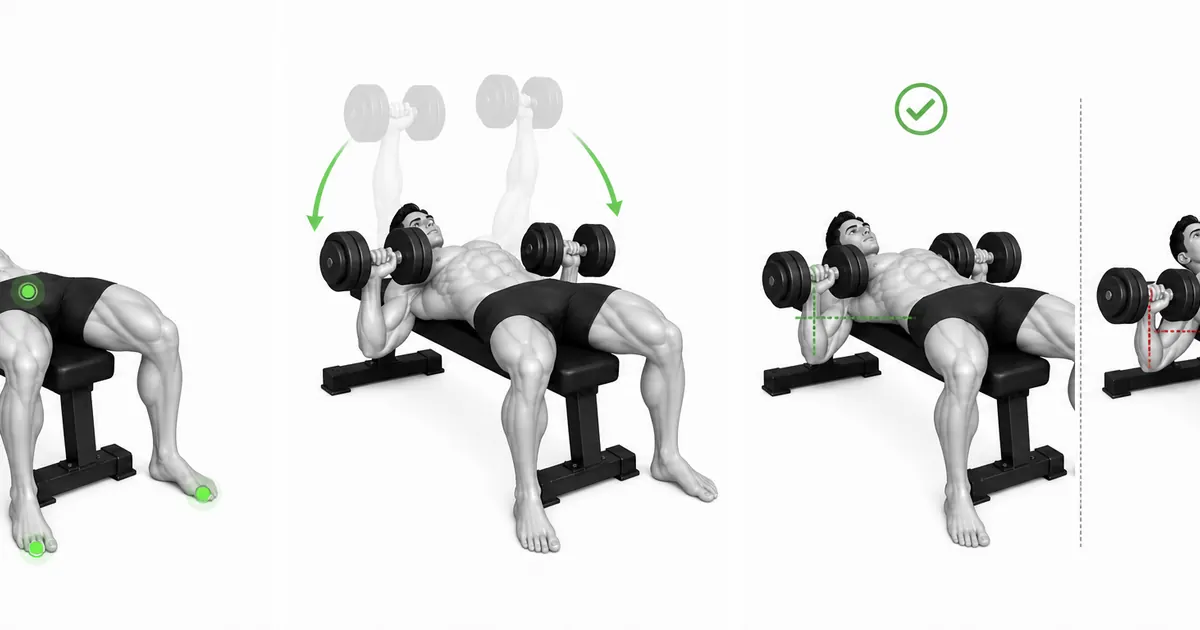
Key point: Practical cue: “Lie back with the dumbbells from your thighs → anchor head, upper back, and pelvis → press both feet into the floor.”
INDEPENDENT PATH
The dumbbells return over each shoulder, not to a single meeting point
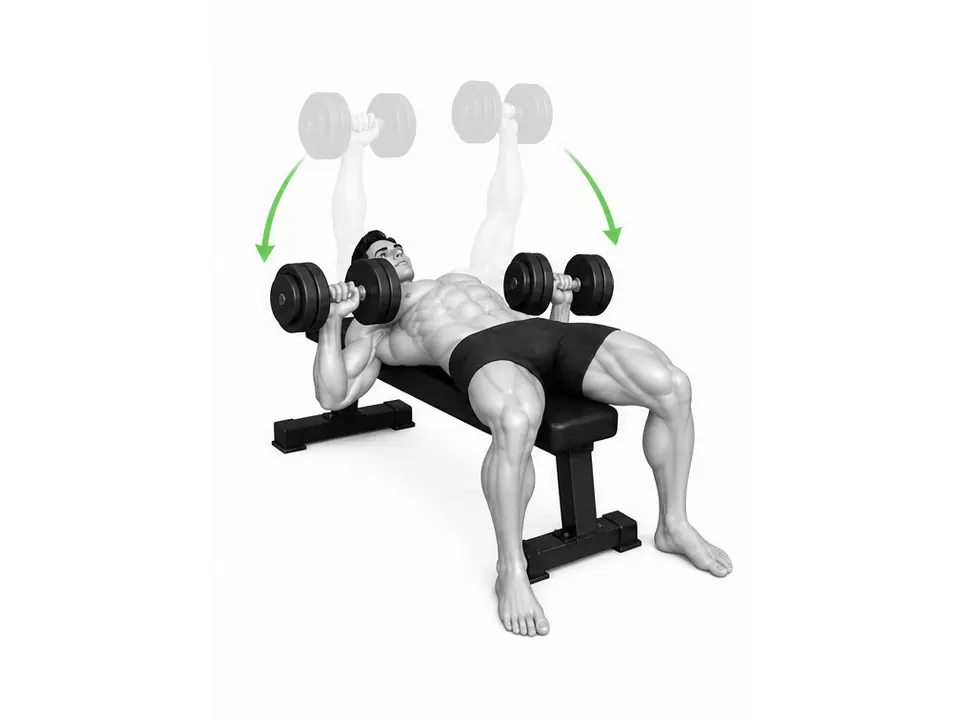
At the bottom the dumbbells sit beside the chest with the elbows taking the load underneath them. As you press, the two dumbbells may drift slightly inward, but they do not need to clash or converge on a single point above your face. Check instead that each dumbbell returns over its own shoulder joint on the same arc and at the same speed.
A small study comparing dumbbell, barbell, and Smith machine pressing found a lower one-rep max and different stabilization demands with the higher-freedom dumbbell version. That does not mean dumbbells inevitably build more muscle—it means that even at the same displayed load, balance and path control can be a separate limiting factor. Do not set your dumbbell weight by halving your barbell number.
WRIST · ELBOW · DEPTH
Judge depth by shoulder stability, not by how low the dumbbells go
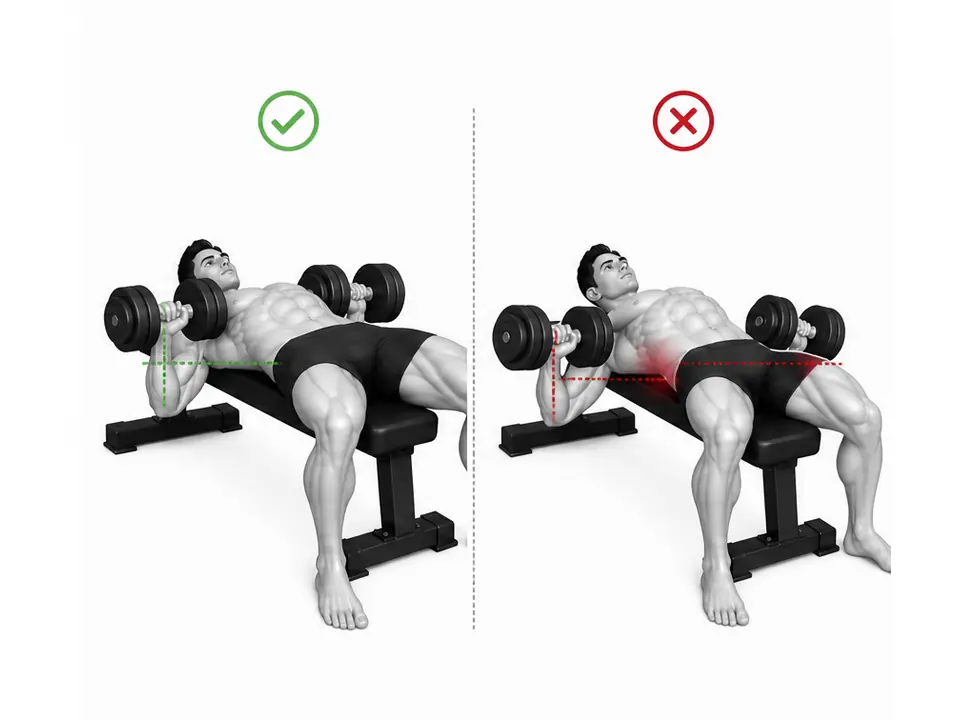
Being able to lower the dumbbells further does not always make for a better repetition. Even as the elbows travel below the torso, the shoulder blades have to stay stable on the bench, the wrist has to remain over the elbow, and the front of the shoulder has to feel comfortable. If the shoulders roll forward, the dumbbells sink toward the floor, or the wrists fold, a shallower point is your current end range.
Range-of-motion research in resistance training generally supports the benefits of a controllable full range, but that is not an instruction to force maximum joint depth on everyone. Arm length, rib cage shape, and shoulder mobility all change where the bottom sits. Build a repeatable path within a pain-free range first, and add depth gradually only as your stability improves.
TROUBLESHOOTING
Fix the cause of a mistake, not just its appearance
The wrists fold backward
- What you see
- The dumbbell handle sits toward the fingers and the wrist joint drifts behind the elbow.
- Likely cause
- The grip may be loose, or the load may be too heavy to support through the forearm.
- How to correct it
- Wrap the thumb, set the handle low in the palm, and stack the dumbbell, wrist, and elbow into one column. Reduce the load as well.
The elbows flare wide to the shoulder line
- What you see
- From above the upper arms sit at nearly 90 degrees to the torso and the front of the shoulder feels pinched or uncomfortable.
- Likely cause
- You may be lowering the dumbbells near the neck, or forcing a shape meant to open the chest wide.
- How to correct it
- Lower the dumbbells from mid-chest toward the lower side of the chest and adjust the elbows to a comfortable path roughly 45–70 degrees from the torso.
Descending until the shoulders roll
- What you see
- The front of the shoulder lifts off the bench at the bottom and the dumbbells drop well below the torso.
- Likely cause
- Often the dumbbell's free range is mistaken for a mandate to reach maximum depth, or the load is out of control.
- How to correct it
- Change direction at the point where the shoulder blades stay on the bench. Learn bottom control with lighter dumbbells or the dumbbell floor press.
Clashing the dumbbells at the top
- What you see
- The two dumbbells collide above your face, the wrists wobble inward, and the descent begins immediately.
- Likely cause
- You may be forcing them together to squeeze the chest, or losing balance at the top.
- How to correct it
- Stop each dumbbell over its own shoulder and leave a small gap. Begin the next repetition once both sides are steady.
One dumbbell rises first
- What you see
- One arm extends first during the press while the other dumbbell stays beside the chest.
- Likely cause
- More than fatigue or a control difference, the load may be too heavy or the start position asymmetrical.
- How to correct it
- With a lighter load, match the bottom height of both dumbbells and press them up together. End the set if the gap widens.
REGRESSION & PROGRESSION
Match the difficulty before adding load
Dumbbell floor press
The floor limits elbow depth, making it useful for learning wrist alignment and the change of direction at the bottom.
Light neutral-grip press
Hold light dumbbells facing each other to practice independent paths and bench support.
Standard dumbbell bench press
With the palms facing forward, hold a pain-free bottom range and a symmetrical path.
Alternating or single-arm press
Once standard two-arm reps are stable, add the anti-rotation challenge with a light load.
BEGINNER PROGRAM
A practical starting framework
Use it as your main chest movement or as an accessory after the barbell bench press, once or twice per week. At first, leave two or three repetitions in reserve while holding your depth and wrist alignment side to side, and choose a load you can control on your own through both the start and the finish of the set.
Reps
8–12
Match speed side to side and depth at the bottom
Sets
2–3
Rest 90–150 seconds between sets
Load
+1–2 kg total
Only when the start and the finish are stable too
- If both dumbbells move at the same height and speed for all 12 reps and wrist and elbow alignment holds, add the smallest available increment next session.
- If after adding weight you cannot start from your thighs, or you have to drop the dumbbells to finish, it is not yet a load you control.
- Do not try to correct a side-to-side difference by arbitrarily giving the weaker arm a heavier dumbbell or extra reps—work within a range both arms can control.
Frequently asked questions
Should the dumbbells touch at the top?
No. Clashing them can destabilize the wrists and shoulders. Stop where each dumbbell is stable over its own shoulder joint, leave a small gap, and set up for the next repetition.
How far below chest level should the dumbbells go?
The elbows can travel slightly below the torso, but only as far as the shoulder blades stay on the bench, the wrists stay stacked over the elbows, and the front of the shoulder feels comfortable. A repeatable, controlled range is the standard, not maximum depth.