DUMBBELL CURL
Curl exercise that resolves biceps imbalance and creates precise muscle lines through independent movement of both arms.
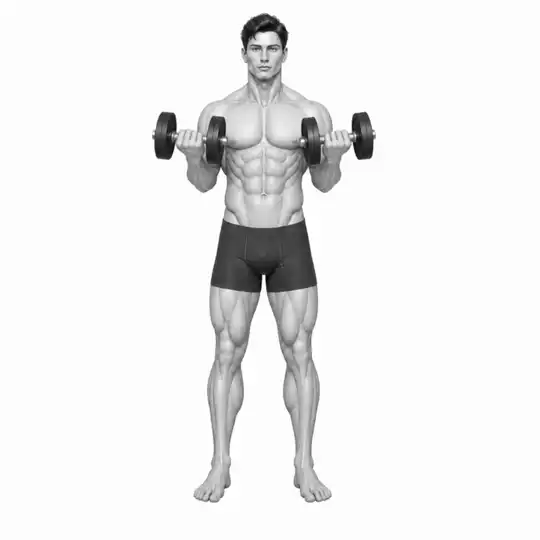
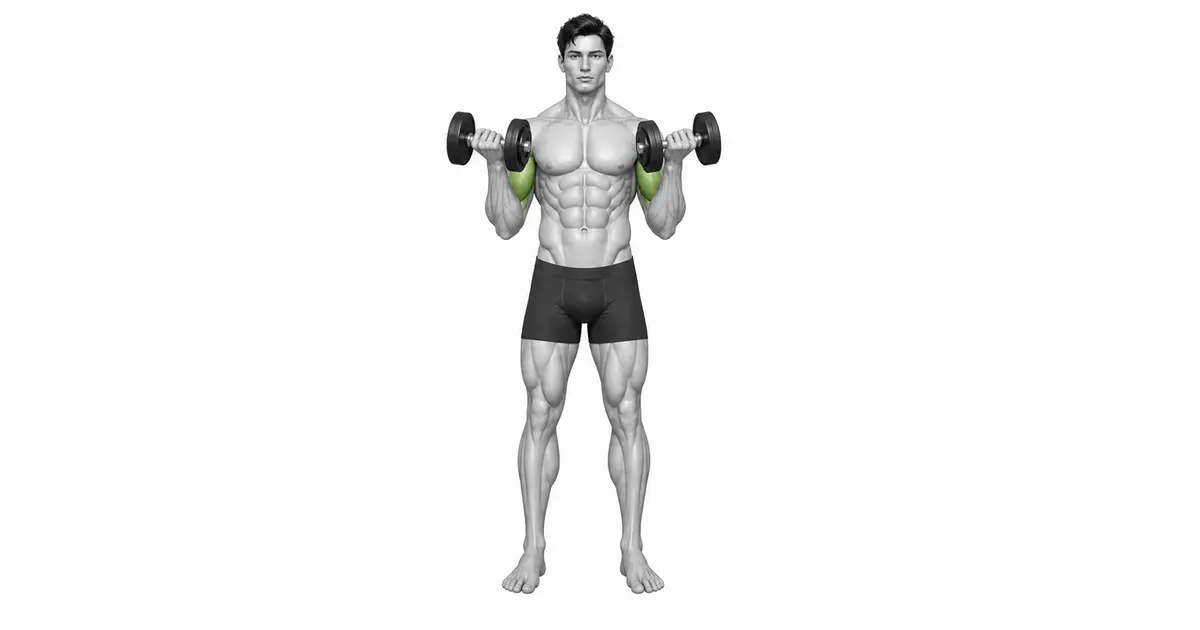
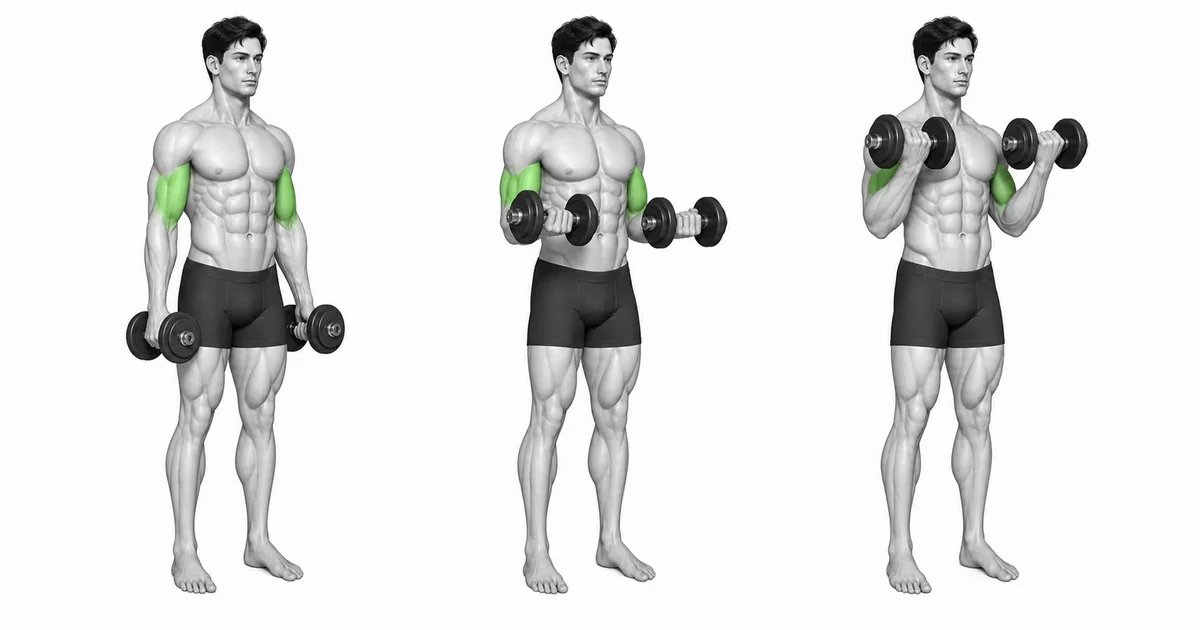
Stand at attention holding a dumbbell in both hands. You can hold it with your palms facing your body (neutral) or with your palms facing forward from the start (underhand). Keeping your elbows at your sides, exhale and raise the dumbbells to shoulder height. At this time, turn your wrist slightly outward and completely squeeze your biceps. Pause briefly at the top, then slowly return to the starting position with resistance.
- Primary muscles
- Biceps Brachii
- Secondary muscles
- Brachialis · Brachioradialis · Forearms
- Difficulty
- Beginner
- Movement type
- Elbow Flexion
Are they better than barbell curls?
The purpose is different. Barbells are good for heavy training, and dumbbells are good for precise isolation and imbalance correction.
STEP BY STEP
4 Steps for One Complete Rep
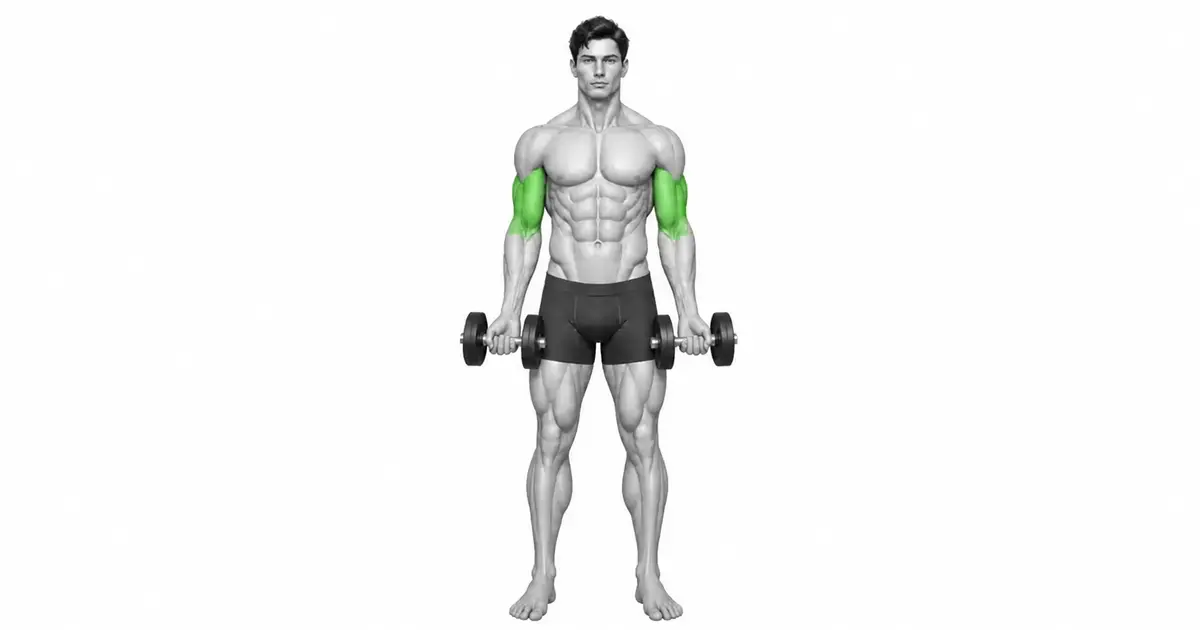
- 1
Ready and Grip
Stand up straight, holding a dumbbell in both hands. Open your chest, stabilize your shoulders, and strengthen your core.
- 2
Lifting Dumbbells
Keeping your elbows locked, raise the dumbbells up. As you raise, turn your wrist so that your palm faces the sky.
- 3
Vertex Contraction
Strongly contract your biceps at the highest point and pause for 1 second. If you place your little finger toward your shoulder, the stimulation will be stronger.
- 4
Slow down
Slowly lower the dumbbells while controlling the weight. Fully extend your arms and lengthen your biceps.
UNILATERAL PRECISION
Independent movement and imbalance correction
The biggest advantage of dumbbell curls is that you can move both arms separately. In barbell curls, it is easy for the stronger arm to assist the weaker arm, but dumbbells are excellent for correcting side-to-side strength and size imbalances because each arm must fully bear the same load.
Also, since the wrist can rotate freely (supination), the muscle can be squeezed to the end by utilizing the rotational force of the forearm, which is one of the main functions of the biceps. This helps make the bicep peaks higher and more defined.
RANGE, LOAD & TEMPO
Choose a range and load that keep the Dumbbell Curl repeatable
The useful range of motion ends before your torso or working joints have to change position to move the load. Keep the biceps brachii producing the movement while the brachialis · brachioradialis · forearms support the same alignment from the first repetition to the last.
Use a controlled lowering phase of about two to three seconds and avoid bouncing through the transition. If the final repetitions become shorter, faster, or visibly different from the first, reduce the load or stop the set before technique breaks down.
Key point: Progress the Dumbbell Curl only after every repetition follows the same path without joint pain.
TROUBLESHOOTING
Fix the cause of a mistake, not just its appearance
Shoulder Use and Recoil
- What you see
- Movement of lifting the shoulders upward or shaking the body when lifting dumbbells.
- Likely cause
- Choosing a weight that is too heavy and cannot be controlled with biceps alone.
- How to correct it
- Lower the weight and keep your elbows firmly pressed to your sides. Keeping your upper body still is the top priority.
Lack of operating range
- What you see
- An action in which the arm is not fully extended but only lowered to the middle.
- Likely cause
- Trying to maintain muscle tension or afraid to relax due to heavy weight.
- How to correct it
- At the bottom, fully extend your arms to ensure sufficient stretch in your biceps. This is the key to muscle growth.
REGRESSION & PROGRESSION
Match the difficulty before adding load
Alternate Dumbbell Curl
Alternate on one arm to increase focus on each arm and strengthen core stability.
Incline Dumbbell Curl
Perform sitting on an incline bench to create a longer stretch of the long head of your biceps.
BEGINNER PROGRAM
A practical starting framework
Dumbbell curls are the classic biceps training. Be aware of the contraction and relaxation of your muscles with each repetition.
Frequency
1-2 times a week
Great for placement after an arm workout routine or back workout.
Volume
3~4 sets, 10~15 times
Select a weight that provides correct posture and stimulation.
- Make sure your wrist does not bend backwards.
- When coming down, do it slowly and controlled for 2-3 seconds, emphasizing the negative.
- Exhale when going up and inhale when going down.
Frequently asked questions
Do I have to turn my wrist?
It is effective even without turning, but turning the wrist outward is recommended as it can induce maximum contraction of the biceps.