TWO-DUMBBELL PULLOVER
The dumbbell pullover is not about going deep—it is about controlling the arc of both dumbbells and your trunk together
This guide covers the two-dumbbell pullover shown in the movement demonstration, performed lying lengthwise on a bench with one dumbbell in each hand. Because you have to stabilize the left and right dumbbells separately, it needs a lighter load than the more common single-dumbbell version held in both hands. The pullover moves the arms from overhead toward the torso and involves the pectoralis major and the latissimus dorsi together, but it does not fully isolate any one muscle. The direct EMG evidence comes from a small study on the barbell pullover, so rather than declaring it a chest or a back exercise, use it based on a safe shoulder range and a repeatable arc.
- Primary muscles
- Pectoralis major
- Secondary muscles
- Latissimus dorsi · serratus anterior · upper-arm stabilizers
- Difficulty
- Intermediate
- Movement type
- Shoulder extension and flexion
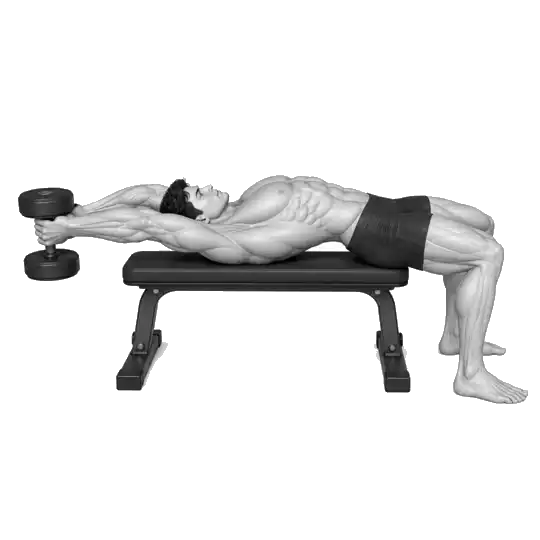
Why two dumbbells instead of the usual single dumbbell?
Because the movement demonstration on this page uses the variation with one dumbbell in each hand. Two dumbbells are harder, since each side has to be stabilized independently. If you are new to the movement or find the balance difficult, start with a single dumbbell held in both hands.
STEP BY STEP
5 Steps for One Complete Rep
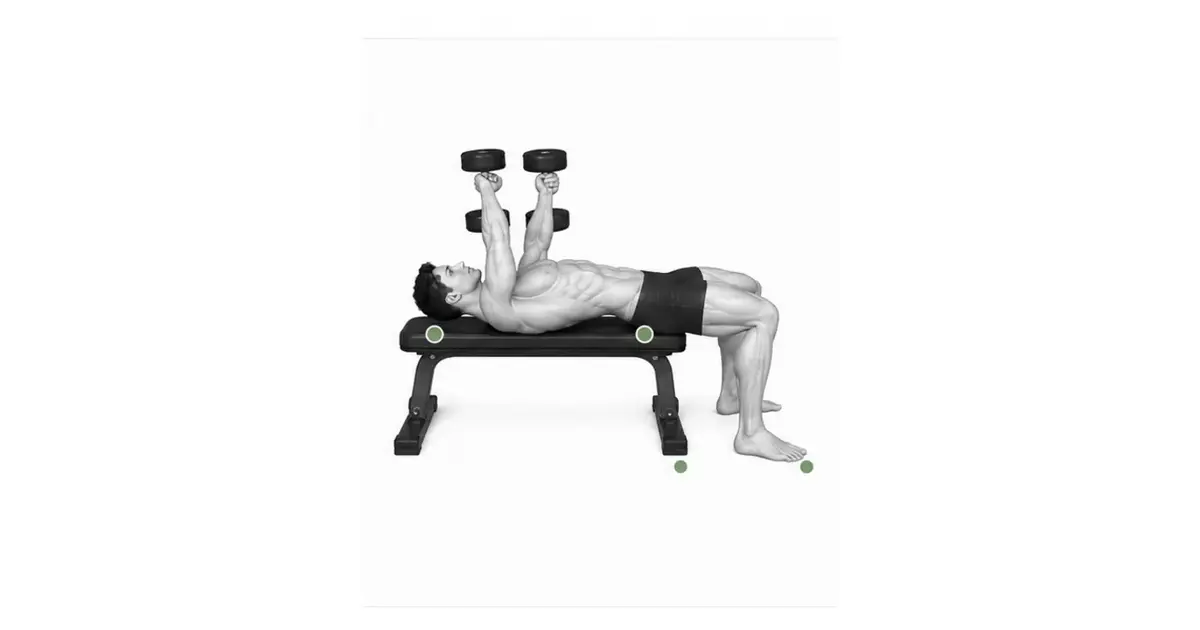
- 1
Get both dumbbells into position safely
Sit with two light dumbbells standing on your thighs rather than on either side of the bench. Use your knee to bring them to your chest one at a time as you lie back, or have a partner hand them to you. Never pick the dumbbells up off the floor behind your head.
- 2
Lock in your contact points on the bench
Place your head, back, and pelvis on the bench with both feet on the floor. Stack the ribs over the pelvis, brace the abdomen, then bring the dumbbells up over your chest. The palms face each other and the wrists stay straight.
- 3
Set the elbow angle and dumbbell spacing
Do not lock the elbows out; hold a soft bend and match the angle side to side. Keep the two dumbbells parallel at about shoulder width so they neither clash together nor drift outward.
- 4
Lower both dumbbells on the same arc
Inhale and move both arms overhead at the same time. Hold the elbow angle nearly constant and let the dumbbells travel past your face toward the back of your head, stopping before the ribs lift or the front of the shoulder becomes uncomfortable.
- 5
Return the arc to over your chest
Keep pressure through the abdomen and feet as you bring both dumbbells back along the same path to over the chest. Do not pull them by bending the elbows or snapping the low back; check your balance side to side at the top before the next repetition.
BENCH SUPPORT
Lie lengthwise on the bench so it supports you from head to pelvis
Lying in line with the bench, as in the movement demonstration, lets it support your head, upper back, and pelvis at once. It is easier to monitor your trunk position than in the across-the-bench variation, which helps beginners control the ribs and pelvis. Place the feet under the knees or slightly ahead and press the whole foot into the floor.
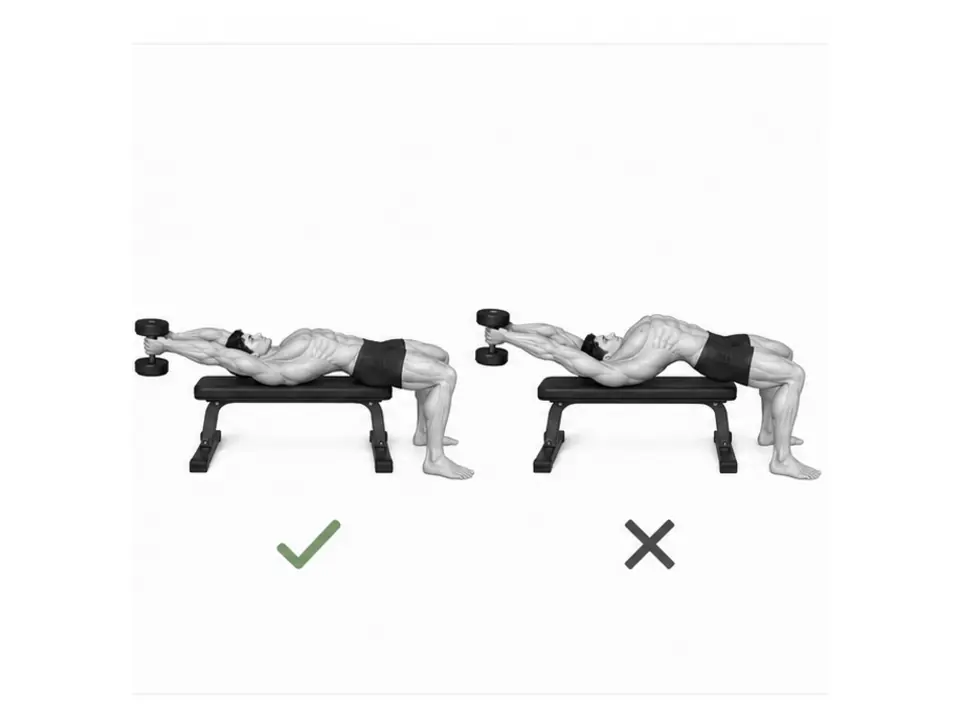
A natural curve in the low back can remain, but if the gap under the low back widens noticeably as the arms lower, you are substituting trunk extension for shoulder range. Keep abdominal tension so the ribs do not flare even as you inhale, and use only the depth at which the pelvis stays on the bench.
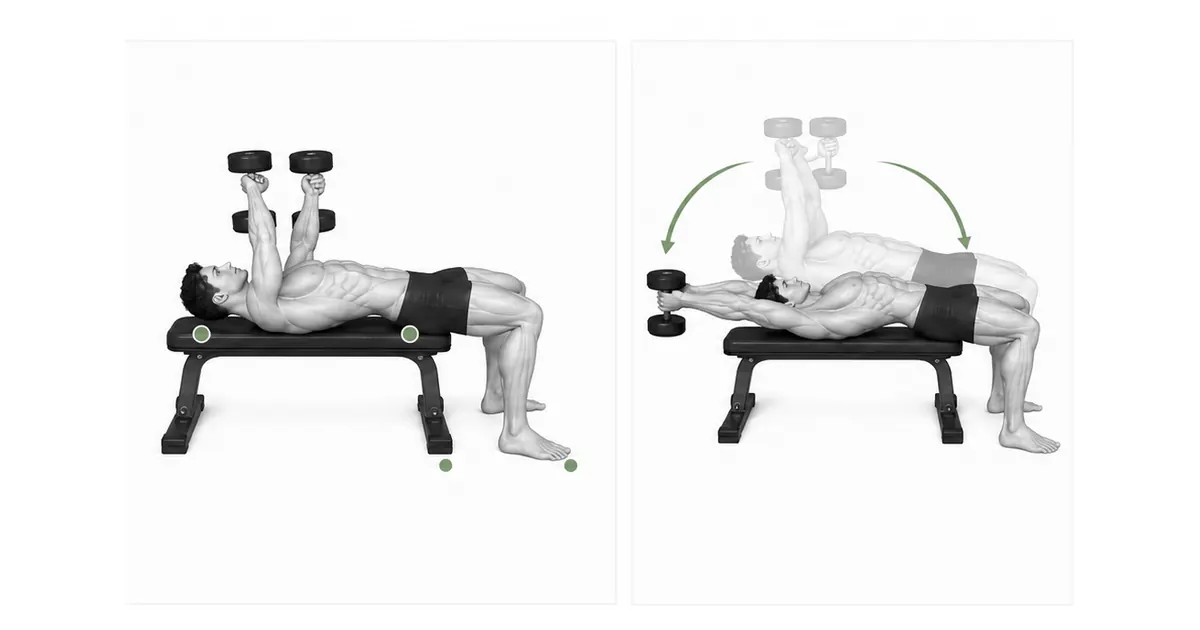
Key point: Practical cue: “Head, back, and pelvis anchored → ribs down → press both feet into the floor.”
PAIRED ARC
The two dumbbells move as a pair, at the same speed and spacing
Start with a neutral grip, palms facing each other, and keep the dumbbells nearly parallel as they pass overhead. Matching elbow angles and dumbbell heights side to side is what keeps one shoulder from dropping deeper than the other. If the wrists fold outward or the dumbbells drift apart, reduce the load.
The resistance moment grows as the dumbbells travel farther from the shoulder joint. Barbell pullover research likewise linked pectoralis major activity to the lever of the external load. A small difference in depth at the bottom can therefore change the perceived difficulty considerably, and going deeper is not automatically a better repetition.
RIBS & RANGE
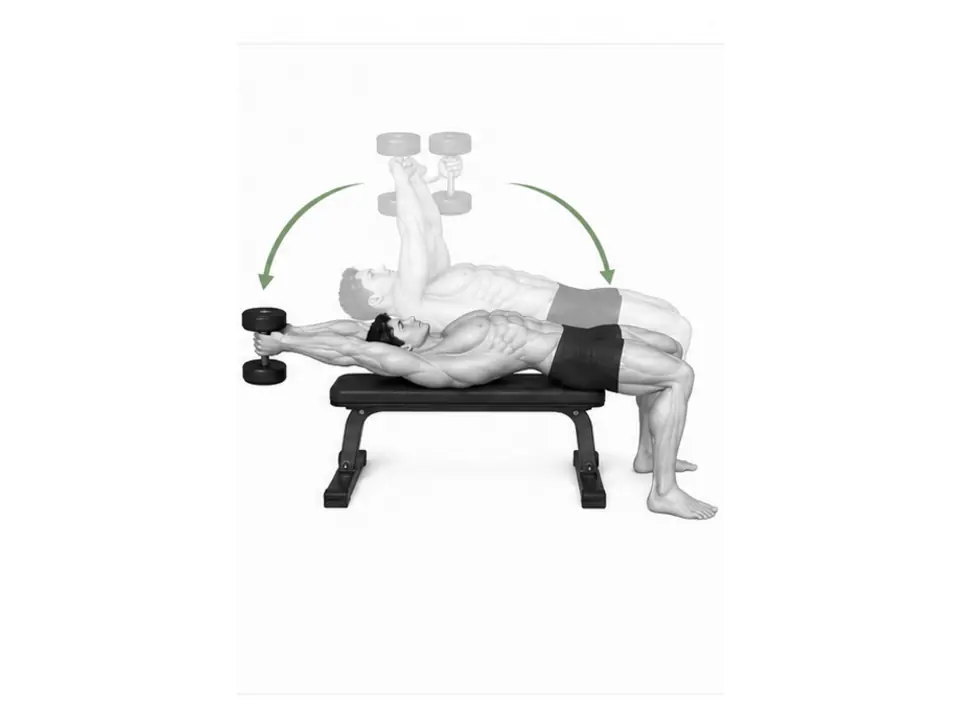
Depth at the bottom is a personal range set by your ribs and shoulders
The lower the dumbbells travel behind your head, the more shoulder flexion and trunk stability the movement demands. Even before the upper arms reach your ears, if the front of the shoulder pinches, the arms shake, or the ribs lift, that is your current end range. Do not force the dumbbells down to floor level for the look of it.
General full-range research does not mean forcing maximum depth at every joint for every person. In the pullover, use the range where you can control the joints and trunk without pain, and widen it gradually only as stability and mobility improve over time. Claims that this permanently expands the rib cage or immediately adds volume to a specific area lack supporting evidence.
TROUBLESHOOTING
Fix the cause of a mistake, not just its appearance
One dumbbell descends faster
- What you see
- At the bottom the two dumbbells sit at different heights and only one shoulder stretches deeper.
- Likely cause
- More often than a strength or mobility difference, the load is too heavy or your eyes are fixed on one dumbbell.
- How to correct it
- Reduce the load and watch the gap between the dumbbells so they move at the same speed. If the difference persists, practice one arm at a time in a light range.
The ribs and pelvis lift
- What you see
- The low-back arch grows as the dumbbells lower and the pelvis or glutes come off the bench.
- Likely cause
- Often you are creating depth beyond your shoulder range, or the abdominal brace has released.
- How to correct it
- Exhale, restack the ribs over the pelvis, and reduce the range. Use lighter dumbbells.
The elbows bend sharply
- What you see
- The dumbbells come close to your face at the bottom and you extend the elbows like a triceps extension on the way up.
- Likely cause
- The load may be hard to control, or you may be substituting elbow movement for shoulder movement.
- How to correct it
- Hold the soft elbow angle you set at the start and move the dumbbells on an arc centered at the shoulder joint.
The dumbbells drift outward
- What you see
- The palms rotate to face forward and the gap between the dumbbells grows well past shoulder width at the bottom.
- Likely cause
- The load may be too heavy to stabilize the wrists and upper arms, or each side may be moving on its own path.
- How to correct it
- Keep the palms facing each other and move both dumbbells as one pair. If needed, learn the single-dumbbell two-handed variation first.
Bouncing the dumbbells over the chest
- What you see
- The dumbbells clash at the end of the ascent and immediately drop into a fast descent.
- Likely cause
- You may be starting the next repetition on momentum without checking your balance at the top.
- How to correct it
- Do not knock the dumbbells together over the chest—settle them briefly, then lower again over two to three seconds.
REGRESSION & PROGRESSION
Match the difficulty before adding load
Single-dumbbell pullover
Hold one light dumbbell in both hands to learn the shared arc and trunk control first.
Light two-dumbbell pullover
Hold a light dumbbell in each hand and match height and spacing side to side.
Paused two-dumbbell pullover
Hold for one second at a controllable bottom position to change direction without rebound.
Single-arm pullover
Work one arm at a time to resist trunk rotation and compare range side to side.
BEGINNER PROGRAM
A practical starting framework
Place it as an accessory once or twice per week, after a chest or back compound lift. Start very light, judging by how stable each hand is rather than by the combined total, and leave two or three repetitions in reserve while holding your side-to-side height and rib position through the last rep.
Reps
8–12
Match the speed and depth of both dumbbells
Sets
2–3
Rest 90–120 seconds between sets
Load
+1–2 kg total
Only when all 12 reps are symmetrical
- If dumbbell height and spacing, elbow angle, and pelvic contact are the same on every repetition, add a small amount of weight next session.
- If one side wavers, slow the stronger side down and match the range of the weaker one. Never load the two hands with different weights.
- Do not use this as a stretching set to build shoulder range—perform it as resistance training within the range you can currently control.
Frequently asked questions
Is the dumbbell pullover a chest exercise or a back exercise?
Both regions can contribute. A small study on the barbell pullover found higher pectoralis major activity than latissimus dorsi activity, but that cannot be generalized directly to a two-dumbbell variation with different equipment and technique. Prioritize a safe path over where you place it in your program or how the movement feels.
How deep should I lower the dumbbells?
Only to the point where the ribs and pelvis stay put and the front of the shoulder is comfortable. Even before the upper arms reach your ears, if the trunk lifts or pain appears, a shallower range is the right depth for you right now.