GOOD MORNING
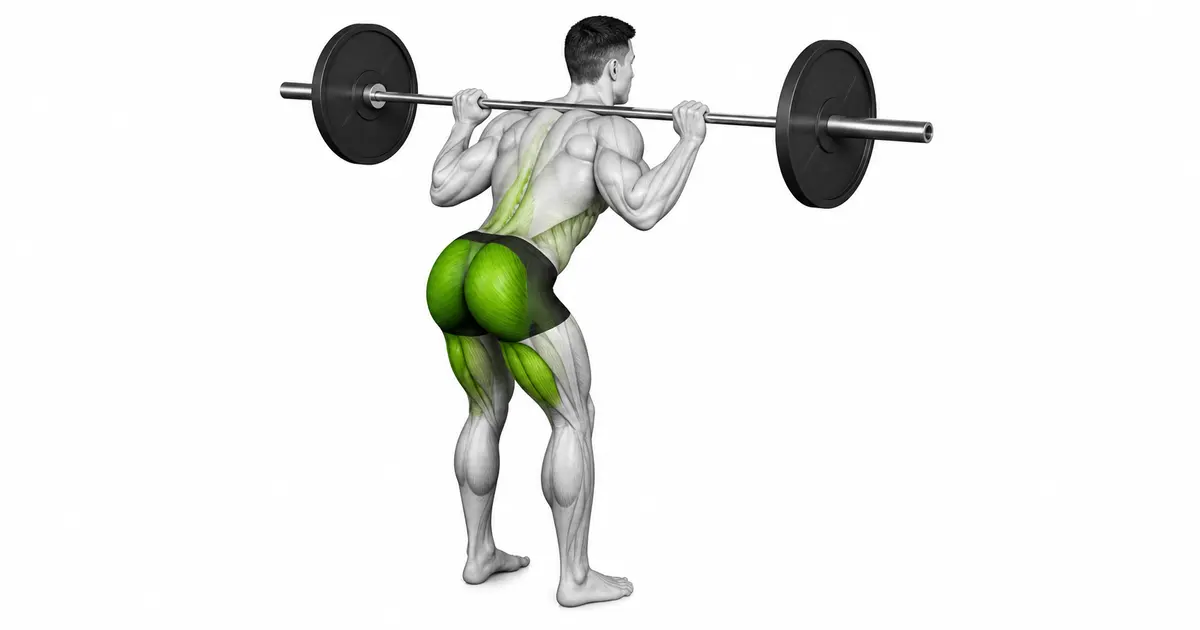
Good morning is not a bending exercise, but a hip hinge that moves your buttocks backwards.
The good morning in the video is a barbell hip hinge that fixes a barbell on the upper back and then sends the hips back without significantly changing the knee angle. 3D motion analysis studies have shown that the Good Morning involves much less knee bending than the Deadlift and creates larger moments in the hip and lower back regions within a similar torso movement. Additionally, a study of men with training experience showed that as the weight increased, the electromyographic activity of the hamstrings and erector spinae tended to increase. However, because these results are short-term biomechanical data measured in a small number of trained participants and at specific loads, they do not directly determine safe depths or long-term muscle growth effects for everyone.
- Primary muscles
- Hamstrings, gluteus maximus
- Secondary muscles
- Erector spinae, adductors, core
- Difficulty
- Intermediate
- Movement type
- Hip hinge/hip extension
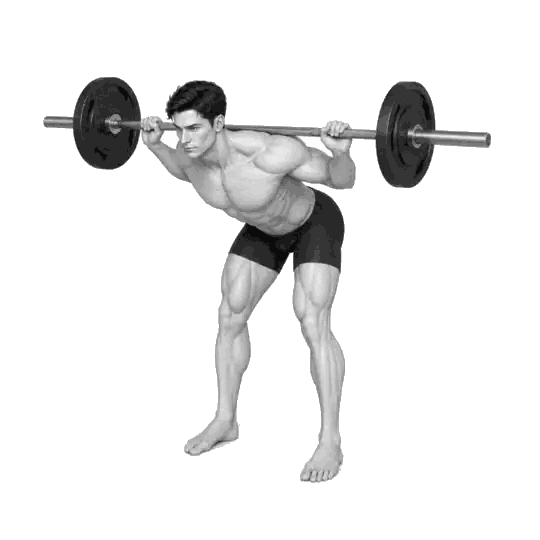
What is the difference between Good Morning and Romanian Deadlift?
Both are hip hinges that relatively maintain the knee angle, but the load location is different. In the Good Morning, the barbell is placed on the upper back and tilted along with the torso, and in the Romanian Deadlift, the barbell is held in the hands and lowered close to the legs. Studies comparing Good Morning and Deadlifts also showed different movements and moments at lower body joints, so don't just apply the same weight or depth.
STEP BY STEP
5 Steps for One Complete Rep
- 1
Fit the rack and safety bar first
Set the rack so that the barbell is at height between your chest and shoulders, with the safety bar slightly lower than the lowest barbell height you expect. Use a disc clamp and have an assistant when you are new to it or when the weights are heavy.
- 2
Secure the barbell to your upper back, not your neck.
Go under the bar and rest the bar on your upper trapezius or back shoulders. Rather than placing it directly on your cervical spine, pull the bar with both hands and hold it close to your back, then stand up with both feet and take one or two steps backwards.
- 3
Determining foot and knee angles
Place your feet about shoulder-width apart from your hips and distribute the pressure across the soles of your feet. Bend your knees slightly without locking them, and make sure the angle doesn't change much during the repetition.
- 4
Take a deep breath and push your hips back
Tighten your stomach so that your ribs and pelvis do not spread out, and then send your buttocks toward the back wall. Lower your torso and the barbell forward for 2–3 seconds, keeping your shins almost erect.
- 5
Change direction at controllable depth
Stop when there is sufficient hamstring tension and just before your lower back or pelvic alignment changes. Press the entire sole of your foot into the floor and bring your hips forward to rise, preparing for the next repetition without arching your back at the top.
BAR & RACK SETUP
Hold the barbell firmly on your upper back so it does not move away from your body.
Good Morning has the barbell positioned higher behind the body, so the more the torso is tilted, the greater the external moment around the hip joints and lower back. If the bar rolls towards your neck or floats off your back, your leverage and balance can suddenly change. Rather than supporting the bar with your wrists like you would with a bench press, place it on a stable rack above your back and pull it toward your body with both hands.
Don't take multiple steps outside the rack. Take just one or two steps back from the safety bar, align your feet, and after completing the set, make sure the barbell has reached the hook and put it down. Even if you test the height of the safety bar at the lowest point, even with an empty barbell, you can reduce the risk of having to straighten your back when you fail.
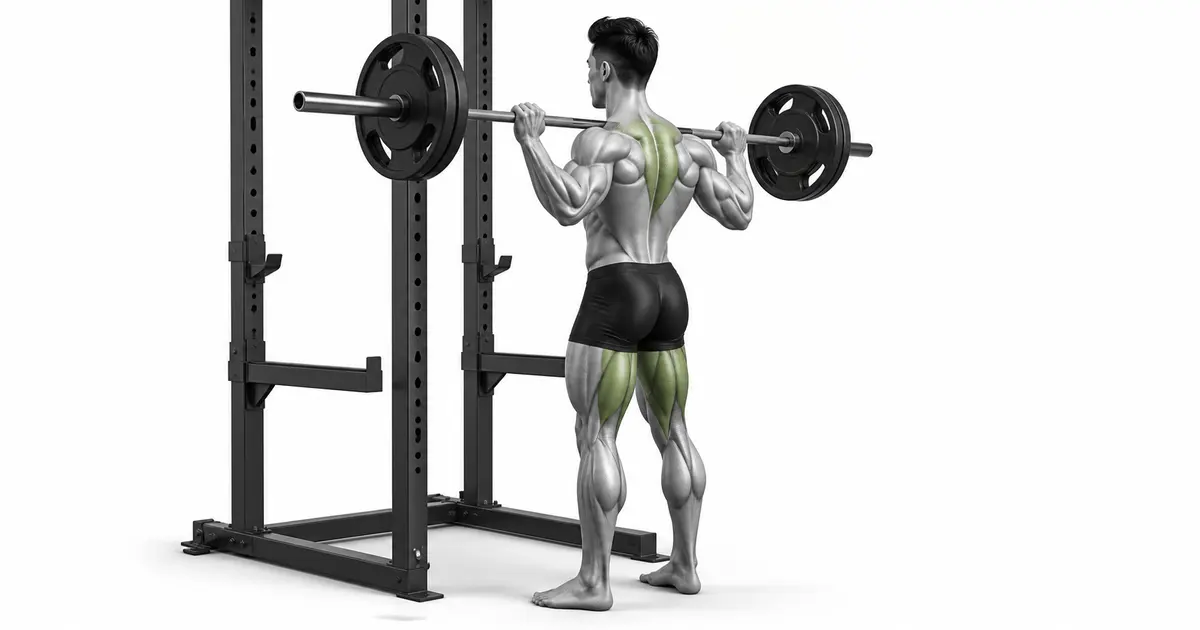
Key point: Check before setting: Is there no pressure on your cervical spine, and is the barbell not rolling over your upper back when you use your hands lightly?
HIP HINGE
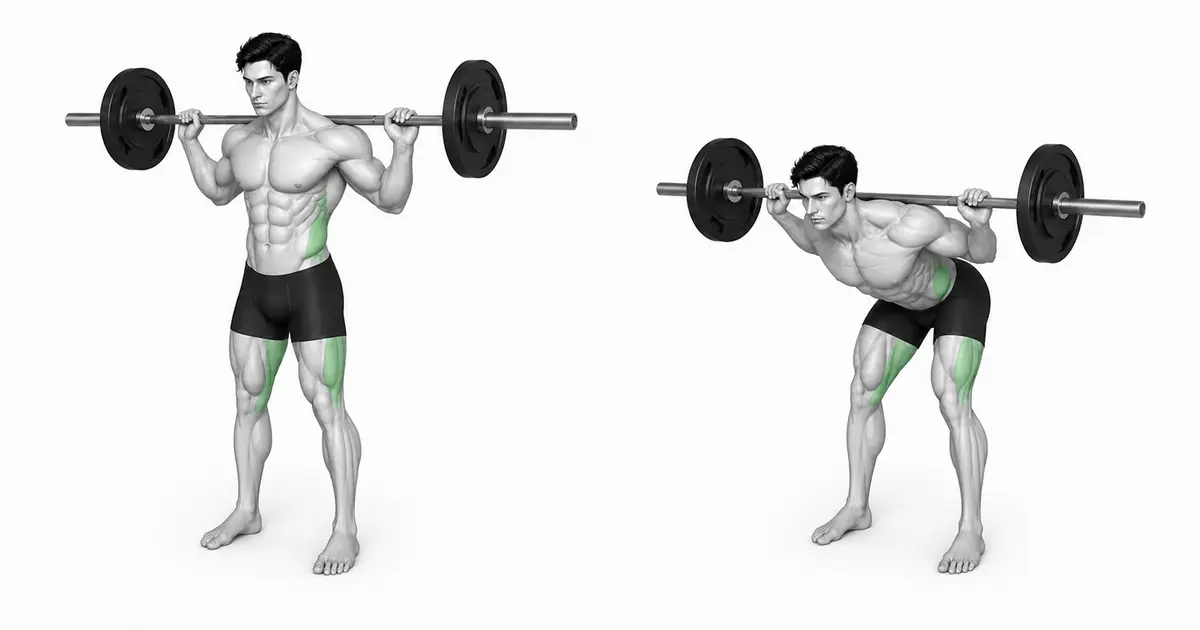
Instead of bending your knees further, your hips should move further back.
In a study comparing Good Morning and Deadlift, Good Morning's maximum knee flexion averaged about 5 degrees, while Deadlift's exceeded about 100 degrees. Although there is no need to replicate the exact angles in the study for each individual, it is clear that Good Morning is not a movement that pushes the knees forward like a squat, but rather a hip hinge with a relatively constant knee angle.
Send your hips back with both your toes and heels pressed into the floor. When viewed from the side, your shins should be almost vertical and the barbell should not be too far above the middle of your feet. If your center of gravity shifts to your toes or your heels rise, stop the movement and lower the weight before going further down.
DEPTH & TRUNK CONTROL
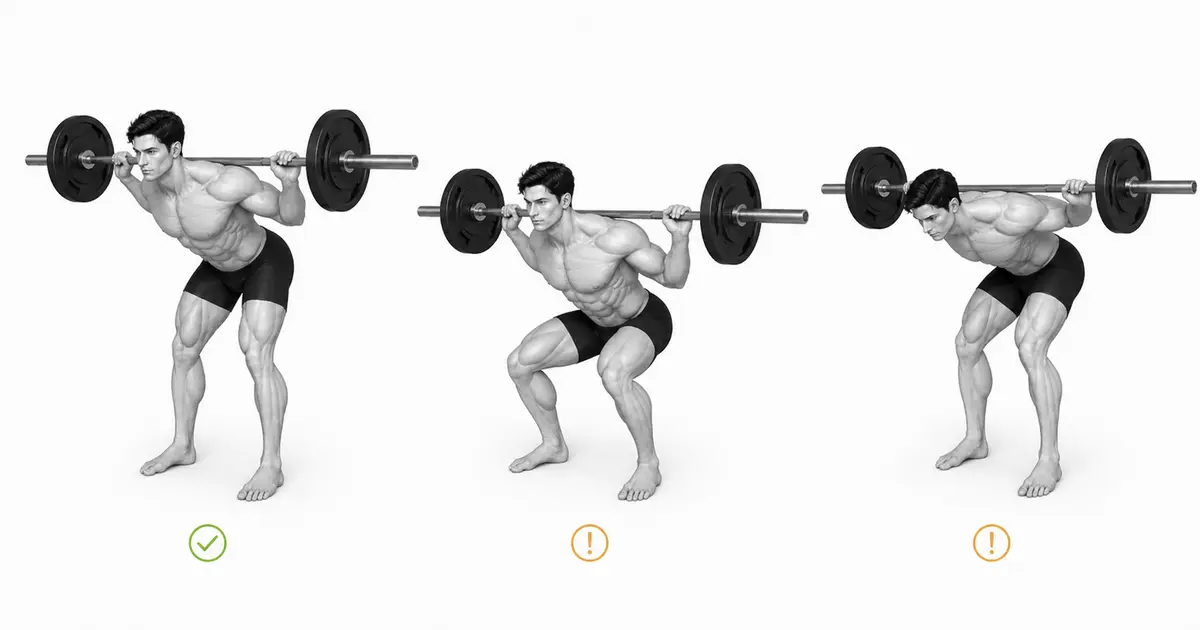
Depth of control of the pelvis and lower back is more important than keeping the torso parallel to the floor.
In the study, it was observed that the hamstrings and erector spinae both receive high demands during Good Morning performance, and that the electromyographic activity of both muscle groups tends to increase as the load increases. At the same time, under heavy loads, knee flexion increased and estimated hamstring length decreased. So heavier weights don’t necessarily mean deeper hip hinge or greater hamstring stretch.
Depth will vary depending on body type, hamstring mobility, bar position and current load. As you go down, if your pelvis rolls and your back begins to round, or if your lower back starts to bend as you raise your neck to look straight ahead, the current end range is just before that. Move your gaze toward the floor along with your torso and maintain a long line from your head to your hips.
TROUBLESHOOTING
Fix the cause of a mistake, not just its appearance
Bend round from the waist
- What you see
- As you go down, your pelvis rolls, the curve of your back and lower back suddenly increases, and the barbell rolls toward your neck.
- Likely cause
- The hip hinge range of motion has been exceeded, or the abdominal pressure and barbell fixation on the back have been loosened.
- How to correct it
- Reduce the weight and depth and practice a hip-first backward movement pattern with a bar hip hinge. Take a side view and stop just before the relationship between the pelvis and ribs changes.
Bring your knees forward like a squat
- What you see
- The hips are lower than the back, the knees are greatly bent, and the torso is relatively erect.
- Likely cause
- You may not be able to create space and balance for your hips to move back, or you may be using a barbell that is too heavy.
- How to correct it
- Think about touching the back wall with your buttocks and keep your shins almost erect. Start again with an empty barbell or bands.
fully lock your knees
- What you see
- The backs of the knees are pulled excessively, the pelvis rolls prematurely, and even the slightest shaking causes loss of balance.
- Likely cause
- I think straightening your legs is more effective for your hamstrings.
- How to correct it
- Gently unlock your knees and maintain that angle. Use only pain-free hamstring tension.
Place the barbell above your neck
- What you see
- You will feel pressure directly on your cervical spine and the bar will roll towards your head as you go down.
- Likely cause
- Failure to achieve upper back shelf or unstable hand and barbell position.
- How to correct it
- Place the bar back on your upper traps or back shoulders and pull it against your back with your hands. If you experience neck pain or numbness, stop the set immediately.
Excessive arching of the lower back at the top
- What you see
- After standing up, the hips are pushed forward, the ribs are lifted, and the front and back of the lower back is compressed.
- Likely cause
- I think the repetition is complete when you lean back further even after completing hip extension.
- How to correct it
- Stop at the point where your head, ribs, and pelvis are stacked vertically. Squeeze your buttocks, but don't let your torso roll back.
Starting too heavy without safety devices
- What you see
- You can't control the speed of your descent and have no room to return the barbell to the rack.
- Likely cause
- Good mornings are judged by weight, like squats or deadlifts.
- How to correct it
- Start with an empty bar and perform inside the safety bar. Increase in small increments only when all repetitions have the same speed and depth.
REGRESSION & PROGRESSION
Match the difficulty before adding load
Wall touch bare body hip hinge
Stand with your back to the wall and touch the wall with your buttocks, keeping your knees almost at an angle. Learn foot pressure and pelvic movement first.
Rod 3 point hip hinge
Hold the bar against your head, upper back, and buttocks, maintain the three points of contact, and bend down to check for changes in torso alignment.
band good morning
Step on the band with your feet and hang it on your upper back, not your neck, to practice hip hinge and rising path with light resistance.
empty barbell good morning
In the power rack and safety bar, perform the same posture as shown in the video 8–12 times at a constant speed.
2 second pause barbell good morning
Pause for a second or two at the bottom where you can maintain alignment, then stand up. Make small increases only when all repetitions are the same.
BEGINNER PROGRAM
A practical starting framework
Good Morning is an assisted hip hinge that places high demands on not only the hamstrings and glutes, but also the erector spinae muscles that support the torso. Place it in the middle of your lower body or back exercise with a weight lighter than squats or deadlifts, and start 1–2 times a week considering back fatigue that will remain until the next day.
number
Episodes 6–12
Weight with 2–4 reps to spare
set
2–4 sets
2–3 minutes recovery between sets
speed
2–3 seconds descent, controlled ascent
Same depth every repetition without recoil
- Before your first work set, check your rack height, safety bar and current range of motion with an empty barbell.
- Even if you achieve the top of your target reps, only increase in the smallest increments if your back alignment, knee angles and barbell position are the same for all reps.
- On the same day as squats and deadlifts, add up the entire posterior chain fatigue, and if your lower back tires first, do a good morning set or reduce the load.
Frequently asked questions
Should your torso be lowered until it is parallel to the floor?
no. Any point where you can maintain balance on the soles of your feet and alignment of your back and pelvis while feeling hamstring tension is sufficient. Change direction just before your pelvis rolls or your back arches.
Should my knees be fully extended?
Rather than locking it completely, it is better to set a slightly bent state and not change it significantly during repetitions. Sitting down with your knees bent too much creates a squat pattern, while locking them completely can increase discomfort and balance issues.
Is it wrong to put pressure on your lower back?
The erector spinae muscles support the torso, so they can become fatigued. However, if you feel a sharp pain in a specific area, a stiffness in your back that increases with each repetition, or a numbness that spreads to your legs, do not treat it as normal muscle fatigue and stop immediately.
How heavy should it be?
Start with an empty barbell or very light weight and choose a load that allows you to lower both the speed and depth for 6–12 reps with 2–4 reps to spare. Research has also shown that performance strategies such as knee movements as well as muscle activity change with increasing weight, so increasing the weight alone is not the goal.
Evidence and references
- 1. Schellenberg et al. — Comparison of kinematics and joint moments between Good Morning and Deadlift
- 2. Schellenberg et al. — Comparison of lower extremity strength estimates for Good Morning, Deadlift, and Split Squat.
- 3. Vigotsky et al. — Good Morning Joint movement and hamstring/erector spinae electromyography according to weight change