HYPEREXTENSION
Hyperextensions are a key strengthening exercise for simultaneously building lumbar stability and posterior chain strength
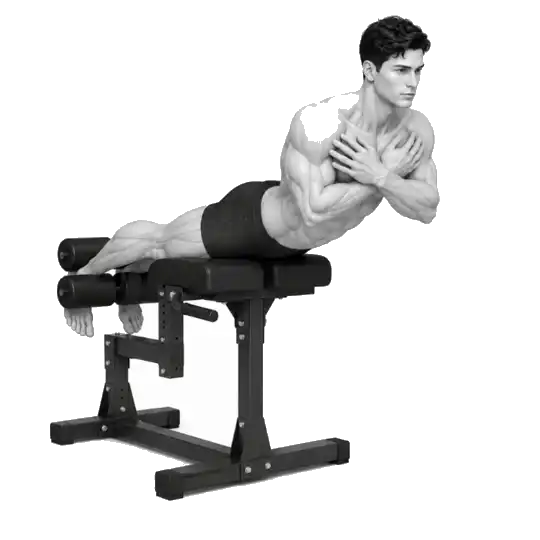
Hyperextensions (also known as back extensions) use a Roman chair or dedicated bench to strengthen the lower back (erector spinae) and buttocks (gluteus maximus) through trunk flexion and extension. While highly beneficial for back health when performed with proper spinal alignment, over-arching or using poor form can lead to injury. It is a flexible exercise where you can choose to focus on the lumbar erectors or the glutes and hamstrings by adjusting the pad height and torso angle.
- Primary muscles
- Erector Spinae · Gluteus Maximus
- Secondary muscles
- Hamstrings
- Difficulty
- Beginner
- Movement type
- Spinal and Hip Extension
Is this a back or glute exercise?
It is both. If you lock your spine and move only at the hips, it targets glutes and hamstrings. If you articulate your spine, it targets the erector spinae.
STEP BY STEP
4 Steps for One Complete Rep
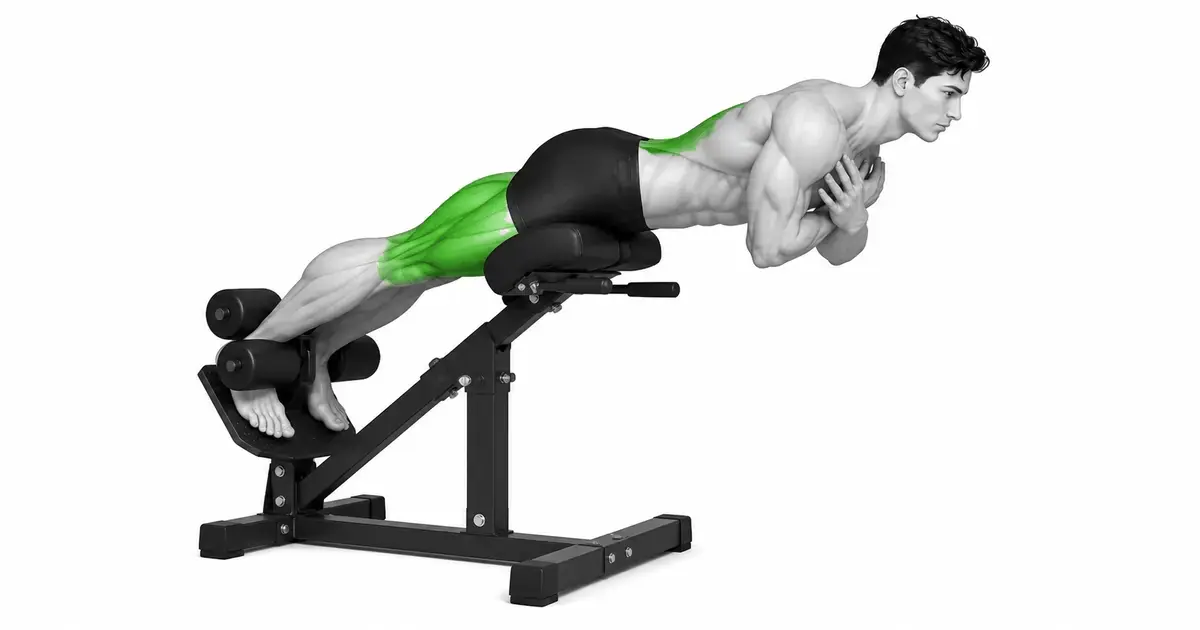
- 1
Adjust pads and position yourself
Adjust the height so the top of the pads is just below your hip bones. Secure your feet on the plate with your Achilles tendons against the rear pads.
- 2
Lower the torso (eccentric phase)
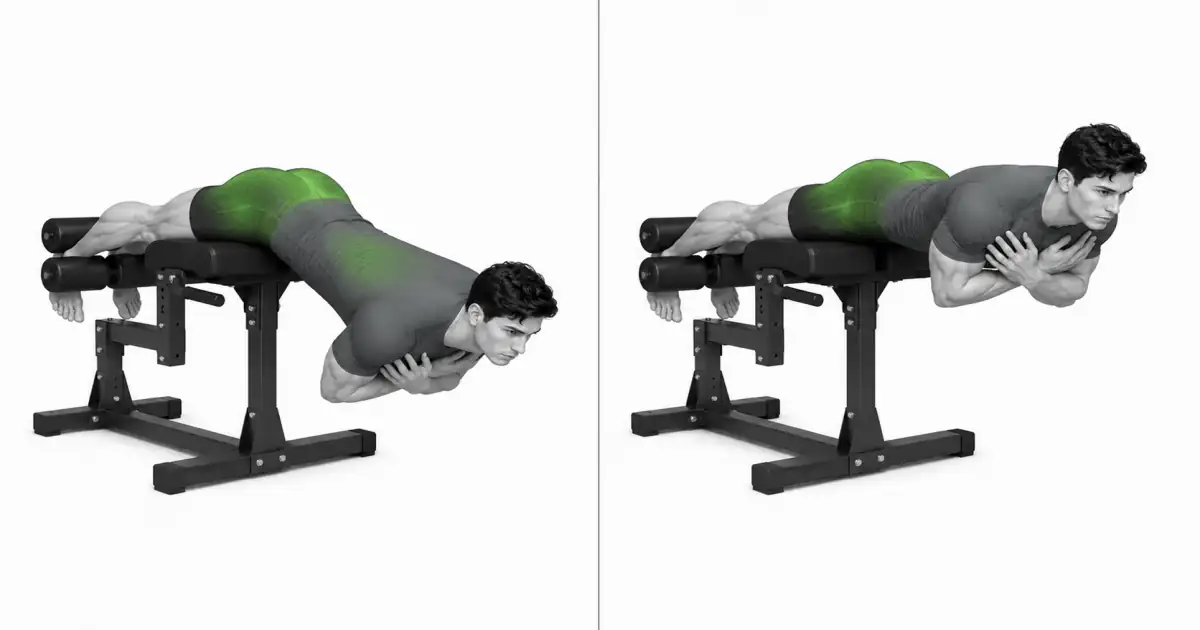
Slowly lower your upper body by hinging at the hips while keeping your back straight. Only descend as far as you can without rounding your back.
- 3
Raise the torso (concentric phase)
Use your lower back and glutes to lift your torso until your body forms a straight line from head to heels.
- 4
Hold and contract
Pause for one second at the top to feel the peak contraction before slowly lowering back down.
BACK VS GLUTE FOCUS
Targeting Strategies
You can shift the primary focus of hyperextensions based on your setup. To emphasize the lower back, set the pads slightly lower than the hips and utilize spinal flexion and extension. To emphasize the glutes, set the pads at hip height, slightly round your upper back (tuck your chin) to reduce spinal involvement, and move solely through the hip joint.
Despite the name 'hyperextension,' you should actually avoid true hyperextension (arching past a straight line). Arching the back excessively beyond neutral creates significant shear force on the lumbar spine, which can lead to disc injuries. Always aim to stop when your body forms a 'straight line'.
RANGE, LOAD & TEMPO
Choose a range and load that keep the Hyperextension repeatable
The useful range of motion ends before your torso or working joints have to change position to move the load. Keep the erector spinae · gluteus maximus producing the movement while the hamstrings support the same alignment from the first repetition to the last.
Use a controlled lowering phase of about two to three seconds and avoid bouncing through the transition. If the final repetitions become shorter, faster, or visibly different from the first, reduce the load or stop the set before technique breaks down.
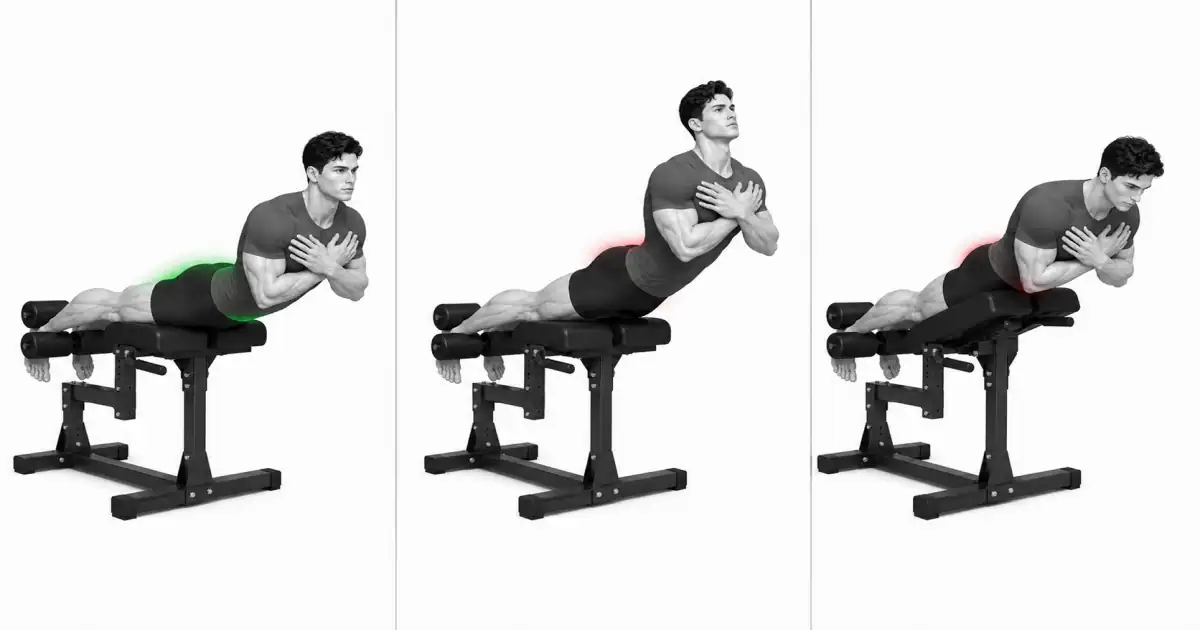
Key point: Progress the Hyperextension only after every repetition follows the same path without joint pain.
TROUBLESHOOTING
Fix the cause of a mistake, not just its appearance
Excessive arching
- What you see
- Arching the back into a 'C' shape past the neutral straight line.
- Likely cause
- Misguided attempt to achieve a stronger contraction.
- How to correct it
- Use a mirror to practice stopping exactly when your body is straight from head to heels.
Rounding the back
- What you see
- Slumping or hunching the back during the descent or ascent.
- Likely cause
- Weak erector spinae or limited hip mobility.
- How to correct it
- Focus on keeping your chest up and eyes fixed on the floor slightly ahead to maintain a neutral spine.
REGRESSION & PROGRESSION
Match the difficulty before adding load
Holding a weight plate
Hold a weight plate against your chest to increase resistance once bodyweight reps are easy.
Overhead Extension
Extend your arms above your head or hold a barbell across your shoulders to lengthen the moment arm and improve intensity.
BEGINNER PROGRAM
A practical starting framework
Hyperextensions are essential for building a resilient lower back. Perform them smoothly at a controlled speed.
Frequency
2-3 times per week
Suitable as an accessory movement for back or lower body sessions.
Volume
3 sets of 12-15 reps
Prioritize muscular endurance and stability over heavy weights.
- Do not use momentum to swing your body up.
- Keep your neck neutral by not looking too far forward.
- A tempo of 3 seconds down and 2 seconds up is recommended.
Frequently asked questions
What about the inverted version hanging upside down?
Inverted extensions provide spinal traction which can help decompress discs, but they should be avoided by those with high blood pressure or high intraocular pressure.