PULL-UP
A pull-up is not an exercise where you hang your chin on a bar, but rather a vertical pull that lifts your entire body without shaking.
Pull-ups are an exercise in which you lift your body while hanging on a bar with an overhand grip with the backs of your hands facing your face, as shown in the video. Not only the lats, but also the biceps brachii, lower trapezius, and rotator cuff work together, and the key is to pull the elbow down while controlling the shoulder and torso rather than starting with arm strength alone. Differences in muscle activity between pull-ups and chin-ups occur in some muscles, but no one grip is absolutely superior to all. Prioritize a pain-free grip and repeatable range of motion.
- Primary muscles
- Latissimus dorsi, biceps brachii
- Secondary muscles
- Lower trapezius, rhomboids, rotator cuff, core
- Difficulty
- Intermediate
- Movement type
- Vertical pulls/body weight exercises
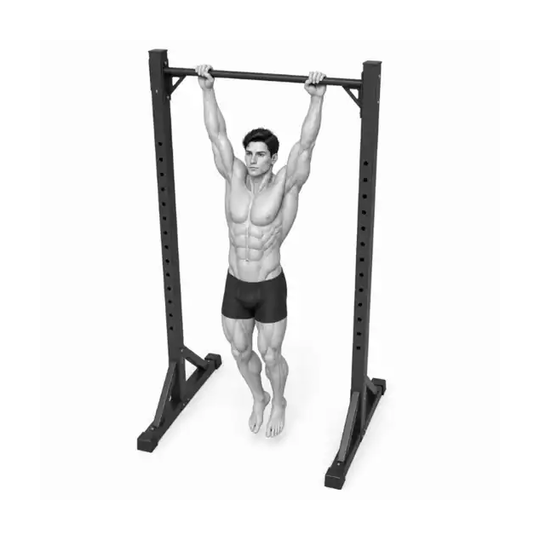
Does your chin have to be above the bar?
You can use it as a general repeat basis, but don't just stick your neck out and pass it on. Bring your elbows down so your upper chest is closer to the bar and your shoulders are in a comfortable range.
STEP BY STEP
5 Steps for One Complete Rep
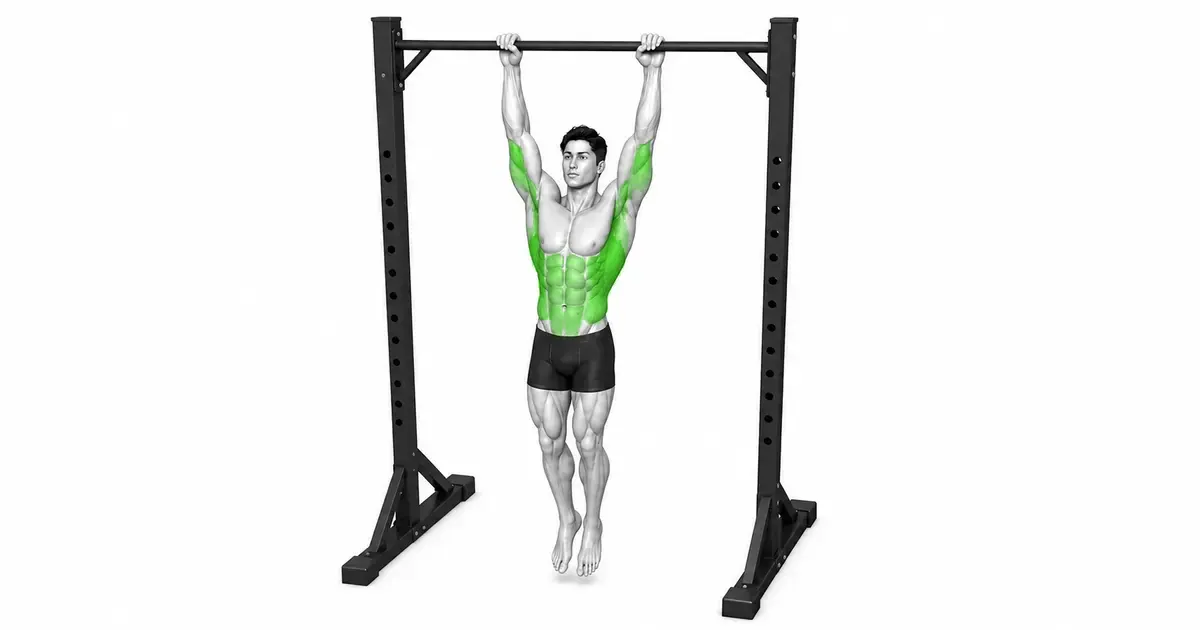
- 1
Check the iron bar and surrounding space
Make sure the iron bar is securely fastened and remove any objects underneath. If you can barely reach a height by jumping, use stable footing to climb up and be prepared to control the descent.
- 2
Grab a closed grip slightly wider than your shoulders
With your palms facing forward, hold it slightly wider than shoulder width. Wrap your thumbs around the bar and keep your wrists neutral. An overly wide grip can reduce range of motion and make some shoulder movements unfavorable.
- 3
Align and hang your torso
Keep your arms almost straight, your ribs and pelvis stacked, and your legs still. Instead of forcing your shoulders all the way down from your ears, leave room for your shoulder blades to move naturally within a pain-free range.
- 4
Raise your body by pulling your elbows down
Exhale and lower your elbows toward the floor and sides. Send your chest toward the bar, without arching your back or kicking your legs, and maintain the same torso alignment until your chin passes the height of the bar.
- 5
Control it all the way down
Instead of just craning your neck past your chin, briefly balance at the top. Lower for 2–3 seconds and return to the controlled starting position with your arms almost straight, stopping at a comfortable range if your shoulders feel sore.
STRICT PATH
The ribs and pelvis must overlap to prevent the pulling force from leaking out due to shaking.
In strict pull-ups, you move your torso and lower body as one mass without kicking your legs or arching your back. In the kipping pull-up study, hip/knee movement and core/lower body involvement significantly increased, while biceps involvement decreased, so it would be more accurate to view kipping as a different technique rather than simply a faster version of the strict pull-up.
Lightly tighten your abdomen and buttocks and place your feet directly under or slightly in front of your body. If your legs shake back and forth as you go up, reduce the number of repetitions or use an auxiliary band or assist machine.
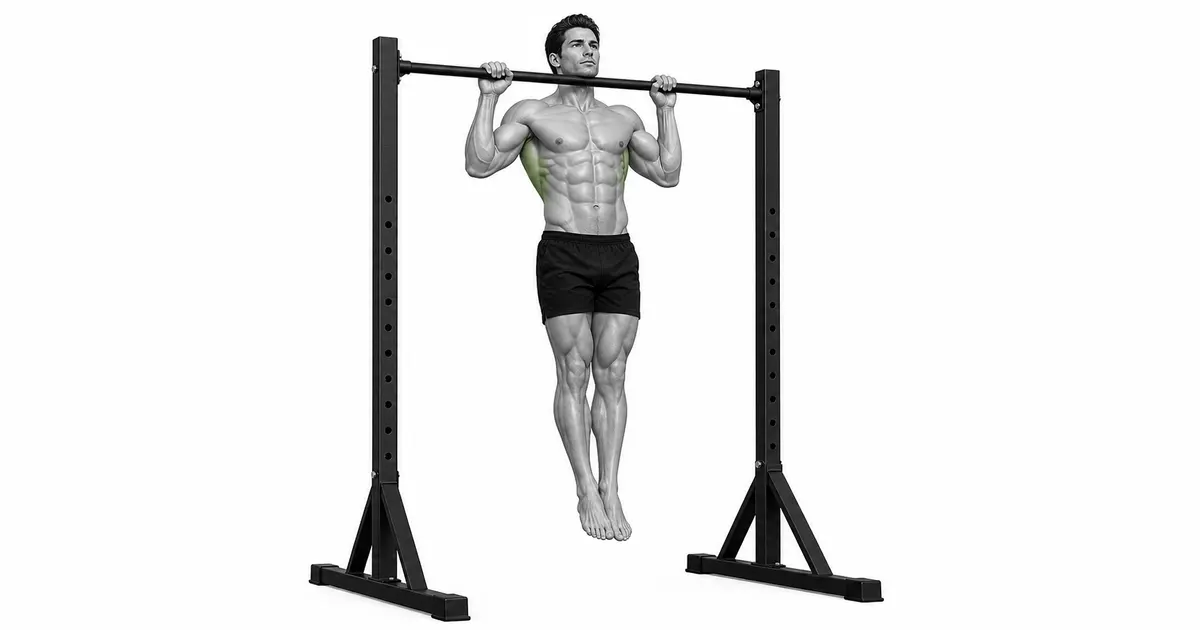
Key point: Cue to try right away: “Torso in one piece, elbows on the floor.”
GRIP & SCAPULA
Holding it wide does not automatically improve your lat muscles.
In a study comparing pull-up techniques, shoulder and upper arm movement patterns that were linked to the risk of shoulder impingement were observed in wide grip and reverse grip. Rather than just looking at muscle activity and spreading your hands as much as possible, a good starting point is to secure a comfortable range of motion with an overhand grip slightly wider than your shoulders.
Do not fully secure the shoulder blades at the bottom. As your arms rise, your shoulder blades should rotate upward as well. Just make sure to re-establish your torso tension and grip before the next repetition to avoid having your shoulders suddenly rise up to your ears or your body going limp.
RANGE OF MOTION
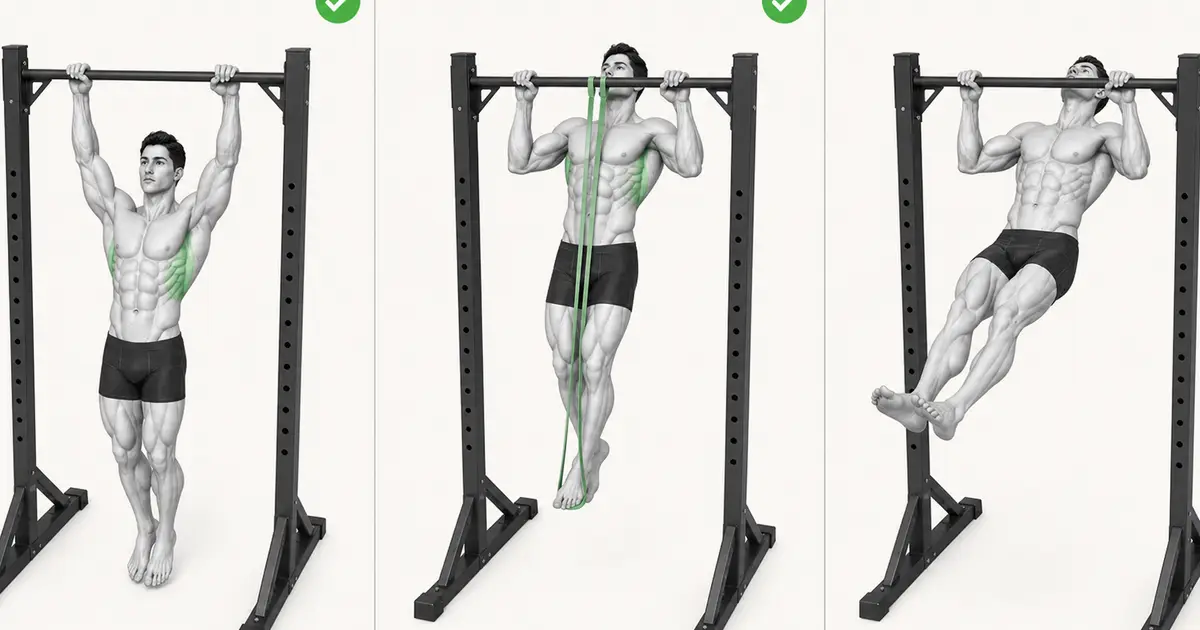
It is based on the range of control of the shoulders and torso rather than the chin.
If you only stick out your neck and roll your shoulders forward while trying to get your chin over the bar, your actual pulling range will not increase. At the top, your elbows should drop toward your torso, your chest close to the bar, and your neck should remain long.
The bottom is where the elbows are almost straight and the shoulder blades are naturally raised. If full suspension is uncomfortable for your shoulders, start in a pain-free range and increase gradually. The priority is not to fall off between repetitions.
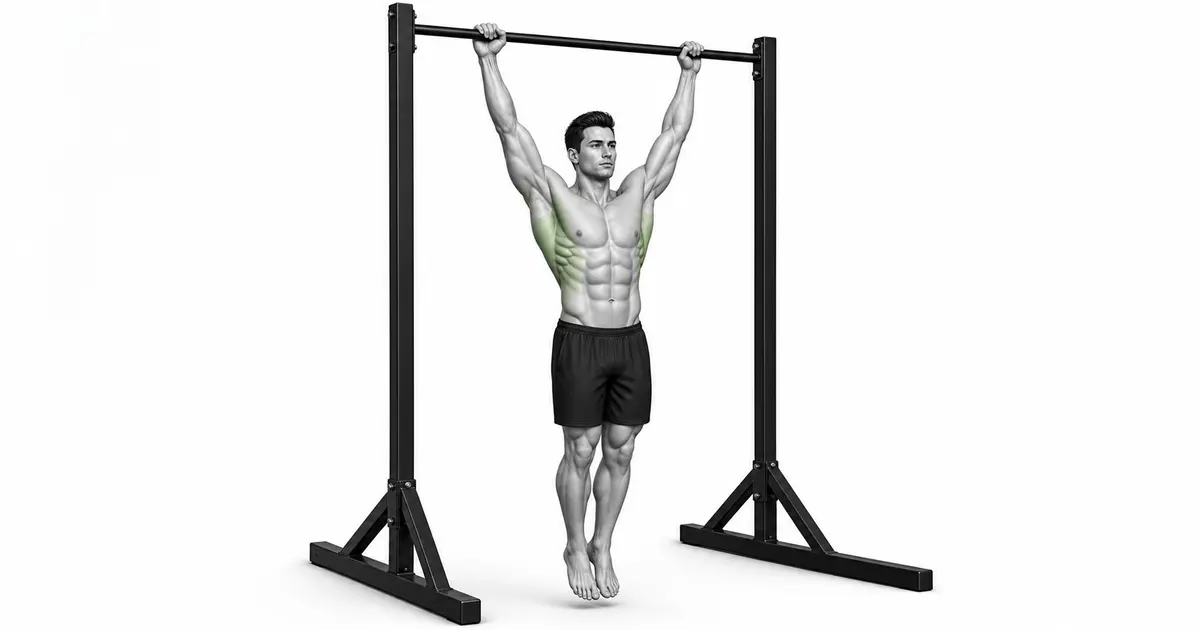
TROUBLESHOOTING
Fix the cause of a mistake, not just its appearance
Kicking your legs and shaking your body loudly
- What you see
- With each repetition, your knees and hips move back and forth and your chin passes the bar by inertia.
- Likely cause
- You find it difficult to complete strict repetitions at your current weight, or you prioritize speed.
- How to correct it
- Finish the rep and increase the intensity of your assistance. Start again on the same path with your ribs and pelvis stacked.
Lift your neck and send your chin over the bar.
- What you see
- At the top, your chin is lifted forward and your shoulders remain under the bar.
- Likely cause
- Only chin passage was used as a repetition criterion and the actual pulling range was reduced.
- How to correct it
- Keep your gaze straight ahead or slightly up, and pull your elbows down to bring your upper chest closer to the bar.
Grip is too wide
- What you see
- The range of motion of the elbow is short and the front and upper part of the shoulder is pressed or uncomfortable.
- Likely cause
- I thought the wider it was, the better it was for my lats.
- How to correct it
- Narrow your hands to a position slightly wider than your shoulders and ensure full, pain-free range.
letting go of the descent
- What you see
- At the top, your body drops straight away, and at the bottom, your shoulders are pulled up sharply.
- Likely cause
- Either you only think of the ascent as a repetition or your grip and back muscles are already tired.
- How to correct it
- End the set at a point where a 2–3 second descent becomes impossible and use assistance.
Stepping unsteadily on the band
- What you see
- The band is hanging in a position where it could slip off your foot or towards your face.
- Likely cause
- The condition of the band and the location of the fixation have not been checked.
- How to correct it
- Hook a non-damaging band securely to the center of the bar and place one foot on a stable footing. If you feel anxious, use an assist machine.
REGRESSION & PROGRESSION
Match the difficulty before adding load
Lat pulldown
Master vertical pulls and elbow paths with adjustable weights.
Shoulder pull-ups
Practice shoulder and torso control in a small range with your elbows straight.
Band/machine assisted pull-ups
Lower your weight just enough to perform 6–10 reps without kicking back.
negative pull up
Climb to the top with a footrest and then come down under control for 3–5 seconds.
strict pull up
Increase the number of repetitions while maintaining the same bottom and top criteria.
BEGINNER PROGRAM
A practical starting framework
Practice 2–3 times a week, with at least a day of recovery between sessions. Rather than rocking and repeating until just before failure, it is easier to maintain the technique by adjusting the intensity of assistance with 1–2 reps to spare.
number
4–8 times
Strict position or use of assistance as needed
set
3–5 sets
2–3 minutes recovery between sets
speed
2–3 second descent
Return to the same starting point without recoil
- If you maintain bottom/top baseline and torso alignment for every set, add one repetition to the next session.
- After reaching the top of your target repetitions, weaken the assist band one level or reduce the assist weight slightly.
- If you have to kick your legs or crane your neck to go up, finish the set instead of adding more repetitions.
Frequently asked questions
Which is better, pull-ups or chin-ups?
It depends on your goals and joint comfort. The study showed higher biceps brachii and pectoralis major activity in chin-ups and lower trapezius in pull-ups, but the lats were heavily involved in both movements. There is no need to view one thing as absolutely superior.
What should I do first if I can’t do even one?
Use lat pulldowns, shoulder pullups, assisted pullups and 3–5 second negatives. Once 6–10 controlled assisted repetitions are possible, it is practical to gradually taper off the assistance.
Should I keep pressing my shoulders down when hanging?
no. As the arm rises, the shoulder blade should naturally rotate upward and rise. Make sure your body doesn't go completely limp, but don't force your shoulders down.
Evidence and references
- 1. Youdas et al. — Comparison of muscle activity and elbow movement of pull-ups and chin-ups
- 2. Prinold·Bull — Shoulder movement and risk of shoulder impingement by pull-up technique
- 3. Doma et al. — Comparison of kinematics and muscle activity between chin-ups and lat pulldowns
- 4. Dinunzio et al. — Differences in movement and muscle activity between strict and keeping pull-ups
- 5. Lusk et al. — Grip width, forearm direction, and muscle activity in lat pulldowns