INCLINE DUMBBELL CURL
Incline Dumbbell Curl — improve biceps long-head tension while protecting the shoulder and spine through controlled alignment, tempo, and progressive overload
This guide explains step-by-step setup, rigourous alignment cues, strict movement execution, common technical faults and their corrections, practical progressions, and a two-week microcycle to integrate the Incline Dumbbell Curl into balanced arm development. The exercise shifts the starting line of elbow flexion by placing the shoulder into relative extension on an incline bench, which increases the long-head contribution. Because that pre-stretch increases the potential for passive tension, emphasis on slow eccentrics, strict upper-arm positioning, and limiting shoulder involvement are essential to both effectiveness and safety. Use this guide to learn initial programming, troubleshooting, and how to increase load while minimizing risk.
- Primary muscles
- Biceps brachii (long and short heads), brachialis
- Secondary muscles
- Brachioradialis, forearm wrist flexors, scapular stabilizers (lower traps and rhomboids) and core stabilizers
- Difficulty
- Intermediate
- Movement type
- Single-joint elbow flexion performed from an inclined trunk position to increase long-head emphasis and reduce momentum
Is the incline curl better than regular standing curls for biceps growth?
The incline curl places the long head of the biceps under a greater initial stretch, which changes the mechanical stimulus compared with a standing curl. That does not make it universally better; it is complementary. Use incline curls to target long-head development and standing or preacher curls to target peak contraction and different joint angles. A varied program that includes multiple elbow-flexion angles tends to produce more balanced hypertrophy than any single exercise alone.
STEP BY STEP
4 Steps for One Complete Rep
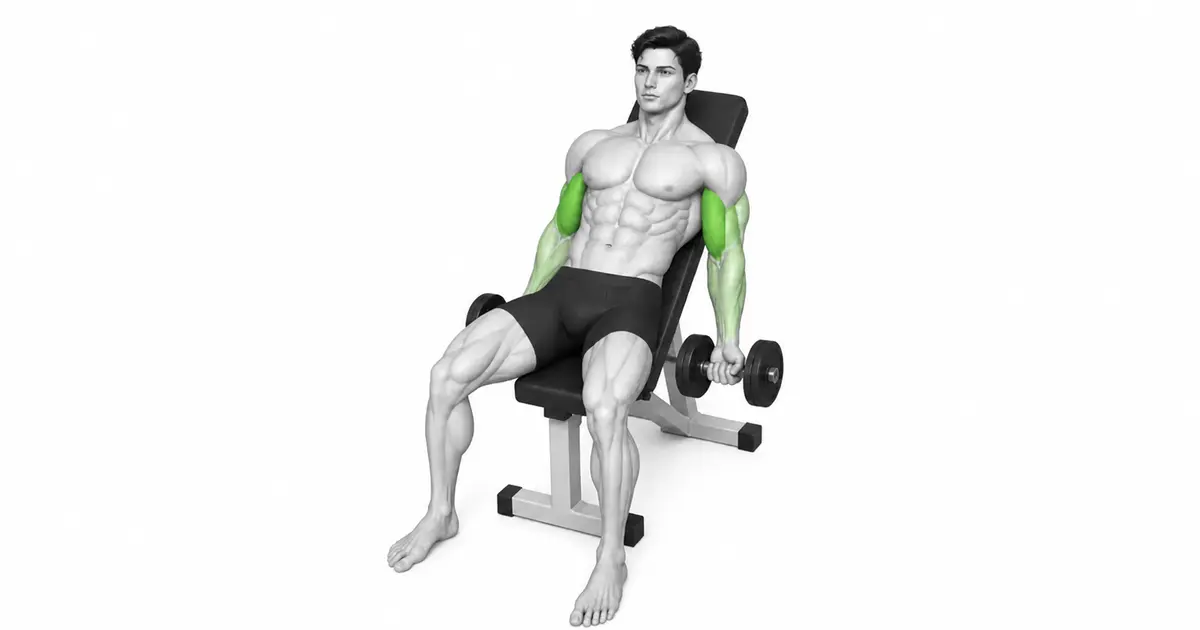
- 1
Seat and brace
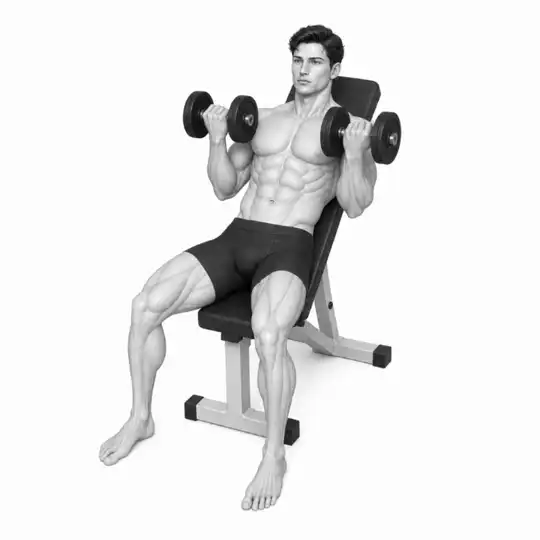
Set the bench to a comfortable incline, usually about 45–60 degrees. Sit with your entire back supported by the pad, feet flat, and pelvis neutral. Let the arms hang beside the bench so the upper arms sit slightly behind the torso. Begin with light dumbbells and a palms-forward or gradually supinating grip that feels comfortable at the wrists.
- 2
Initial position and alignment
Keep the back of your head and torso resting comfortably on the pad without forcing the shoulder blades together. Let the elbows point down and remain slightly behind the torso. Keep the wrists stacked with the forearms and the shoulders away from the ears. The upper arms do not press into the pad; they stay quiet in space while the elbows bend and straighten.
- 3
Curl concentrically with control
Exhale and bend the elbows to curl the dumbbells without lifting the elbows forward. Supinate gradually if comfortable so the palms face more upward near the top. Stop before the shoulders roll forward or the wrists fold back. Keep the torso against the pad and use a smooth, controlled lift rather than accelerating the weights.
- 4
Eccentric return and reset
Lower the dumbbells under control on the eccentric for about 2–3 seconds, fully lengthening the biceps until the elbow reaches near full extension but stops short of joint hyperextension. Keep constant tension by not resting the weights on your thighs or the bench between repetitions. If you need a break, set the dumbbells down and reset posture. Throughout the eccentric, maintain scapular position and a braced core—do not allow the shoulders to protract excessively or the lower back to arch. Reduce range only if you experience anterior shoulder or distal bicep discomfort; when reducing range, emphasize the controlled eccentric portion you can do pain-free.
OPTIMAL FORM
Key technical considerations for an effective and safe Incline Dumbbell Curl
Upper-arm position and shoulder behavior: The defining feature of the incline curl is that the upper arm begins slightly behind the torso while the back is supported. Keep that position generally stable without trying to pin the arm to the bench. If the elbow travels forward as the dumbbell rises, reduce the load or stop the repetition a little earlier. Keep the shoulder blades comfortable against the pad rather than forcing them down and back.
Tempo, tension and eccentric emphasis: For hypertrophy and tendon health, prioritize slow, controlled eccentrics and a deliberate pause at the top of the concentric contraction. A recommended starting tempo is 1 second concentric, 1-second pause at peak, and 2–4 seconds eccentric. This approach increases time under tension while minimizing ballistic movement that transfers load through the shoulder and trunk. Focus on continuous tension: avoid resting the elbows on the bench pad or your legs between reps. If you notice momentum (upper body sway or rapid shoulder extension), reduce the load by 10–20% and repeat with perfect form.
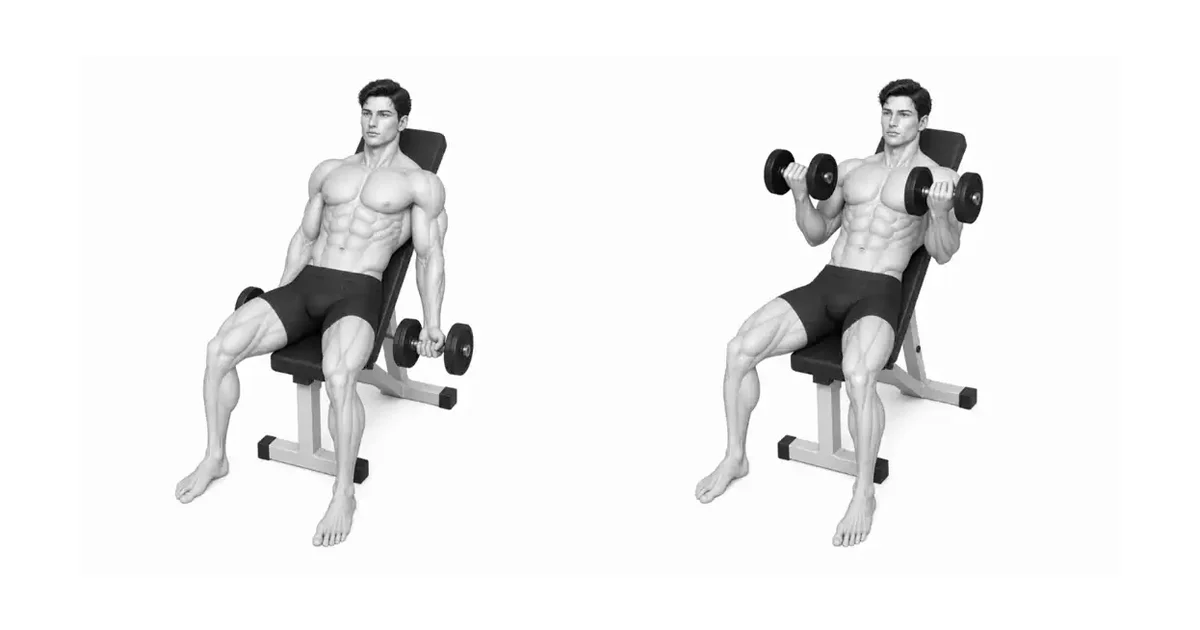
RANGE, LOAD & TEMPO
Choose a range and load that keep the Incline Dumbbell Curl repeatable
The useful range of motion ends before your torso or working joints have to change position to move the load. Keep the biceps brachii (long and short heads), brachialis producing the movement while the brachioradialis, forearm wrist flexors, scapular stabilizers (lower traps and rhomboids) and core stabilizers support the same alignment from the first repetition to the last.
Use a controlled lowering phase of about two to three seconds and avoid bouncing through the transition. If the final repetitions become shorter, faster, or visibly different from the first, reduce the load or stop the set before technique breaks down.
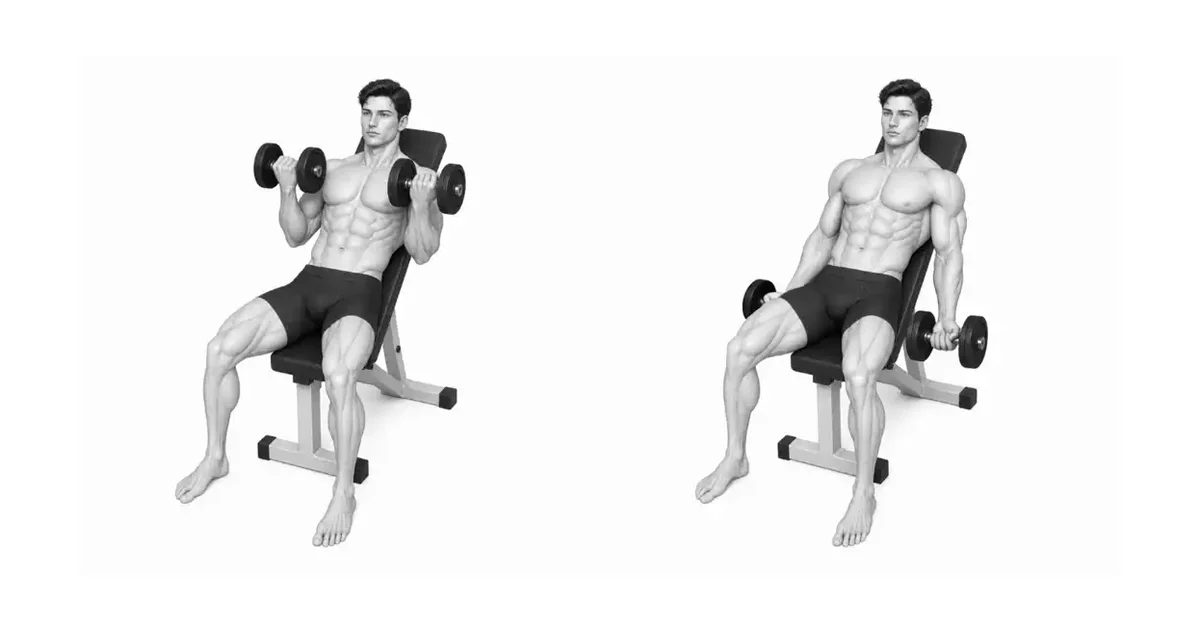
Key point: Progress the Incline Dumbbell Curl only after every repetition follows the same path without joint pain.
TROUBLESHOOTING
Fix the cause of a mistake, not just its appearance
Using trunk momentum (swinging)
- What you see
- The torso or hips rock to help lift the dumbbells; the elbows move forward or the back arches.
- Likely cause
- Load exceeds the capacity to perform isolated elbow flexion at the chosen tempo, or fatigued elbow flexors recruit larger trunk muscles to assist.
- How to correct it
- Reduce the weight, reset your back against the pad, and keep the upper arms quiet beside the torso. Rehearse slower repetitions with a 3–4 second lowering phase. If momentum persists, use one arm at a time with a lighter dumbbell until the position is repeatable.
Partial range and short reps
- What you see
- Repetitions stop short of full elbow extension or avoid lowering to the pre-stretched start; top-range contractions are rushed.
- Likely cause
- Desire to keep tension while using a load that is too heavy, or fatigue leading to avoidance of the least mechanically advantageous positions.
- How to correct it
- Re-establish full, controlled range by lowering the load and consciously feeling the stretch at the start position. Implement a tempo prescription—for example, 1:1:3 (concentric:pause:eccentric)—and limit sets to a rep range you can perform with full range before failure. Use drop-sets or partials only as an advanced, pre-planned technique, not as a correction for poor load selection.
REGRESSION & PROGRESSION
Match the difficulty before adding load
Increase time under tension
Before increasing absolute load, extend the eccentric phase progressively. Add 0.5–1.0 second to the eccentric every 1–2 workouts until you reach a controlled 3–4 second descent. This progression builds tendon resilience and technique fidelity while keeping the joint loading conservative.
Gradual load progression and rep density
Once your form is consistent through full range and slower eccentrics, increase the training stimulus by modestly increasing load (2–5% increments) or by adding additional quality repetitions per set. Alternatively, keep weight constant and increase set density—perform more sets with perfect technique rather than pushing to failure on every set. Track the last two reps of each set: if they are controllable without swinging, you can add 1–2 kg to the dumbbells at your next session.
BEGINNER PROGRAM
A practical starting framework
Programming the Incline Dumbbell Curl should prioritize quality over quantity. Because this movement increases long-head emphasis and places biceps at a more elongated starting position, modest loads performed with control deliver substantial stimulus for hypertrophy without unnecessary shoulder or tendon strain. Integrate the exercise into a weekly plan that balances pulling motions, pressing, and elbow-extension work to maintain structural balance across the arm and shoulder complex.
Frequency
2 times per week
Place the incline curl after compound upper-arm work (for example, after chin-ups or barbell rows) or on a dedicated arm day. Allow 48–72 hours between intense arm sessions to support recovery.
Volume
3–4 sets of 8–12 controlled reps
Choose a load that permits all reps at the prescribed tempo with clean technique. If tempo is extended, you may need to increase reps or reduce weight to maintain total training stimulus.
- Prioritize strict technique over load. If you cannot keep your back supported and your upper arms stable beside the torso without swinging, reduce the weight or repetitions.
- Breathe rhythmically: inhale during the eccentric (lowering) and exhale during the concentric (lifting), avoid breath-holding except for coached maximal efforts where appropriate.
Frequently asked questions
What bench angle should I use?
A backrest angle around 45–60° is a practical starting range. A lower backrest places the upper arm farther behind the torso and may create a stronger stretch, while a more upright position is often easier to control. Choose the angle that lets your back stay supported, your upper arms remain stable beside the torso, and your shoulders move without pain.
Evidence and references
- 1. ExRx.net