JUMP ROPE
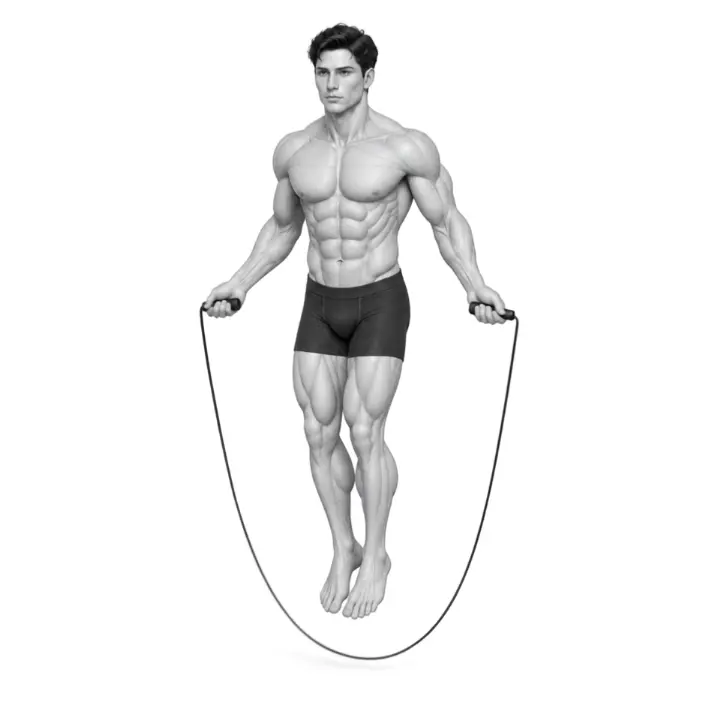
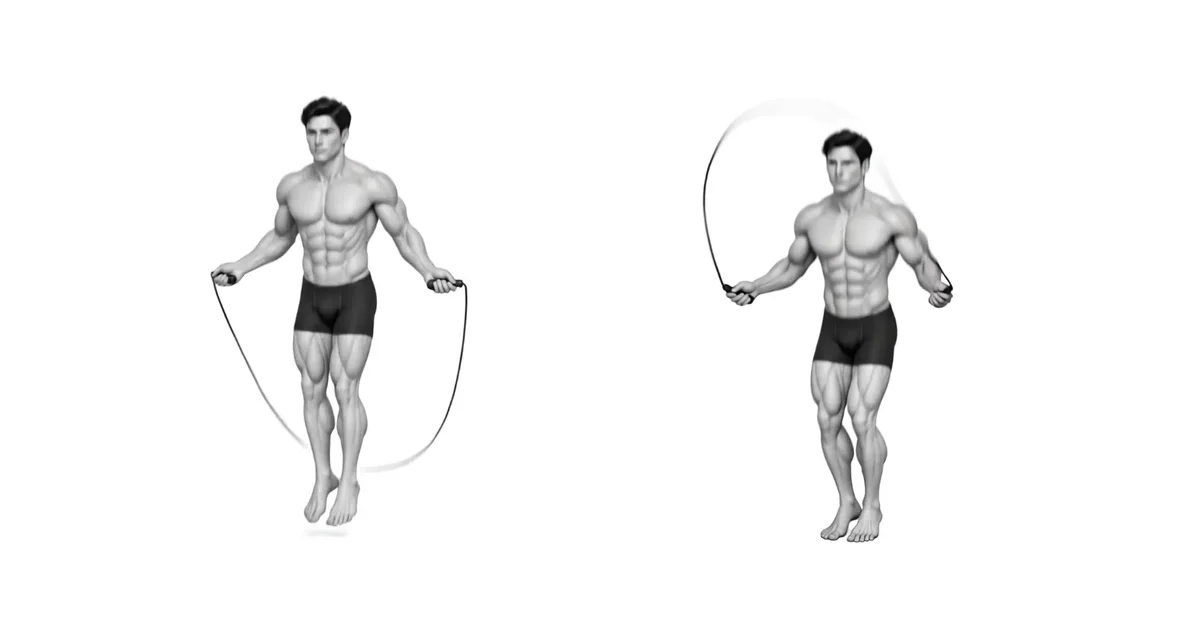
Rope jumping is not an exercise in which you raise your knees high and rotate the rope with your entire arm, but rather a rhythmic exercise in which you rotate the rope with your wrists and jump repeatedly low and quietly on the floor.
Jumping rope trains cardiorespiratory fitness and ankle elasticity in a small space, but jumping high or suddenly performing many reps on a hard floor can quickly put strain on your calves and Achilles tendons. Start with a length that brings the handle near your armpits when you step on the middle of the rope, and learn low pogo jumps and wrist rotations without the rope, then connect them with short sections.
- Primary muscles
- Calf · Quadriceps
- Secondary muscles
- Hamstrings, glutes, forearms, deltoids, core
- Difficulty
- Beginner
- Movement type
- Wrist rotation and repeated two-legged jumps
What is the appropriate line length?
When you step on the center of the rope with one foot, use the length that the handle is approximately near your armpits as an initial standard and adjust it according to your technique.
STEP BY STEP
4 Steps for One Complete Rep
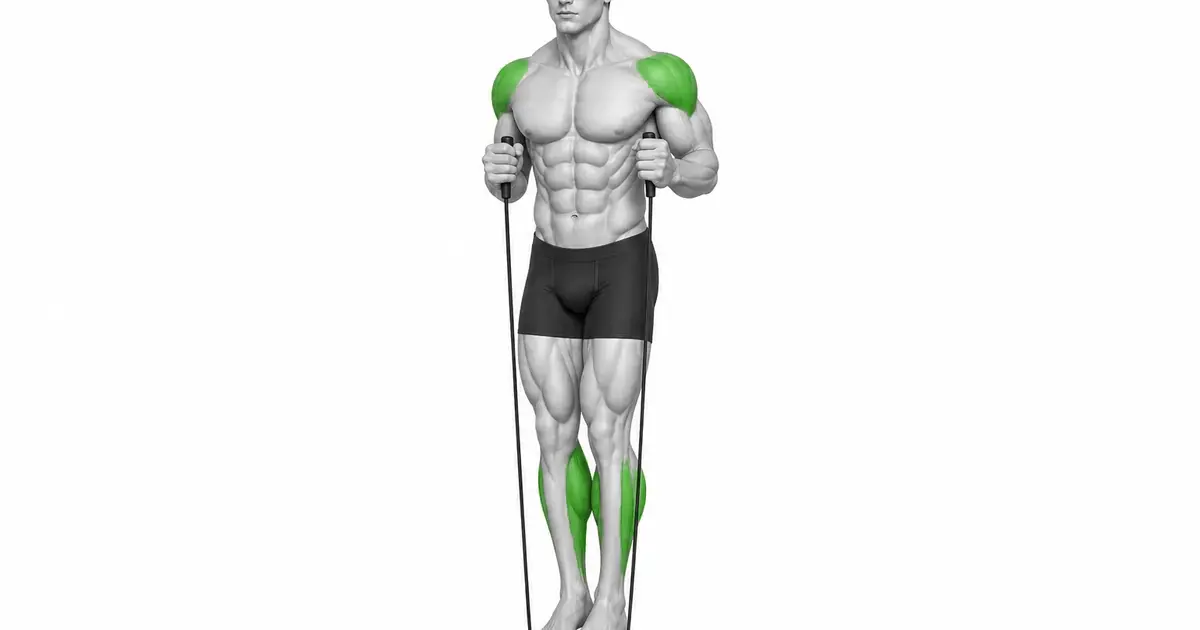
- 1
Check line length and surrounding space
Step on the center of the string to check the height of the handle and adjust the length. Make sure there is nothing above your head, front or back that the cord could touch.
- 2
Attach elbow and rotate with wrist
Lower your shoulders and keep your elbows close to your ribs. Send the string from back to front in a small circle around your wrist rather than across your entire arm.
- 3
Jump low when the rope is at your feet
Push the floor in front of your feet and hop only as far as necessary. Land quietly on both feet, gently using your ankles and knees.
- 4
Increase rhythm by repeating short sections
Perform for 10 to 20 seconds, then rest sufficiently and start again. If you fail, don't jump in a hurry and reset your stance.
TURN FROM THE WRISTS
Hands should stay next to the pelvis to keep the center of rotation and length of the string consistent
If your hands are spread outward or upward, the string becomes shorter and often gets caught on your feet. Keep your elbows close to your body.
Listen to the string sound and find a steady rhythm of one jump per revolution.
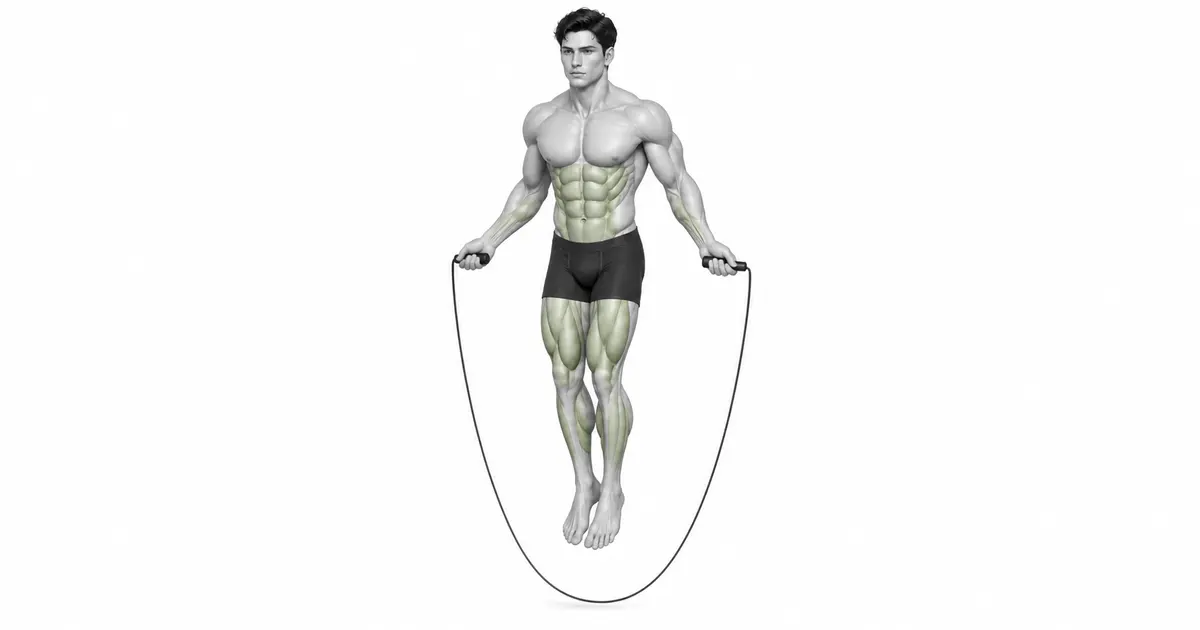
Key point: Cue to use right away: “Small wrists, low jump, low landing”
BUILD TENDON TOLERANCE
Even if your cardio is fine, your calves and Achilles tendons may adapt more slowly.
Starting from the first week, avoid doing long continuous sets and use short work/rest intervals.
If Achilles tendon stiffness or local pain increases the next morning, reduce the total number of jumps.
TROUBLESHOOTING
Fix the cause of a mistake, not just its appearance
Jump high by bending your knees
- What you see
- Each time, the foot lifts wider and the landing sound becomes louder.
- Likely cause
- The line is too long or trying to avoid it with height instead of timing.
- How to correct it
- Match your rope length and practice only the height you need with low pogo jumps without a rope.
Draw a large circle with your entire arm
- What you see
- Shoulders get tired quickly and hands move away from the body.
- Likely cause
- Use shoulder instead of wrist rotation.
- How to correct it
- Keep your elbows against your ribs and move only your wrists in small circles.
Excessive repetition on hard floors
- What you see
- Pain in the calf, shin, and Achilles tendon is cumulative.
- Likely cause
- Surface and weekly jump volume exceeded recovery capacity.
- How to correct it
- Use rubber or wooden soles and sneakers and gradually decrease and increase total time.
REGRESSION & PROGRESSION
Match the difficulty before adding load
Interval Training
improve calorie consumption efficiency by repeating high and low intensity.
Increased time and resistance
Strengthen your stamina by increasing performance time or increasing the resistance level of the machine.
BEGINNER PROGRAM
A practical starting framework
Begin with 5 to 10 rounds of 10 to 30 seconds of work and 30 to 60 seconds of rest. Increase the total based on quiet landings and tissue response the next day rather than the number of failures.
Frequency
3 to 5 times a week
If your goal is to lose body fat, it is important to do it consistently.
Volume
20~40 minutes
Gradually increase the time according to your fitness level.
- Do this while drinking plenty of water.
- Protect your joints through light stretching before and after exercise.
Frequently asked questions
Can I jump rope every day?
Depends on organizational adaptation and existing activity level. Beginners, take a rest day and check your calf and Achilles tendon response the next day.
If I keep tripping, should I jump higher?
Hand position, wrist timing and string length should usually be checked first. It is efficient to jump only as low as necessary.