LANDMINE PRESS (CHEST)
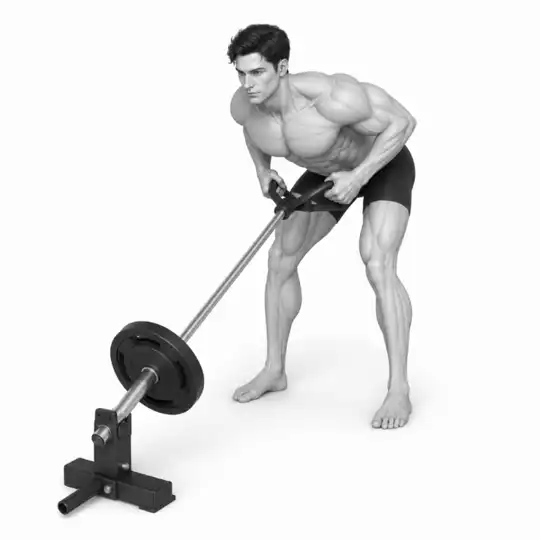
The arc-shaped trajectory of the Landmine Press Chest is not a way to forcefully imitate a vertical press, but rather a way to push diagonally while keeping the body stable along a fixed rotation axis.
The Landmine Press Chest is an exercise in which the other end of a barbell, one end of which is fixed to a Landmine sleeve or a safe pivot, is pushed diagonally up and forward in front of the chest. Because of the fixed ends, the bar tips follow an arc-shaped trajectory rather than a straight or perfectly vertical line. This route may be an easier option for some people to control shoulder and wrist strain, but it doesn't mean it will solve all shoulder pain or is automatically safer than the regular bench press. Be sure to first check for a dedicated attachment or secure immobilizing method, do not force the end of the bar vertically, and only use controlled repetitions with your ribs and pelvis aligned.
- Primary muscles
- Upper pectoralis major
- Secondary muscles
- Front deltoid, triceps, serratus anterior, core
- Difficulty
- Beginner
- Movement type
- Standing diagonal push
Is the Landmine Press always safe if you have shoulder pain?
Not always. Although the arc diagonal path may be easier for some people, response varies depending on the cause of the pain, range of motion, technique, and weight. Do not force yourself to proceed while in pain and consult a medical professional if necessary.
STEP BY STEP
5 Steps for One Complete Rep
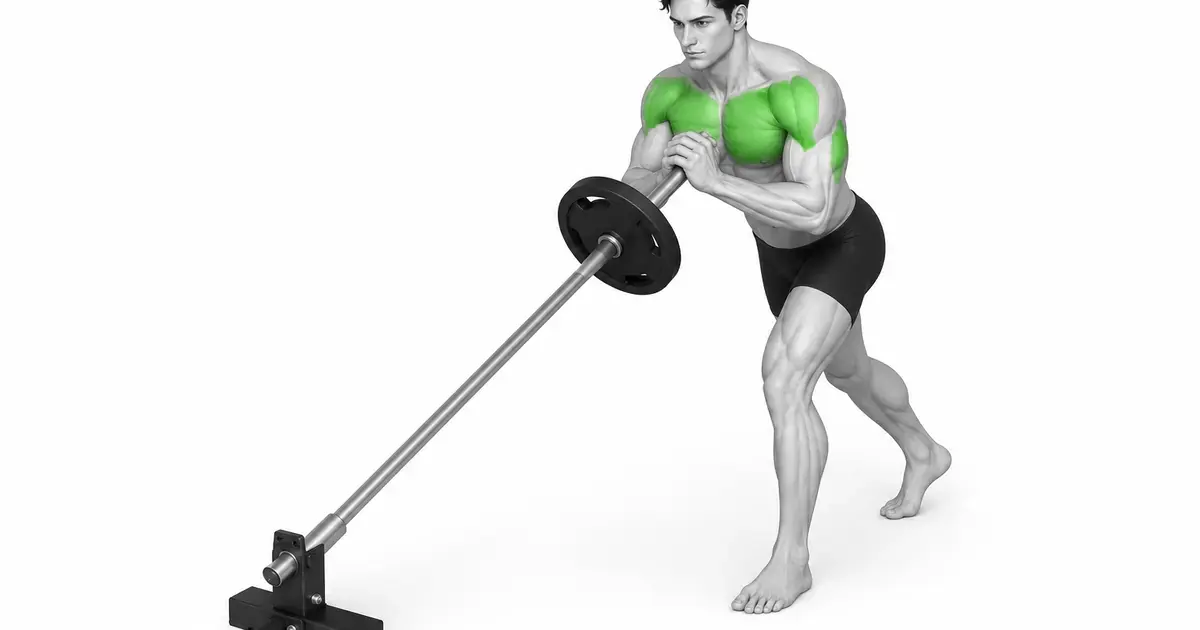
- 1
Checking the rotation axis and barbell fixation
Check that the dedicated landmine attachment is fixed without shaking, that one end of the barbell does not come off, and that the loaded disc and collar are stable. If you do not have dedicated equipment, you will need a secure fixation method that will not allow the barbell to move or damage the wall or floor. Do not set on unstable corners or slippery floors.
- 2
Hold the end of the bar stably in front of your chest and create a split stance.
Place the foot opposite to your working hand slightly in front of you and press both feet into the floor. Hold the bar end or grip steady in front of your upper chest, but without excessive bending of your wrists. Do not stand over the end of the bar or across its path.
- 3
Aligning the ribs and pelvis and preparing the elbow path
Lightly tighten your abdominal and gluteal muscles to prevent your ribs from lifting forward, and do not bend your lower back to create tension. Start with your elbows facing down and outward next to your torso, without shrugging your shoulders toward your ears.
- 4
Pushing diagonally along the arc-shaped trajectory of the bar
Exhale and push the tip of the bar diagonally up and forward. Let the barbell's axis of rotation follow the designated arc, and do not forcefully twist your hands or shoulders to raise it vertically. Keep your wrists close to your forearms and do not lock your elbows or lean your torso back at the end.
- 5
Controlled return to chest for 2-3 seconds
Inhale and return the bar tip to the starting position in front of your chest over 2 to 3 seconds. Use only to the extent before your elbow goes too far behind your torso or pain occurs in the front of your shoulder. Do not drop the bar tip or kick back to start the next rep.
ANCHOR & STANCE
The rotation axis must be stable to use arc-shaped orbits safely.
Landmine Training can be used for press, pull, squat, and rotation movements by fixing one end of the barbell to a single rotation axis. Just because the rotation axis is fixed does not mean that the surrounding environment is safe, so first check the condition of the sleeve, rack, disk collar, and floor, and make sure there is room for the bar end to move.
Split stance can help control the force with which the barbell pulls your body backwards and sideways. However, if you put your weight only on your front foot or lift your heels and arch your back excessively, stability will disappear. Press both feet into the floor, keep your ribs over your hips, and lean forward only as much as necessary.
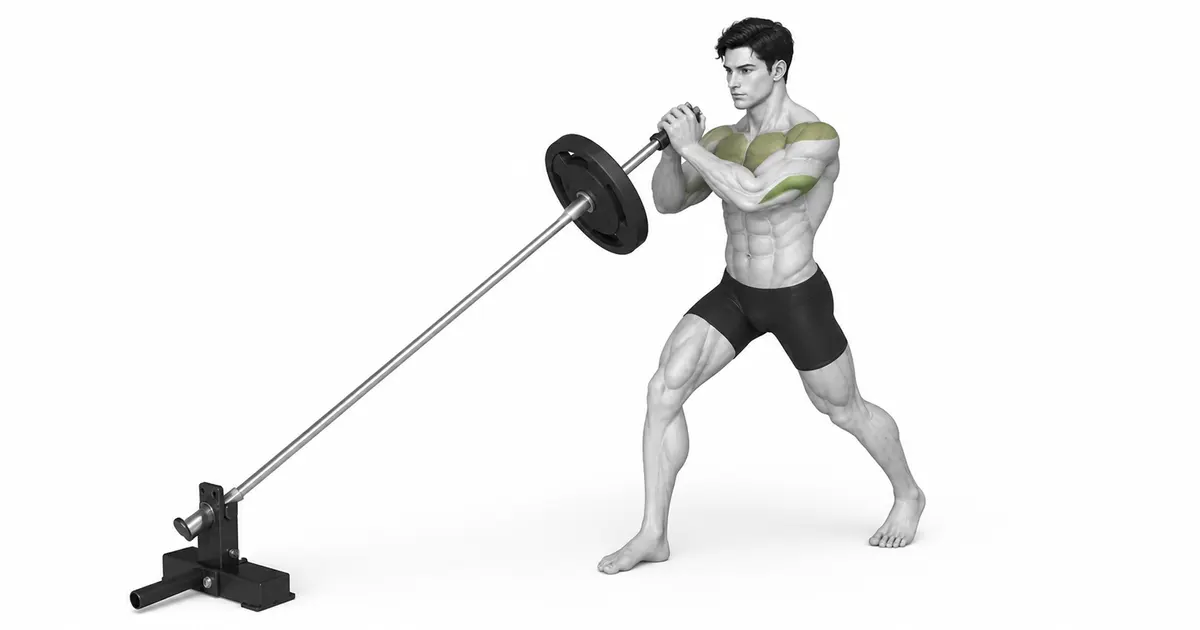
Key point: Cue to use right away: “Check the fixed axis → Press both feet into the floor → Place the ribs on the pelvis.”
ARC & PRESS
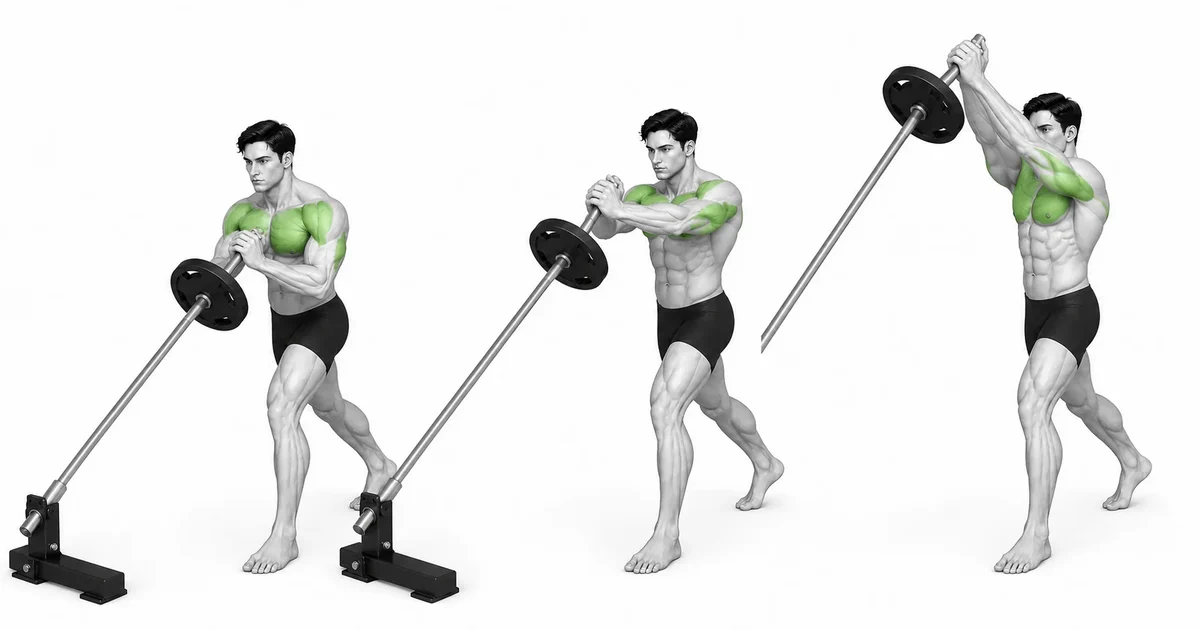
A diagonal press that follows the arc of the bar does not mimic a vertical press.
Landmine The rotation axis creates an arc-shaped trajectory at the tip of the bar, which presses with a mix of horizontal and vertical forces. For some, this route may be more accessible than the full vertical press, but pain-free range of motion and stable technique are priorities. If you ignore the arc and try to raise your hand straight up, your wrists, shoulders, and torso may compensate.
The hand moves diagonally up and forward in front of the chest, and the shoulder has room to move naturally following the arm movement. But don't end up pulling your shoulders up to your ears or opening your ribs too much. A weight that cannot be maintained on the same path is not the weight for the next repetition.
RETURN & LOAD
Return speed and body alignment come before weight
The bar tip moves downward and backward on return. If you let go of your arms at this time, the barbell may fall faster than expected or may swing around its axis of rotation. Go down over 2 to 3 seconds, maintaining alignment of your wrists, elbows, and shoulders and pressure on the floor.
Landmine training can require a combination of full body strength and core stability, but unilateral variations require left and right programming. Even if the weight is the same, the perceived load may vary depending on the barbell length, disc position, and stance, so judge whether to proceed only within the recorded settings.
TROUBLESHOOTING
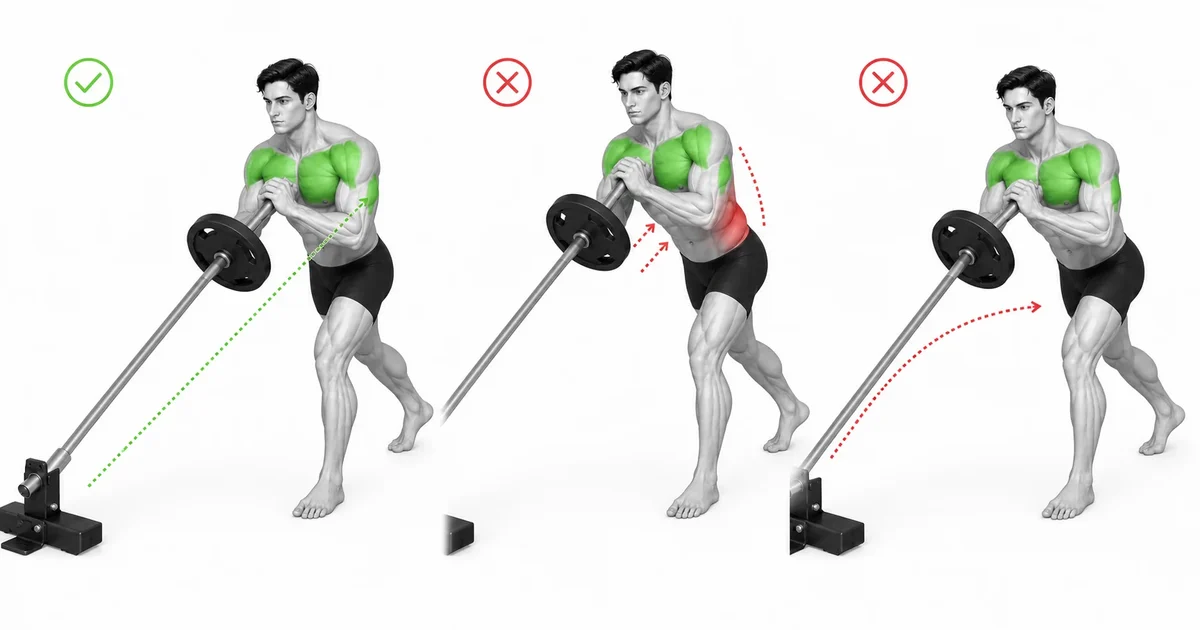
Fix the cause of a mistake, not just its appearance
Starting with unstable fixation method
- What you see
- There is room for the rotation axis or barbell tip to shake and move toward the floor or wall.
- Likely cause
- The weight may have been increased before checking the landmine attachment, original color, and installation environment.
- How to correct it
- Use a dedicated sleeve or non-slip secure fixation method, and do not start the set if fixation is uncertain.
Forcibly push the end of the bar vertically.
- What you see
- Wrists are bent, shoulders are twisted, or hands are pulled up in a direction different from the barbell arc.
- Likely cause
- You might think of the landmine press as a straight path, like the overhead press.
- How to correct it
- Send your hands up and forward along the diagonal arc created by the rotation axis of the bar, and if uncomfortable, reduce the range of motion or weight.
Excessive bending of the lower back at the end point
- What you see
- As the hand moves further away, the ribs lift, the lower back arches, and the pressure on the forefoot disappears.
- Likely cause
- The weight may be too heavy or you may be trying to move the end point farther away.
- How to correct it
- Re-align your torso with your abs and glutes and lower the weight to a level that allows you to maintain the same position.
Lock elbows hard and shrug shoulders
- What you see
- At the end of the repetition, elbows lock and shoulders rise toward ears.
- Likely cause
- You may have thought that maximum range is always a better iteration.
- How to correct it
- Stop gently in the pain-free range and keep your shoulder blades and neck in a relaxed position.
Let go of the barbell on the return
- What you see
- The bar tip drops down quickly or kicks back to start the next repetition.
- Likely cause
- There may be no strength left to control the descending arc.
- How to correct it
- End the set on the first repetition where you cannot maintain a 2-3 second return and lower the weight.
REGRESSION & PROGRESSION
Match the difficulty before adding load
Two-hand landmine press
First learn the rotation axis, arc path, and body alignment with a light bar or light disk.
Split Stance Single Arm Press
Perform a diagonal press with one hand, adjusting the barbell so that it does not rotate your torso.
Half Kneeling Landmine Press
Practice pelvic and rib alignment and core stability in a position with reduced leg kick.
Slow Return Landmine Press
Add a small amount of disc only after maintaining the return for 2~3 seconds.
BEGINNER PROGRAM
A practical starting framework
Place 1-2 times a week as an upper body push or chest/shoulder assistance exercise. When performing one side at a time, perform the same repetitions and sets on each side, and only progress if you can maintain the arc of the bar, neutral wrists, and rib and pelvic alignment for all repetitions. Start with a weight that leaves you with 2 to 3 reps left on the last repetition.
Count
6–10 times
Diagonal arc and return hold for 2-3 seconds
Set
2–3 sets
90–150 seconds recovery between sets
Increase
+1–2.5kg
Only if all iterations have the same alignment
- If bar arc, wrist neutrality, rib/pelvic alignment, and recovery speed are the same until the last repetition on both sides, only increase slightly in the next session.
- If your back is wet or your shoulders are shrugged after you increase the weight, you will immediately return to the previous weight.
- Record barbell length, disc position, stance, and one- or two-handed variations to compare only identical settings.
Frequently asked questions
Can I put the barbell in the corner of the wall?
The dedicated Landmine attachment is the most predictable choice. If you use an alternative fixation method, make sure the barbell is not slippery and there is no risk of damage to the wall or floor or dislodgement. If fixation is uncertain, do not perform it.
Is it a chest exercise or a shoulder exercise?
Depending on the press angle and posture, the upper pectoralis major, front deltoid, and triceps work together. Although this guide covers chest variations that push the chest further forward, it cannot be said to isolate any particular muscle.