ONE-ARM DUMBBELL ROW
The one-arm dumbbell row is not an exercise where you lift the dumbbell high, but rather an exercise where you keep your torso fixed and send your elbows back.
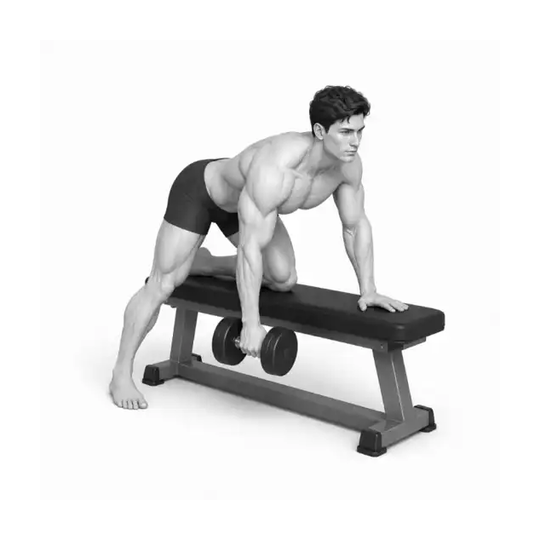
The one-arm dumbbell row is a one-arm horizontal pull in which you place one hand and the knee on the same side on the bench and pull the dumbbell in the opposite hand to the side of your body, as shown in the video. The lats, middle trapezius, rhomboids, rear deltoids, and elbow flexors move the dumbbells, and the trunk muscles support the posture against the asymmetric load. In the one-arm row study, oblique muscle activity was higher than in the two-arm variation, and in the other study, the trunk's ability to resist rotation was required. However, these studies did not have exactly the same conditions as the bench-supported dumbbell row in the video, so specific muscle values cannot be directly applied. In practice, use the support of the bench to stabilize your pelvis and ribs as much as possible, and prioritize repeatable paths over dumbbell height.
- Primary muscles
- lats
- Secondary muscles
- Middle trapezius, rhomboids, rear deltoids, biceps brachii, obliques
- Difficulty
- Beginner
- Movement type
- One arm horizontal pull/bench support
Where do you pull the dumbbells: to your chest or to your waist?
For the lat-centric path in this video, bring your elbows toward your hips, close to your torso, and pull the dumbbells next to your lower ribs. Pulling your elbows further out and closer to your chest will create a different row variation, with different contributions from your back shoulders and upper back.
STEP BY STEP
6 Steps for One Complete Rep
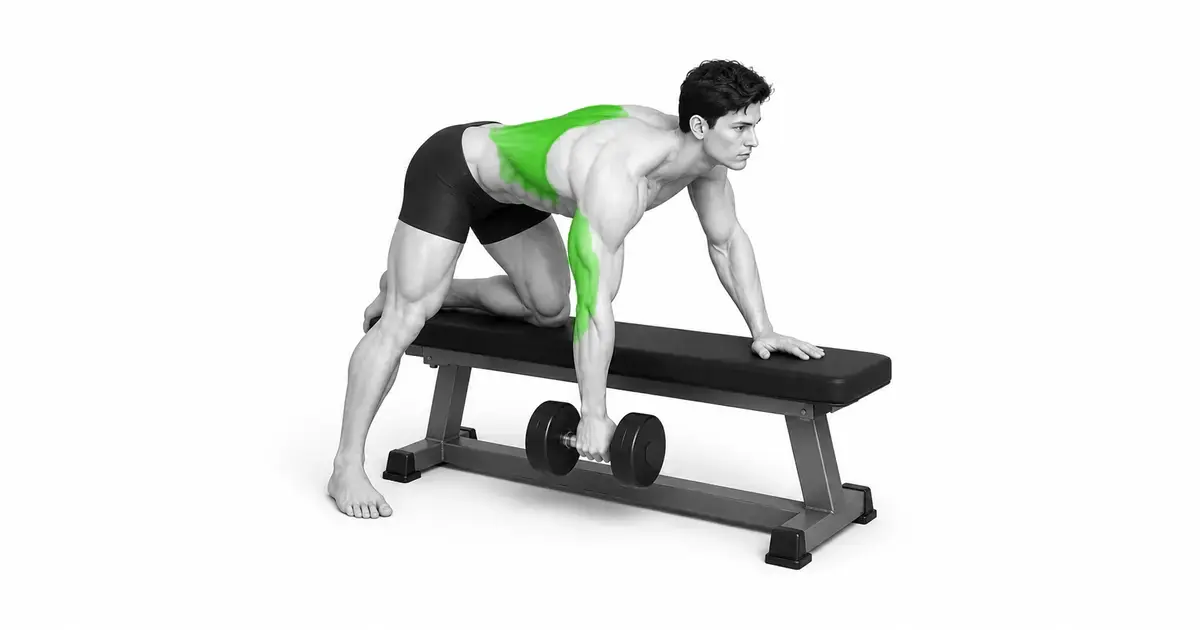
- 1
Check the area around the bench and dumbbells
Make sure the bench is stable and all non-slip feet are on the floor. Check whether the dumbbell lock is solid, and make sure there is space so that the foot on the pulling side does not collide with the dumbbell.
- 2
Support one hand and the knee on the same side
As shown in the video, place your support hand slightly in front of your shoulder and place the knee on the same side on the bench. Place your opposite foot wide on the floor next to the bench and bend your knee comfortably so that the three points create a stable base.
- 3
Align the pelvis and ribs
Send your hips back, tilt your upper body and lengthen from your head to your pelvis. Align your chest and pelvis toward the floor and strengthen your stomach and sides, but do not force your back to hyperextend.
- 4
Hanging dumbbells below your shoulders
Extend your free arm toward the floor so the dumbbells are under your shoulders. Keep your wrists neutral and keep your neck long without your shoulders rising too quickly towards your ears. Keep the shoulder blades completely stationary and allow them to move within a controlled range.
- 5
Pull your elbows toward your hips
Exhale and bring your elbows back and toward your hips, close to your torso. As the dumbbells get closer to your lower ribs, stop at a point where you don't rotate your torso more or shrug your shoulders.
- 6
Slowly lower it to below the shoulders
Extend your elbows and lower the dumbbells in the same vertical line for 2–3 seconds. Allow your shoulder blades to move naturally forward over your ribs, but begin the next repetition before your lower back rounds or the dumbbells touch the floor.
THREE-POINT SUPPORT
The triangle of the support hand, knee, and opposite foot is the stable base of the row.
Bringing your supporting hand and knee too close together will narrow your base, and placing your pulling foot directly under the bench can block the dumbbell's path. Place your hands under or slightly in front of your shoulders, your knees under your hips, and your opposite foot on the outside of the floor to create a wide base front, back, and side to side.
The support arm presses into the bench with the support arm almost straight rather than locking the elbow. If the supporting shoulder rises toward the ear or the chest sinks toward the floor, the path of the shoulder on the side pulling the dumbbell will also change each time. Think of a long line between your shoulders and don't vary that height much throughout the set.
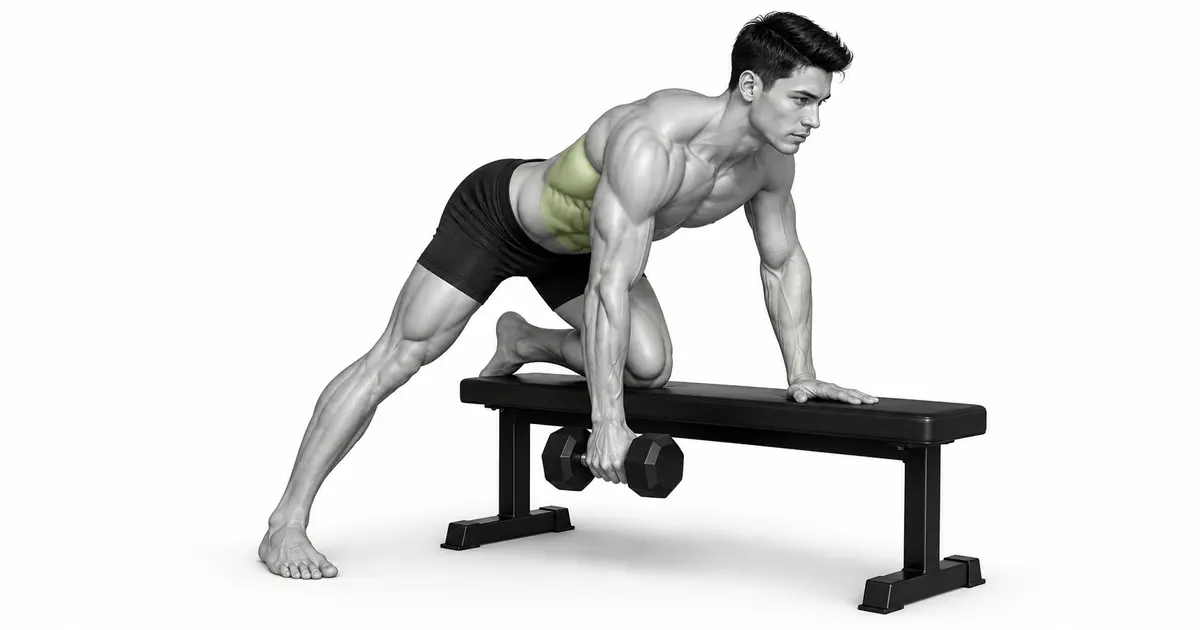
Key point: Check before set: Does your body not fall to the side even if you lightly lift your support hand for a moment without lifting the dumbbell?
TRUNK CONTROL
One-arm loads attempt to rotate the torso, but the goal is to control the rotation, not the rotation itself
A study comparing one-arm rows to two-arm rows found higher external oblique activity in the one-arm condition, and a study of one-arm cable rows also reported a demand for torso rotational resistance. This doesn't mean you have to actively twist your torso. As shown in the video, place your chest and pelvis toward the floor and hold on so that the shoulder and pelvis on the work side do not open toward the ceiling as the dumbbells rise.
There is also no need to force the shoulder blades and ribcage to be completely motionless. When the elbow goes back, the shoulder blade moves back over the ribs, and then forward again when the arm is extended. The key is to distinguish between lifting dumbbells with a large rotation of the lower back and pelvis and normal movement of the shoulder blades.
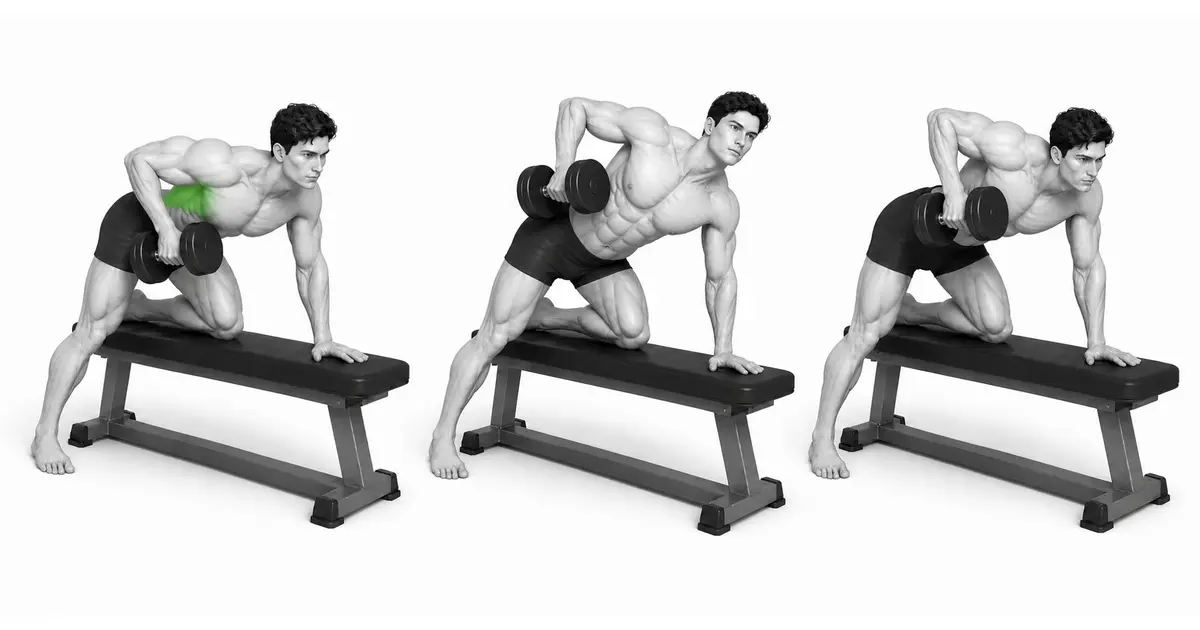
ELBOW & SCAPULA
Move your elbows towards the back of your torso and towards your hips, not upwards.
Keep your elbows close to your torso and pull toward your hips so that the dumbbells are next to your lower ribs. If you open your elbows wide to shoulder height and pull them toward your armpits, the proportion of your rear deltoids and upper back will change, making it easier for your shoulders to shrug. Neither variation is absolutely wrong, but this guide is based on the near elbow path centered on the lats mapped on the video.
The dumbbells do not necessarily have to touch your torso. A point where the upper arms are close to the torso line and the shoulder blades are moved back in a controlled manner is sufficient. If you curl your wrists, push the front of your shoulders forward, or rotate your torso to pull higher, you are not increasing range of motion, but rather adding compensation to other joints.
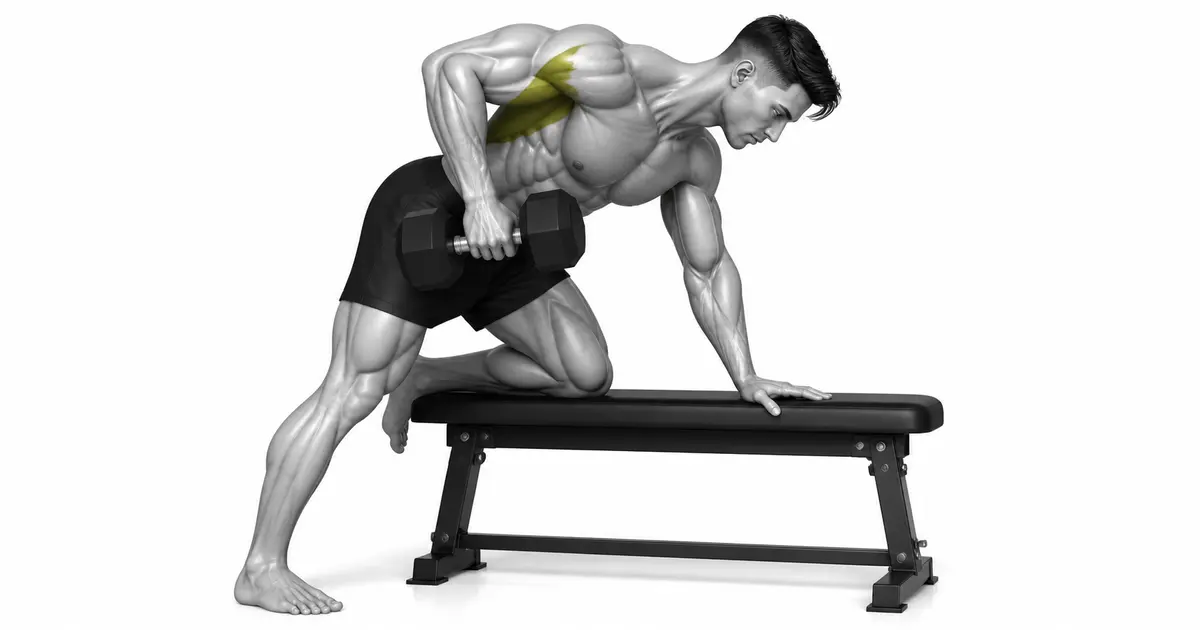
TROUBLESHOOTING
Fix the cause of a mistake, not just its appearance
Open and pull your torso and pelvis toward the ceiling.
- What you see
- As the dumbbells rise, the shoulder and pelvis on the working side rise together and the chest looks to the side.
- Likely cause
- The weight may be beyond your current rotational control, or your goal is to lift the dumbbells higher.
- How to correct it
- Lower the weight and think of your breastbone and belt buckle touching the floor. Repeat the range, maintaining your torso as you lower the top height.
Shrugging your shoulders and raising your elbows too high
- What you see
- The neck is shortened, the shoulder on the working side is brought closer to the ear, and the elbow is raised well above the back.
- Likely cause
- Try to pull the dumbbells up to your armpits or just pull them with your hands and arms.
- How to correct it
- Keep your neck long and your elbows toward your hips, not up. The dumbbells stop at a control point close to the lower ribs.
Rounding or arching the back excessively
- What you see
- The back is rounded at the bottom, the ribs are lifted at the top, and the curve of the lower back changes significantly.
- Likely cause
- If your feet are not positioned properly on the bench, you may be releasing tension in your stomach and shifting the range of motion to your lower back.
- How to correct it
- Drive your hips back to create a near-neutral spine, then reduce the range to lighter weight. Take a photo from the side to check that the length from head to pelvis is maintained.
Swing the dumbbells in front of your shoulders
- What you see
- The lower dumbbells swing back and forth more than below the shoulders, and the path at the top varies.
- Likely cause
- You start with a kickback or your support foot is blocking the dumbbell's path.
- How to correct it
- Move the opposite foot slightly outward, pause the dumbbell under your shoulder for 1 second, and then pull. Lower it in the same vertical line.
Insist on equal weight on both left and right sides
- What you see
- Only on the weak side will the trunk rotation and shoulder shrug be greater and the repetition range be shorter.
- Likely cause
- You may think that using the same weight and repetitions on each side is balanced, but your actual control may vary.
- How to correct it
- Start on the weaker side and use the number of controlled reps on that side as the upper limit for your stronger side. If necessary, create the same path with lighter weight on both sides.
REGRESSION & PROGRESSION
Match the difficulty before adding load
Bench Support Shoulder Row
Using light dumbbells or bare hands, master a small range of motion with your elbows almost straight and your shoulder blades moving back and forth over your ribs.
Light suspended one-arm dumbbell row
Pause for 1 second at the bottom and top and repeat the same path without bouncing your torso.
Standard Bench Support Row
As shown in the video, place one hand and the knee on the same side on the bench and perform 8 to 12 reps, leaving about 2 reps to spare.
One-Hand Bench Supported Split Stance Row
Place both feet on the floor and support only one hand on the bench to slightly increase the load on your lower body and torso.
Unsupported one-arm row
Progress to variations that maintain the hip hinge without bench support, but only when you have sufficient lumbar and rotational control.
BEGINNER PROGRAM
A practical starting framework
It can be used 1–3 times a week as a one-arm horizontal pull in a back exercise. If you alternate left and right without resting, your breathing and torso control may first collapse, so take a short breath between both sides if necessary.
number
8–12 times left and right
Starting from the weak side, follow the same path.
set
2–4 sets
1–2 minutes recovery between sets
speed
2–3 second descent
Cleaning up the dumbbell swing from the bottom
- Start with your weak side and perform only as many reps on the other side as your torso and shoulders are maintained.
- When you reach the top of your rep goal on every set and have about 2 reps to spare, increase in the smallest increments.
- If you have to rotate your torso or shrug your shoulders to raise the dumbbells higher, finish the set on that repetition and lower the weight for the next set.
Frequently asked questions
Can I turn my torso a little bit at the top?
There is no need to block the small natural movements of the ribcage and shoulder blades, but if the more you raise the dumbbells, the working shoulder and pelvis together open significantly toward the ceiling, which is a reaction. Use a range where your chest and pelvis are mostly on the floor throughout the set.
Should I keep my scapula held back?
no. The shoulder blades naturally move forward over the ribs when the arm is extended, and backward when the arm is pulled. Rather than forcefully fixing your shoulder blades, control the movement of your shoulders rising toward your ears or your torso collapsing.
Should I use the same weight on both left and right sides?
You can aim for similar training volume over the long term, but you don't have to stick to the same weight right away. Start with weights and repetitions that allow you to control your torso and shoulders on your weak side, and match those reps on your strong side as well.
What row should I change to if I have back discomfort?
First, lower the weight and range of motion and realign the bench support position. If this is still uncomfortable, you may want to consider variations with more torso support, such as chest-supported rows or seated machine rows. If you have sharp or persistent pain, do not push it into exercise and get evaluated.
Evidence and references
- 1. Saeterbakken et al. — Comparison of core muscle activity between two-arm and one-arm exercise
- 2. Fenwick et al. — Comparison of trunk muscle activity, spine movement and load by row variation
- 3. Mannarino et al. — Comparison of elbow flexor changes in one-arm dumbbell row and dumbbell curl training.
- 4. Kibler et al. — Muscle activity analysis of row series shoulder control exercises
- 5. Comparison of acute thickness changes in elbow flexors after dumbbell rows and dumbbell curls