SINGLE-DUMBBELL PULLOVER (BACK FOCUS)
The back-centered dumbbell pullover is not an exercise that involves dropping the dumbbells deeply, but rather an exercise that returns the arc of the long arms to the lats.
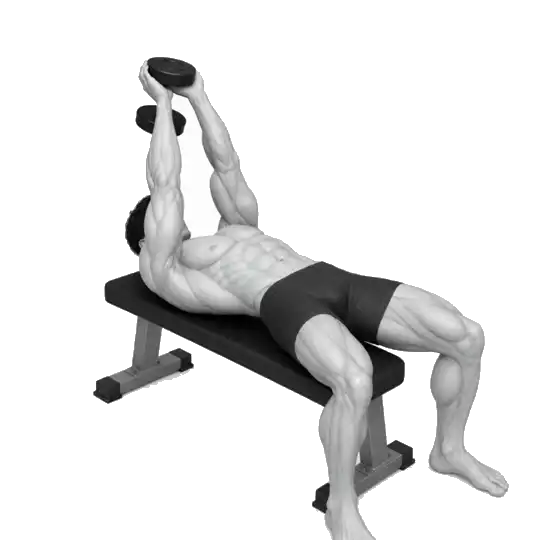
Rather than the traditional two-dumbbell pullover, which involves holding one dumbbell in each hand, this guide covers a variation performed by lying long on a flat bench while holding the top disc of one dumbbell with both hands. When the arm moves behind the head, not only the latissimus dorsi and teres major, but also the pectoralis major and the long head of the triceps brachii work together, so it cannot be assumed that specific muscles are completely isolated. In a small barbell pullover electromyography study, pectoralis major activation was higher than latissimus dorsi and the results were associated with external moment arms. Therefore, rather than relying solely on the classification of ‘back exercises’ and forcing maximum depth, it is practical to use the intention of pulling the upper arms toward the torso from behind the armpits while maintaining the elbow angle and torso.
- Primary muscles
- Latissimus dorsi and teres major
- Secondary muscles
- Pectoralis major, serratus anterior, long head of triceps brachii
- Difficulty
- Beginner to Intermediate
- Movement type
- Shoulder extension in supine position
Is the dumbbell pullover a back or chest exercise?
Both areas may be involved. Smaller barbell studies have shown higher pectoralis major activation, but cannot be directly generalized to one dumbbell variation. This page emphasizes the intention of bringing the upper arms to the torso, but does not assert that this is a lat isolation exercise.
STEP BY STEP
6 Steps for One Complete Rep
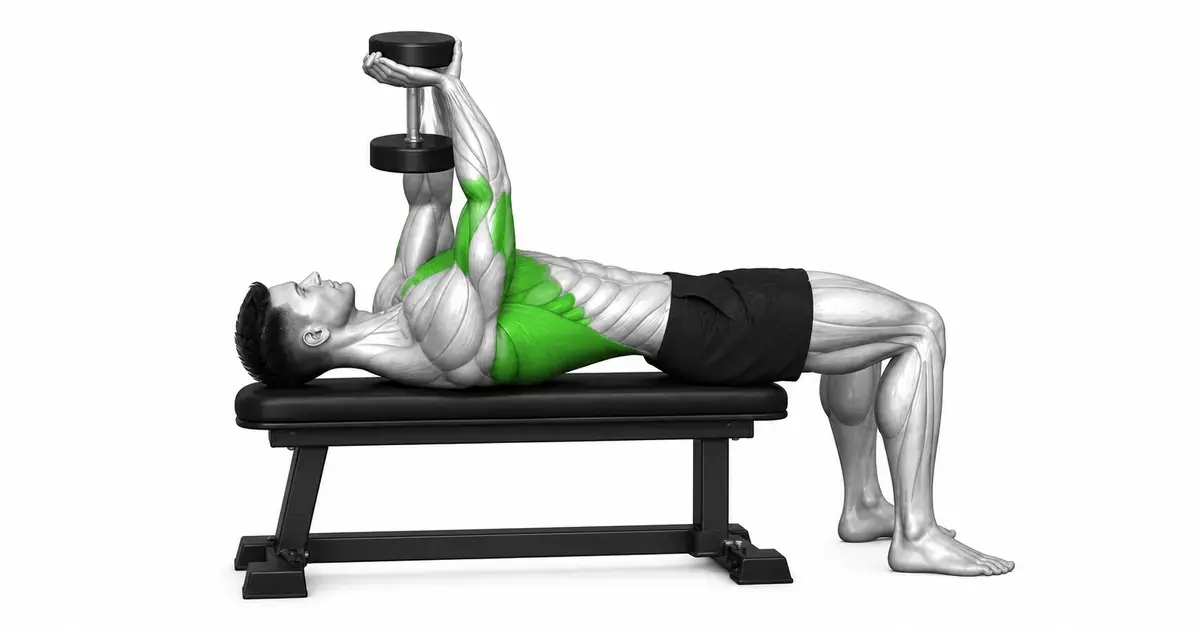
- 1
Checking the condition of the bench and dumbbells
Flat Bench Make sure all four legs are on the floor and the pad is not slippery. Check the dumbbell handles and discs for wobble or loosening, and initially choose a light weight that you can control for at least 12 repetitions.
- 2
Bring the dumbbells safely above your chest
Sit with the dumbbells on your thighs, then hold them with both hands and either lie down or have an assistant pass them to you. While lying down, do not pick up the dumbbells from the floor behind your head. Support the inside of the upper disk with both palms and wrap your thumb and index finger around the handle.
- 3
Fixing the head, back, pelvis and both feet
Lie on the same side of the bench and place your head, upper back, and pelvis on the pad. Press the entire sole of your foot into the floor and stack your ribs over your pelvis, leaving only the natural curve of your back.
- 4
Start by determining your elbow angle
Hold the dumbbells above your chest and keep your wrists straight. Without locking your elbows, gently bend them about 10–20 degrees and maintain that angle for most of the repetition. Make sure the dumbbells are stable above the center of your face.
- 5
Lower your head back while keeping your torso fixed.
Inhale and move the dumbbells from above your chest to behind your head for 2–3 seconds. Without bending your elbows further, create a large arc in your shoulders, but stop just before your ribs lift or the front of your shoulder feels uncomfortable.
- 6
Return by bringing the upper arm to the torso
Exhale briefly and think of the back of your armpits pulling your upper arms toward your pelvis. Rather than lifting the dumbbells by arching your back or straightening your elbows, allow the dumbbells to stabilize above your chest before starting the next repetition.
GRIP & ARC
Hold one dumbbell with both hands and make an arc from your shoulders, not your elbows.
Both palms support the inside of the upper disk symmetrically, and the thumb and index finger surround the handle. If you place only the edges of your palms on the disc, the dumbbells may tip when you get tired. Keep your wrists and forearms in one line and ensure that the center of the dumbbell passes through the exact center of your face and chest.
Maintain the small elbow bend you made at the beginning almost all the way to the bottom. If the elbows are greatly bent and straightened, it becomes closer to a supine triceps extension than a pullover, and it is difficult to confirm the shoulder movement of the long lever. Lighter weights are needed as the arc of the dumbbells away from the body becomes heavier.
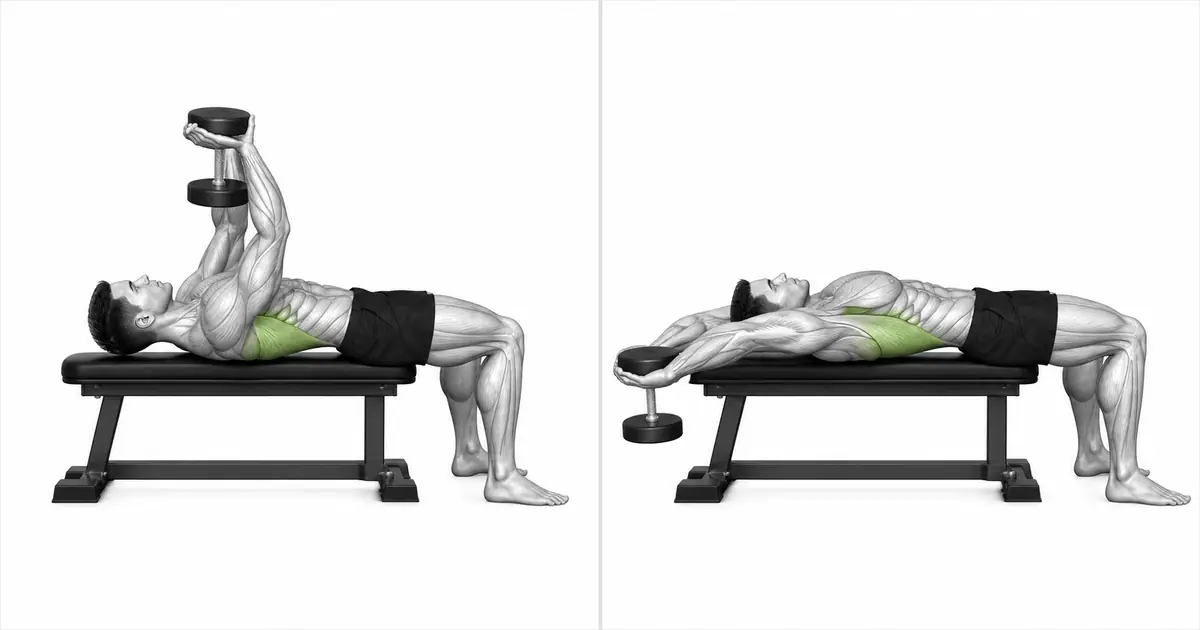
Key point: Standards to try right away: one dumbbell dead center, neutral wrist, fixed elbow angle, arc from shoulder
BACK FOCUS & RANGE
Back-centered practice is created with the intention of bringing the upper arms back toward the torso rather than at maximum depth.
The latissimus dorsi is involved in moving the upper arm back and down the body. Rather than lifting the dumbbells with your hands at the bottom, pull your upper arms toward your pelvis with the feeling of shortening the back of your armpits. Keep your elbows and hands like a link connecting the dumbbells.
There is limited direct evidence that pullovers are a lats-only exercise. The barbell pullover study included eight men and showed higher pectoralis major muscle activity. Since you can't generalize across dumbbell variations with different equipment and grips, prioritize pain-free paths and repeatable techniques rather than predicated on back stimulation.
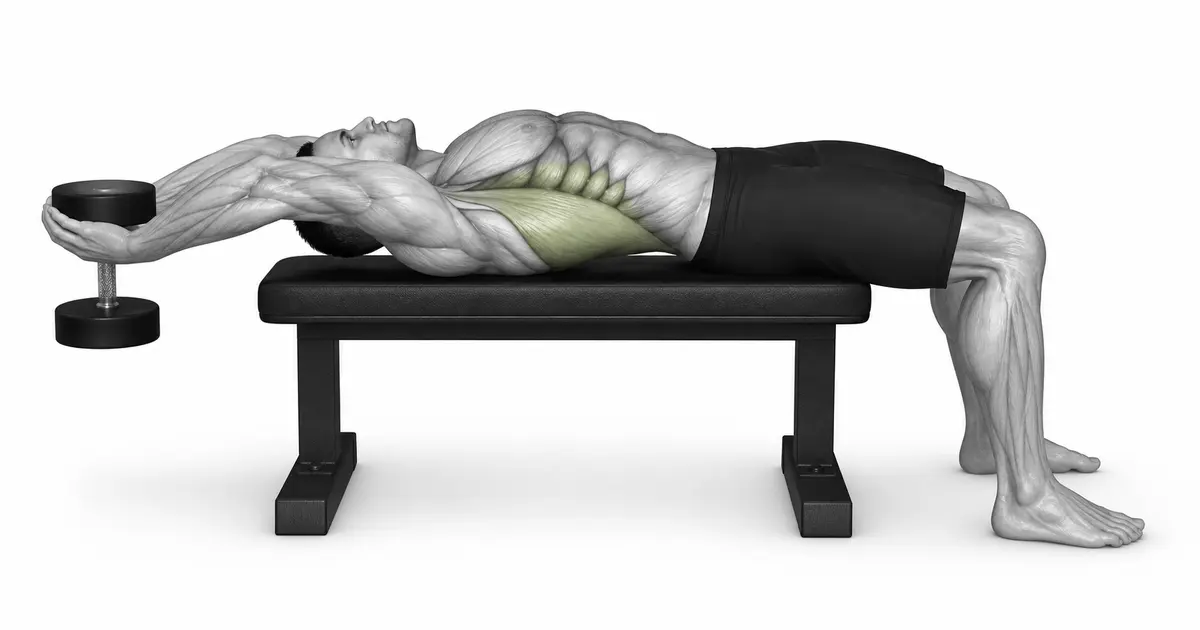
TROUBLESHOOTING
Lifting ribs and bending elbows are signs that you need to lower your depth or weight
As the dumbbells go down, your back arch increases, and as your pelvis lifts off the bench, your shoulder range is replaced by torso extension. Press your feet into the floor, lower your ribs toward your hips, and lower the dumbbells only to the point where you can maintain that position.
If your elbows are folded next to your face at the bottom and straightened again as you come up, the weight is often too heavy or the arc is too deep. Lighten the dumbbells and limit the bottom to shallow. Sharp pain in the front of your shoulder or tingling that radiates down your arm is not a stretching sensation.
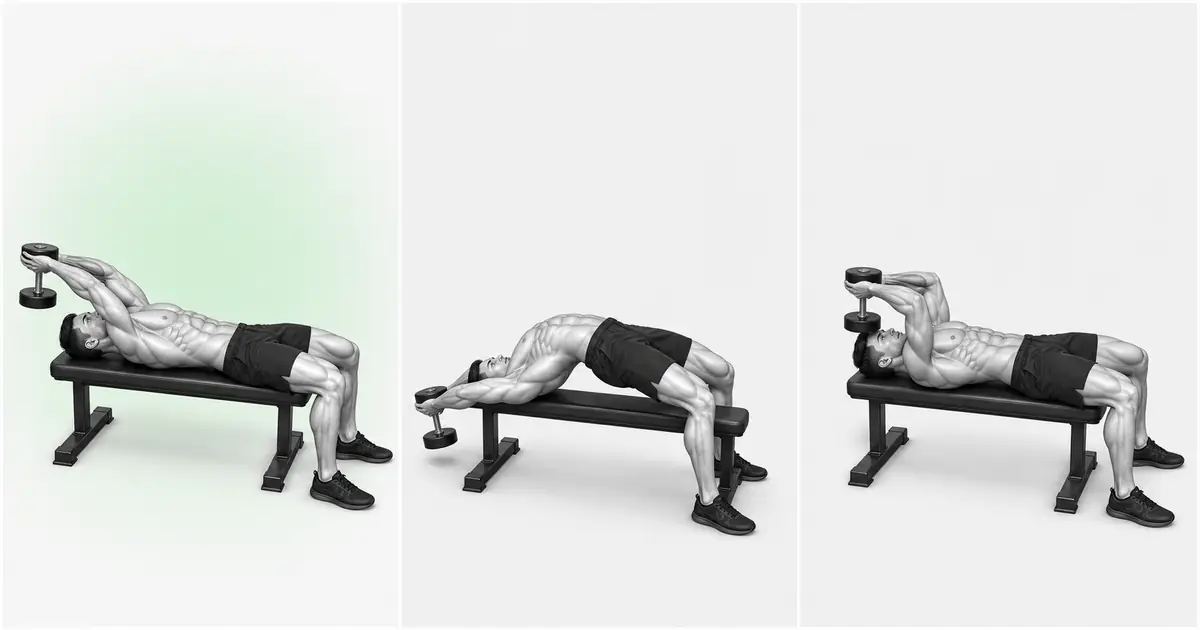
TROUBLESHOOTING
Fix the cause of a mistake, not just its appearance
Support the dumbbell disc with only your fingertips
- What you see
- Dumbbells lean to one side and your wrists are bent or slip off your palms.
- Likely cause
- The positions of the hands are asymmetrical or only the fingers rest on the edge of the disc.
- How to correct it
- Support the inside of the upper disk symmetrically with both palms and wrap your thumb and index finger around the handle. If you feel anxious, use lighter dumbbells.
Elbows are greatly bent at the bottom
- What you see
- Lower the dumbbells close to your face and straighten your elbows strongly when returning.
- Likely cause
- Loss of control over long arm arcs, reducing leverage with elbow movement.
- How to correct it
- Lower the weight and depth and maintain the small elbow bend you created at the beginning throughout the repetition.
Ribs and pelvis are lifted
- What you see
- The further the dumbbells are behind your head, the more space you have in your lower back and the more your hips come off the bench.
- Likely cause
- Your shoulders are lowered deeper than your current range of motion, or your abdominal tension is relieved.
- How to correct it
- Press the soles of your feet into the floor, lower your ribs, and use your torso only as far as you can maintain it.
Shoulders are pulled towards the ears
- What you see
- The neck becomes shorter at the bottom, and pressure or tightness is felt in the front and upper part of the shoulder.
- Likely cause
- You lack shoulder range or the dumbbells are too heavy and you lose control of your shoulder blade movements.
- How to correct it
- Reduce your depth and keep your neck long. If sharp pain recurs, stop exercising.
Change direction by bouncing the dumbbell across your chest.
- What you see
- The dumbbell swings at the top and then quickly falls behind your head.
- Likely cause
- The stability section was omitted because the repetition speed was fast or the grip was fatigued.
- How to correct it
- Check your balance for 1 second on your chest and then lower it under control for 2–3 seconds. If your grip becomes shaky, end the set.
REGRESSION & PROGRESSION
Match the difficulty before adding load
Band straight arm pulldown
Learn the pattern of standing and pulling on a light band, keeping your elbows at an angle and sending your upper arms toward your torso.
Short range dumbbell pullover
Practice your grip and torso control by lowering light dumbbells from above your chest to about behind your forehead.
Controlled one dumbbell pullover
Lower your torso to the bottom of the individual for 2–3 seconds, then return in the same arc.
Bottom 1 second pause pullover
Pause for 1 second at the pain-free lower end and return your upper arm to your torso without recoil.
BEGINNER PROGRAM
A practical starting framework
Use it 1–2 times per week as an accessory movement at the end of your back or chest training, rather than as a main exercise replacing vertical pulls or rows. Start with light dumbbells, enough for 12–15 reps, leaving 2–3 reps to keep your grip, elbows, and ribs in the same position for every rep.
number
8–15 times
Same depth and arc without pain.
set
2–3 sets
60–120 seconds recovery between sets
speed
2–3 seconds down, 1 second pause, 1–2 seconds return
Recheck your balance on your chest
- If the dumbbells do not tilt and head, back, pelvis contact and elbow angle are maintained for all repetitions, add one repetition to the next session.
- Once you've hit your target reps on every set, increase in smallest increments. Reducing depth at new weights is safer than breaking your back.
- Don't judge your success solely by whether or not you feel tired in your back. If you experience anterior shoulder pain, wrist instability, or trunk compensation, immediately lower the range or weight.
Frequently asked questions
Should I lower the dumbbells to floor level?
no. The individual's bottom is where the ribs and pelvis are maintained and the front of the shoulder is relaxed. If your torso starts to lift or your elbows start to bend more, stop lower than that.
Which disc do you hold the dumbbells on?
Usually, the inside of the upper disc, which is farthest from the body, is supported with both palms and the thumb and index fingers are wrapped around the handle. If the dumbbell structure makes it difficult to provide stable support or if the disc is wobbly, do not use the dumbbell.
What is the difference from the existing two dumbbell pullover?
The two dumbbell variation involves holding one dumbbell in each hand to stabilize the left and right sides independently. This variation supports one dumbbell with both hands, so symmetry may be easy, but as the dumbbell passes over your face, you'll need to check your grip and equipment more closely.
Evidence and references
- 1. Marchetti·Uchida — Pectoralis major, latissimus dorsi muscle activity and external moment arm during pullover
- 2. Pallarés et al. — Systematic literature review and meta-analysis on the adaptive effects of resistance exercise range of motion
- 3. Alizadeh et al. — Systematic literature review and meta-analysis on resistance exercise and joint range of motion
- 4. Aasa et al. — Systematic review of resistance exercise techniques and safety limits