STRAIGHT ARM PULLDOWN
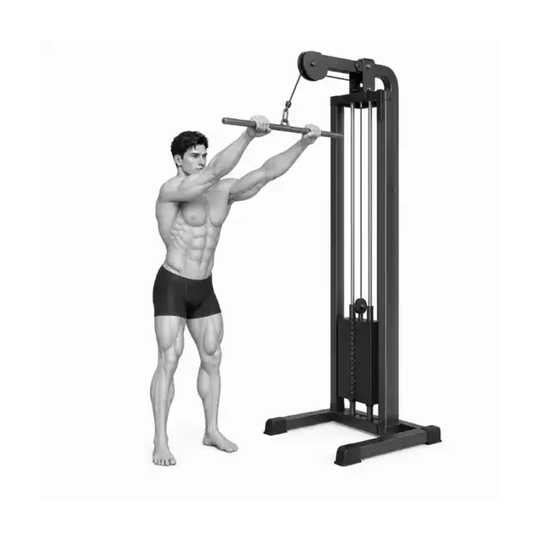
The straight arm pulldown is not an exercise in which you press the bar with your arms, but rather an exercise in which you bring your upper arms to your torso in an arc of your outstretched arms.
The straight arm pulldown in the video is a cable shoulder joint extension movement in which the person holds a straight bar on a high pulley and lowers the arm from the front of the head to the thigh without changing the elbow angle. The latissimus dorsi is attached to the humerus and contributes to the extension, compression, and internal rotation of the shoulder. Anatomical studies have reported that, thanks to its long muscle fiber structure, it can generate force while its length changes significantly throughout the shoulder range of motion. However, studies directly verifying the long-term muscle growth of this exercise itself or 'stimulation of the latissimus dorsi muscle alone' are limited. Therefore, rather than completely locking the elbow or forcing the shoulder blade down, it is more accurate to use it as an auxiliary back exercise that reproduces upper arm movement and lat tension within a pain-free range.
- Primary muscles
- Latissimus dorsi and teres major
- Secondary muscles
- Rear deltoid, long head of triceps brachii, abdominal muscles
- Difficulty
- Beginner to Intermediate
- Movement type
- Shoulder joint extension with elbow fixed
Should I fully straighten my elbows?
no. Gently bend 10–20 degrees and maintain approximately the same angle throughout the repetition. It is more important to move the upper arm away from the shoulder rather than locking the joint.
STEP BY STEP
6 Steps for One Complete Rep
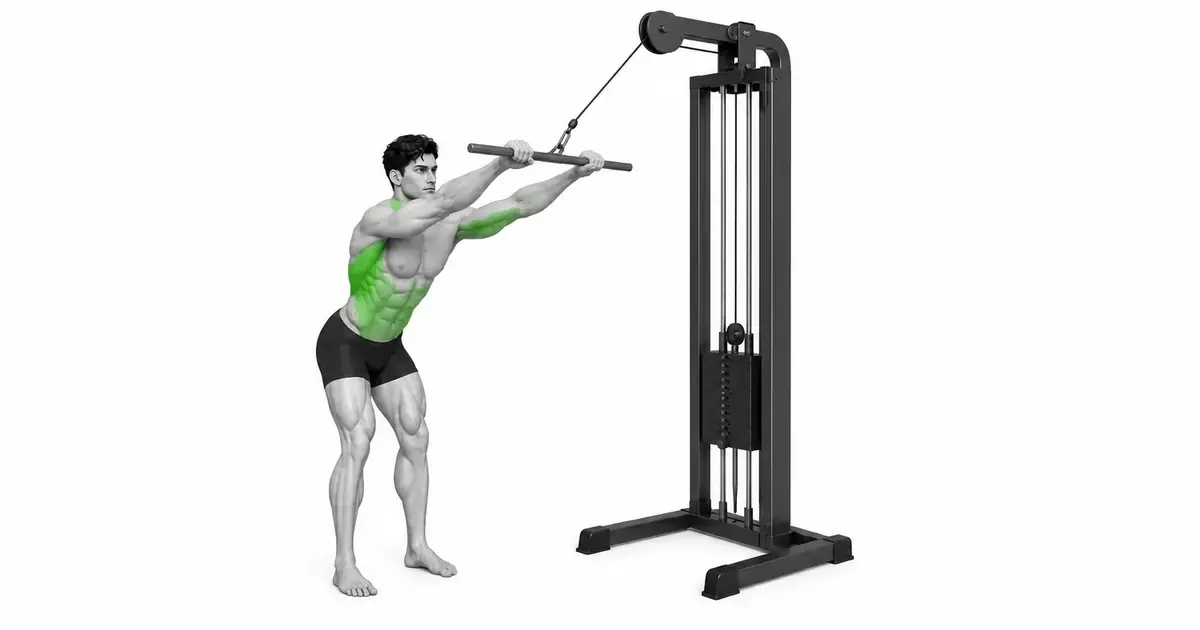
- 1
Checking high pulleys and straight bars
Hold the pulley in the highest position and make sure the straight bar is fully locked into the cable loop. Plug the pin into a light weight and first check the cable for wear, snags and traffic around it.
- 2
Establish a starting position one or two steps behind
Hold the bar with an overgrip slightly wider than shoulder width and take a step or two back. Place your feet hip-width apart, bend your knees slightly, and send your hips back slightly to find a position where the cable is taut.
- 3
Stabilizing the torso by overlapping the ribs and pelvis
Lightly press your stomach and place it on your pelvis without letting your ribs lift forward. Do not round your back or arch your back excessively, but maintain the same small hip hinge and neutral neck from start to finish.
- 4
Hold your elbows at a gently bent angle
Raise your arms in front of your head, stopping within a pain-free range and gently bending your elbows about 10–20 degrees. This angle is intended to avoid locking the joint and causing further flexion and extension during the repetition.
- 5
Move the upper arm in an arc toward the thigh
Exhale and bring your upper arms down and back, feeling the backs of your armpits tighten. Start the bar away from your body and arc toward the front of your thighs, keeping your elbows and wrists at the same angle.
- 6
Return to starting range for 2–3 seconds
When the bar gets close to your thighs, pause without arching your back. Raise your arms in front of your head over 2–3 seconds to avoid being dragged by the cable, and begin the next repetition when your shoulders are comfortable.
SHOULDER EXTENSION
The role of the lats becomes clear when the upper arm moves at the shoulder joint, not at the elbow.
The focus of the straight arm pulldown is not elbow bending or extension, but shoulder joint extension, which lowers the upper arm in front of the head to the side of the body. The latissimus dorsi and teres major contribute to this movement, and the posterior deltoid and long head of the triceps brachii may also assist depending on posture and joint angles. The name 'fully straight arms' does not mean locking your elbows, but is a practical way of saying that they should remain at approximately the same angle throughout the repetition.
If you bend your elbows sharply and bring the bar straight down close to your torso, the movement becomes more of a triceps pressdown. Conversely, there is no need to lock your elbows excessively and force your wrists and shoulders. Shoot from the side with a light weight to make sure your elbow angles are similar at the start and finish.

Key point: Key criteria: elbow angle remains approximately the same, only upper arm moved to the side of the torso in front of the head
RANGE & CABLE
Choose a pain-free starting range that maintains cable tension rather than maximum stretch.
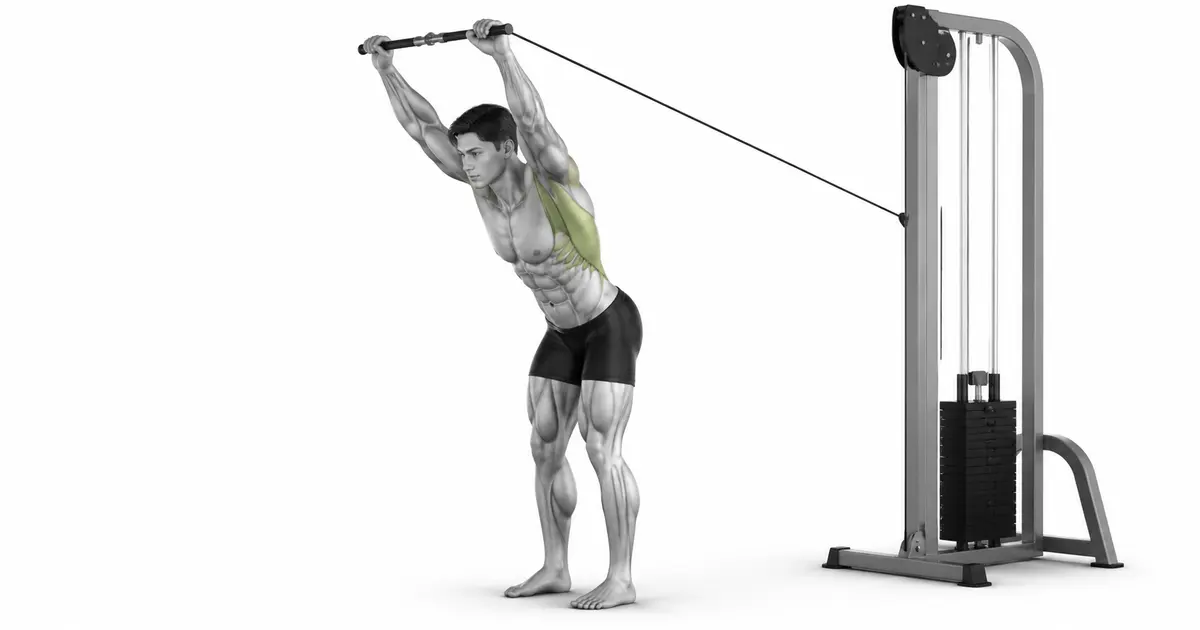
The higher you raise your arms, the longer your lats will work, but not everyone needs the same overhead range. If the front or top of your shoulders are pinched or you have to lift your ribs to raise your arms, stop just before that. If you take a step or two back, it's easy to find your personal range while maintaining cable tension even at lower weights.
Forcing the bar to the back of the thighs can create torso roll and excessive forward movement of the shoulders rather than additional range of motion. Finishing at a point where your arms are next to your torso and you can tighten your lats is sufficient. Use a foot position that does not allow slack in the cable at both the start and end.
TROUBLESHOOTING
Trunk kick and elbow flexion are signs that the weight is beyond your current skill range.
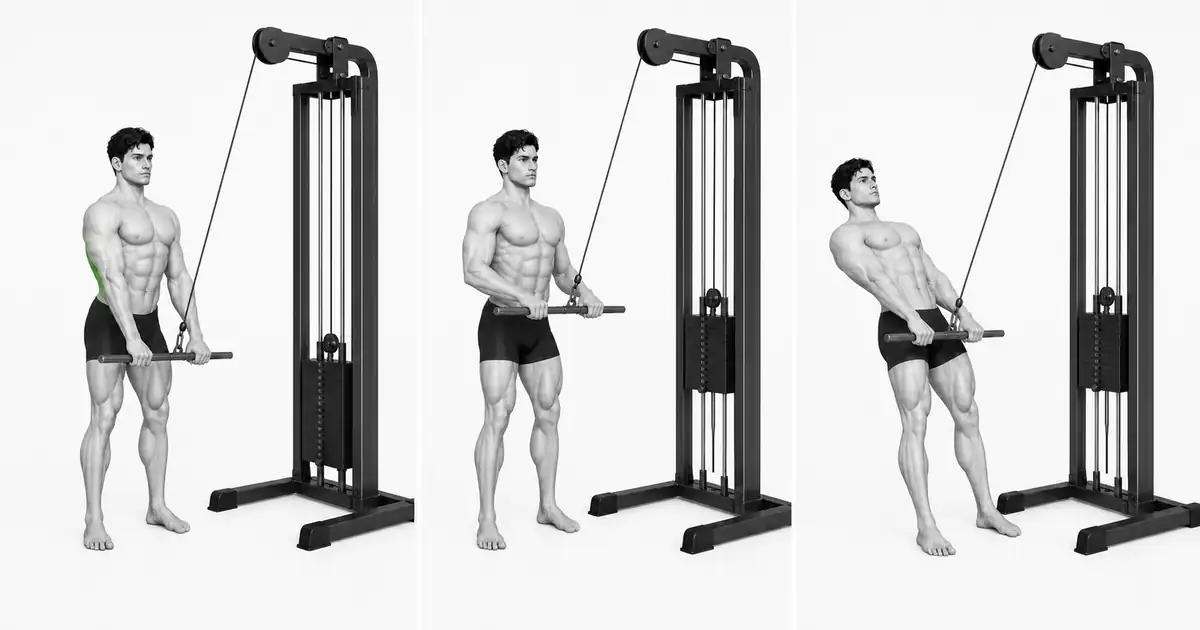
If the weight is too heavy, you'll often push your hips forward or lean your torso back before moving the bar, and lift your ribs at the finish. At this point, even though the bar goes down, the actual extension range created by the shoulders is reduced. Keep your foot pressure and torso angle the same for each repetition, and end the set as soon as the 2–3 second return is gone.
Avoid starting with your shoulders pulled up towards your ears or forcing them down at the end. The shoulder blades can move naturally over the ribs as the arm rises and falls. Perform this exercise in a range where your neck is long and your left and right shoulders are at similar heights.
TROUBLESHOOTING
Fix the cause of a mistake, not just its appearance
Broadly bend and straighten your elbows
- What you see
- The bar is lowered close to the chest, only the elbows are extended at the end, and triceps fatigue comes first.
- Likely cause
- Either the weight is heavy or I went the route of a regular cable pressdown.
- How to correct it
- Lower the weight and keep your elbows slightly bent. Only count repetitions where the upper arm draws an arc around the shoulder.
Lean your torso back and lower the bar.
- What you see
- As soon as you start pulling, your pelvis moves forward, your ribs lift, and your lower back bends sharply.
- Likely cause
- Currently, I can't control the weight just by shoulder extension, or I'm trying to force it down to my thighs.
- How to correct it
- Secure your feet and small hip hinge and reduce weight. Use only up to the finishing range just before the torso angle changes.
Shrug your shoulders towards your ears
- What you see
- At first, the neck becomes short and one shoulder rises first, causing discomfort in the front and top of the shoulder.
- Likely cause
- You raised your arms higher than your personal range of motion or rested on the cables.
- How to correct it
- Keep your starting height low and your neck long. Re-establish cable tension at a comfortable point for your shoulders and then pull.
elbows fully locked
- What you see
- During repetitions, the elbow joint is overextended and pressure is concentrated on the wrist and elbow.
- Likely cause
- The ‘straight arm’ in the name of the exercise was interpreted as joint locking.
- How to correct it
- Gently bend your elbows 10–20 degrees and maintain that angle. A pain-free, natural joint position is a priority.
Push the bar behind your body at the finish
- What you see
- The bar passes through your thighs and behind your body, bringing the front of your shoulders forward.
- Likely cause
- I thought a longer range of motion would be a better repetition.
- How to correct it
- Stop with your upper arms next to your torso and just before the bar touches the front of your thighs. It is based on the range before the shoulder is pushed forward.
Let go of the return section
- What you see
- The bar rises quickly, your body drags towards the cable, and the weight plates collide.
- Likely cause
- I only thought of the lowering section as repetition, or my lats and grip were already tired.
- How to correct it
- Raise your arms for 2–3 seconds and control the weight plates before they hit each other. If the pace is not maintained, end the set.
REGRESSION & PROGRESSION
Match the difficulty before adding load
Light rope straight arm pulldown
Using a rope makes it easier for your hands and shoulders to find a comfortable path so you can learn elbow angles and torso stability first.
Straight bar straight arm pulldown
As shown in the video, use an overgrip straight bar to move your left and right arms at the same speed and repeat a certain finishing position.
Half kneeling straight arm pulldown
Place one knee on the floor to reduce torso rotation and practice rib and hip alignment with light weights.
slow relaxation repetition
After a controlled basic repetition, raise your arms over 3–4 seconds to become more precise with your starting range and torso hold.
Single-sided cable pulldown
Use the one-hand handle to check the left and right range of motion separately. Start with light weights that don't rotate your torso.
BEGINNER PROGRAM
A practical starting framework
It can be used 1–3 times a week as an auxiliary exercise to additionally train the lats after vertical and horizontal pulling. For the first set, use a light weight of at least 15 reps. Check your shoulder response and cable path, and increase the load only within the range that does not disrupt your elbow and torso angles.
number
10–15 times
Weight with 2–3 reps to spare
set
2–4 sets
60–90 seconds recovery between sets
speed
1–2 second descent, 2–3 second return
Fixed elbow and torso angles
- Before your first set, use a light weight to check the cable loops and pins, and determine a starting range that won't pinch your shoulders when you raise your arms.
- If you maintain the same foot position, small hip hinge, approximately the same elbow angle and 2–3 second return for all repetitions, add one repetition to the next session.
- After hitting the top of your target reps on every set, increase the weight pin just one step. If you bend your elbows or flex your torso, immediately return to your previous weight.
Frequently asked questions
How far should the bar be lowered?
A point where your upper arms are next to your torso and the bar is close to the front of your thighs is sufficient. If you have to bend your back or push your shoulders forward to go down further, stop just before that.
Why do I feel it more in my triceps than in my lats?
If you bend and straighten your elbows significantly during repetitions, the nature of the press will increase. Lower the weight, keep your elbow angle fixed, and think of yourself moving your upper arm toward your thigh, not your hand.
Which is better, a rope or a straight bar?
You can use both. The rope makes it easy to freely adjust the wrist and shoulder path, and the straight bar makes it easy to move left and right in the same path. Choose a tool that can stabilize your elbows and torso without pain.
How much should I bend down?
Larger angles are not the answer. It is enough to slightly bend your knees and move your hips back slightly to raise your arms, as long as your ribs and pelvis are aligned. Maintain the same angle throughout the repetition.
Can I just do this exercise instead of the lat pulldown?
It is difficult to see it as a complete replacement. The straight arm pulldown is a shoulder extension assisted exercise with reduced elbow flexion, while the regular lat pulldown is a compound vertical pull that involves the elbow flexors and several back muscles working together. Place them together according to your purpose and recovery.
Evidence and references
- 1. Brown et al. — Strength and length characteristics of latissimus dorsi structure and shoulder range of motion
- 2. Marchetti·Uchida — Pectoralis major, latissimus dorsi muscle activity and external moment arm during pullover
- 3. Doma et al. — Comparison of kinematics and muscle activity between chin-ups and lat pulldowns