SINGLE-PLATE SVEND PRESS
The Svend press is not about pushing the plate far away—it is about never losing the inward squeeze
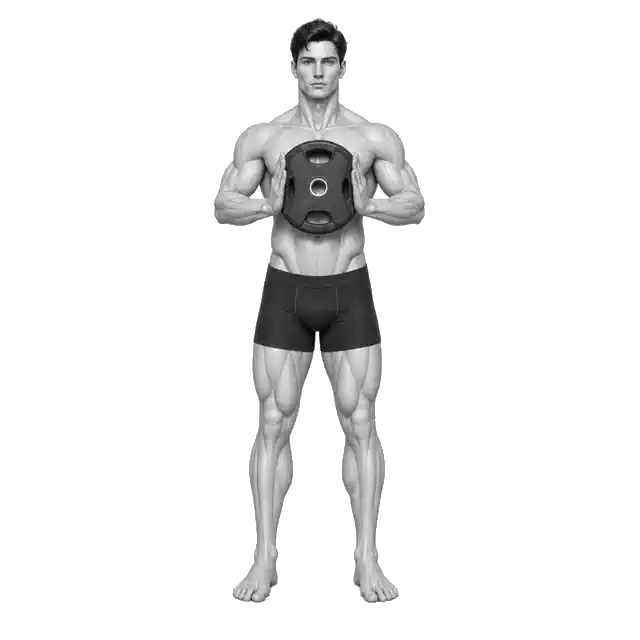
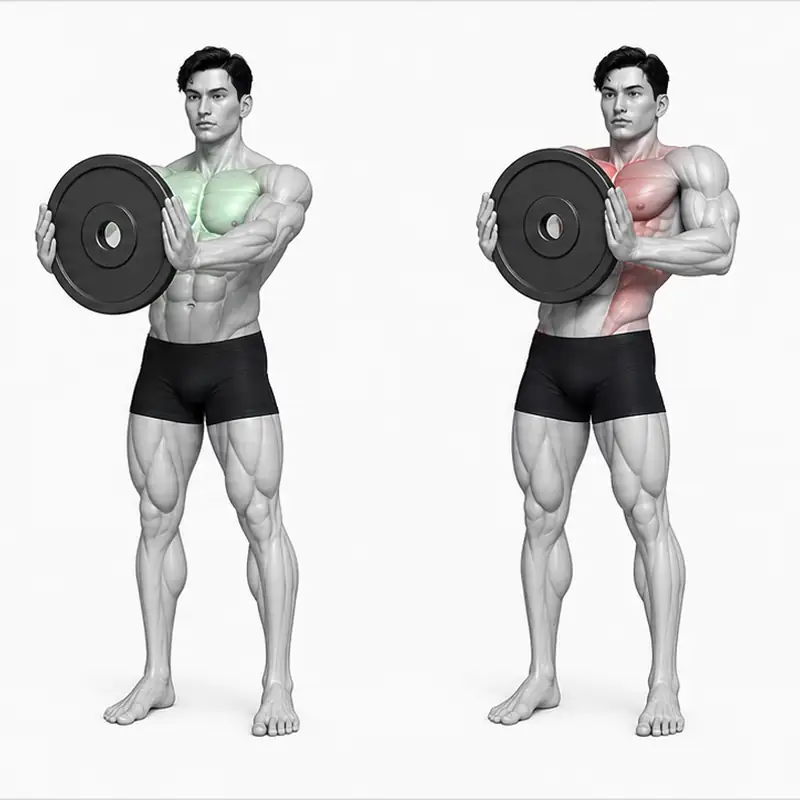
Unlike the common description that stacks two plates, the movement demonstration on this page is a single-plate variation: you squeeze the sides of one large plate with handle cutouts in front of the chest, press it straight forward, and bring it back. Because the plate fixes the distance between your hands, the pectoralis major produces an isometric force squeezing inward rather than actually adducting the arms further. The anterior deltoids and triceps work alongside it as the elbows extend. There is no evidence for the claim that it isolates the inner chest to create definition, so use it as an accessory for learning sustained chest pressure and trunk alignment at light loads.
- Primary muscles
- Pectoralis major
- Secondary muscles
- Anterior deltoids · triceps · serratus anterior
- Difficulty
- Beginner
- Movement type
- Isometric adduction with forward press
Does the Svend press use one plate or two?
Both methods go by the same name, but this page and its movement demonstration use the variation that squeezes the sides of a single handled plate. Stacking two plates between the palms carries different grip and drop risks and should be treated as a separate movement.
STEP BY STEP
5 Steps for One Complete Rep
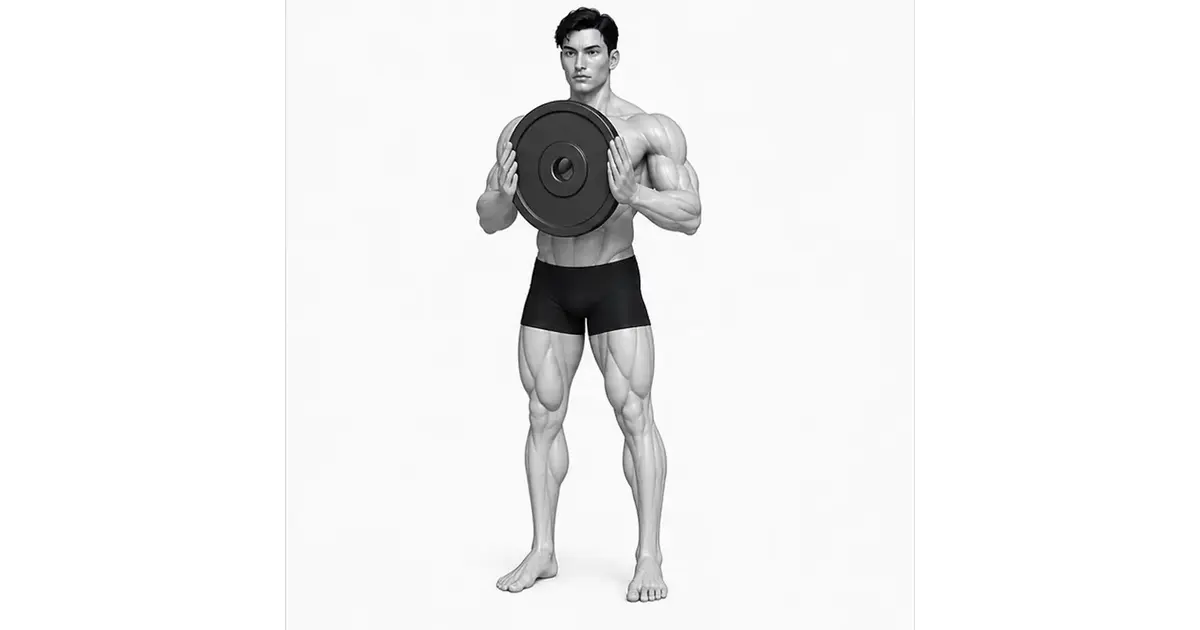
- 1
Choose a light plate that is easy to hold
As in the demonstration, pick one plate with handle cutouts whose sides you can squeeze securely. Start with a load light enough that the plate will not slip and your wrists stay straight even with the arms extended forward.
- 2
Set your feet and stand tall
Place the feet between hip and shoulder width and keep the knees softly straight. Brace the glutes and abdomen lightly, stack the ribs over the pelvis, and do not lean back to counterbalance the weight of the plate.
- 3
Squeeze the plate inward in front of the sternum
Stand the plate up near the center of the chest and press the flat sides or outer edges with equal force from both hands. Keep the elbows slightly out from the sides of the torso and the wrists in line with the forearms.
- 4
Press straight forward while holding the pressure
Exhale and send the plate horizontally forward at sternum height. Keep the force of both hands pushing toward each other the entire time, without shrugging the shoulders or leaning back. Stop where the elbows are softly extended rather than locked.
- 5
Return to the chest over two seconds
Inhale and bring the plate back at the same height so it does not sag downward. Maintain the inward pressure until just before it reaches your chest, then recheck your trunk and shoulder position before the next repetition.
SINGLE-PLATE SQUEEZE
This demonstration squeezes one plate from the sides, not two stacked plates
The traditional Svend press is often introduced as pressing two small plates together between the palms so they do not drop. The demonstration on this page, however, uses one large handled plate. Even under the same exercise name, different equipment and hand positions change how hard it is to hold and how much strain reaches the wrists, so this guide describes only the single-plate variation shown.
Because the plate fixes the distance between your hands, they do not actually travel toward the midline. Instead you produce an isometric horizontal adduction force by trying to squeeze the plate inward. Pectoralis major research has reported that increases in muscle activity during horizontal adduction tasks relate to motor unit recruitment as force rises, but that finding does not directly prove the Svend press builds muscle or outperforms other chest exercises.
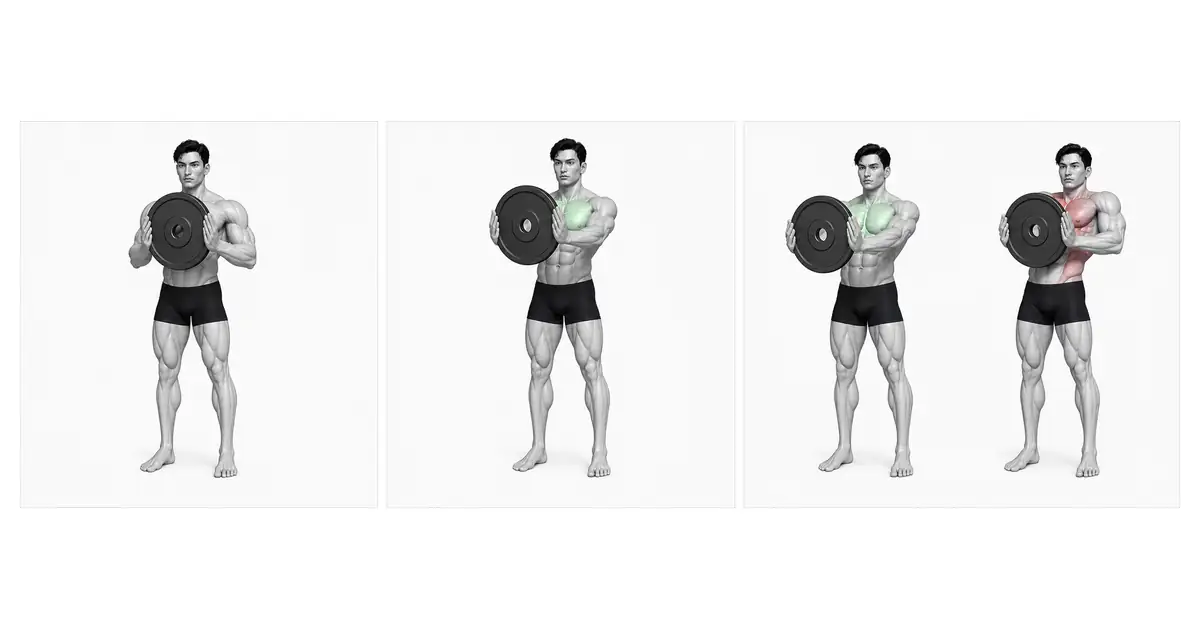
Key point: Practical cue: “Squeeze one plate from both sides → hold the pressure → press at sternum height.”
PRESS PATH
The plate travels a short horizontal path at sternum height
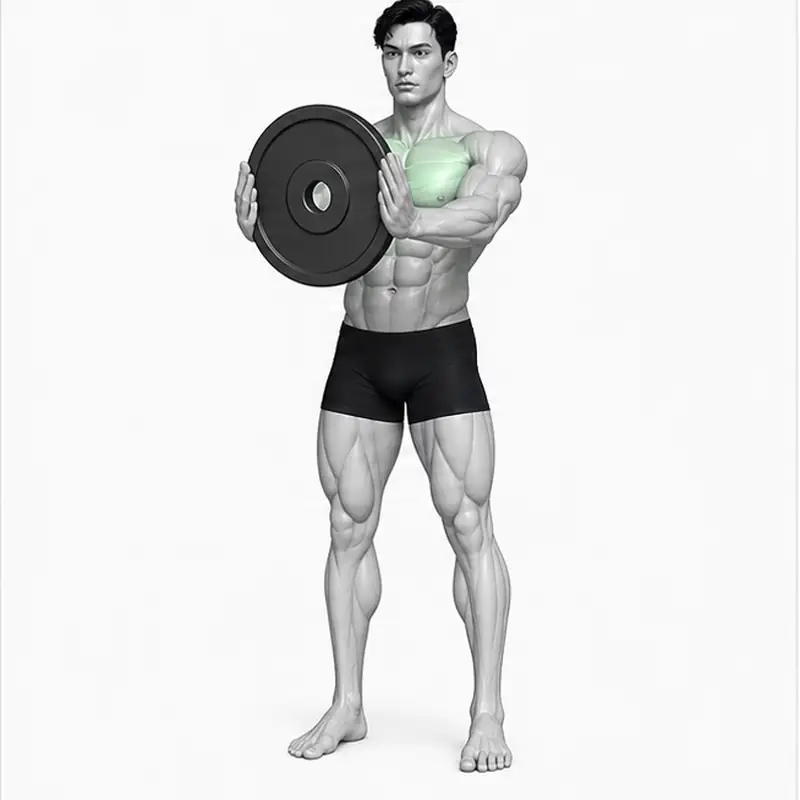
Lifting the plate upward increases shoulder flexion and can expand the role of the anterior deltoids. As in the demonstration, start at the center of the chest, press straight forward along sternum height, and return along the same path. You do not need to push the shoulders forward or hard-lock the elbows in order to fully straighten the arms.
The same plate feels different close to the chest than it does with the arms extended. The longer the arms, the farther the plate sits from your body and the greater the moment your shoulders and trunk have to resist. If the low back arches or the plate drops at the end range, reduce the load before you reduce the range.
ALIGNMENT & EXPECTATIONS
You can feel the chest squeezing, but that is not "inner chest isolation"
The pectoralis major has fibers running in different directions, including clavicular and sternocostal portions, but the "inner" region near the breastbone cannot be trained as though it were a separate muscle. Force direction and arm position can influence regional contribution, yet research has not been able to fully separate portions of the pectoralis major at maximum contraction. Do not read a strong squeezing sensation at the center of the chest as evidence that one region has been isolated.
Because you squeeze the plate continuously, this exercise makes pectoralis major tension easy to notice even at a relatively light load—but it does not automatically replace movements that handle large external loads, like the bench press or a chest press. Research likewise suggests choosing exercises based on loading capacity, skill level, and purpose rather than EMG numbers alone. The Svend press works best as a warm-up, a light accessory set between chest exercises, or a finisher.
TROUBLESHOOTING
Fix the cause of a mistake, not just its appearance
The inward squeeze releases
- What you see
- Your hands slip toward the edges as you extend and the plate wobbles.
- Likely cause
- You may be focused only on pressing forward, or using a load you cannot hold at the end range.
- How to correct it
- Reduce the load and squeeze the plate with equal force from both hands from the start to the return. End the repetition if the pressure releases.
The plate rises toward your face
- What you see
- As you extend, the hands climb to eye level and the shoulders lift toward the ears.
- Likely cause
- You may have lost the horizontal path at sternum height, or you may be supporting the load with the anterior deltoids.
- How to correct it
- Switch to a lighter plate and press a short distance straight forward from the center of the chest. Keep the shoulders down.
The wrists fold backward
- What you see
- The weight of the plate shifts toward the fingers rather than the base of the palm and pressure builds in the wrist.
- Likely cause
- The plate may be too large or heavy, or your hands may not be placed symmetrically.
- How to correct it
- Line the palm up with the forearm and use a lighter plate with handle cutouts.
Arching the low back to finish the range
- What you see
- The ribs lift and the pelvis pushes forward as the arms travel out, and the trunk leans back.
- Likely cause
- This is a compensation to fully extend the arms, or the load is more than the trunk can manage.
- How to correct it
- Stack the ribs over the pelvis and shorten how far you extend. Reduce to a load where the trunk does not move.
Pulling back fast so the plate hits the chest
- What you see
- The elbows fold abruptly on the return and the plate strikes the chest or drops downward.
- Likely cause
- You may be treating only the forward travel as the exercise and neglecting to resist the return.
- How to correct it
- Return at the same height over two seconds and control it to a stop just before it reaches your chest.
REGRESSION & PROGRESSION
Match the difficulty before adding load
Empty-hand palm press
Press the palms together in front of the chest with equal force for 10–20 seconds to learn rib and wrist alignment.
Plate hold in front of the chest
Squeeze one light handled plate in front of the chest and hold it steady for 10–20 seconds.
Short-range single-plate press
Send the plate only halfway out and check that the inward pressure and trunk alignment hold.
Full-range Svend press
Extend to a softly straight elbow position once the wrists and shoulders are comfortable and the pressure holds.
BEGINNER PROGRAM
A practical starting framework
Place it once or twice per week as a light preparation exercise before chest pressing, or as an accessory after your main work. Leave two or three repetitions in reserve while the plate stays secure and you hold chest pressure and trunk alignment to the end.
Reps
10–15
Hold the inward squeeze through the whole range
Sets
2–3
Rest 60–90 seconds between sets
Tempo
1s press · 2s return
Keep chest height and the trunk fixed
- If the plate stays level, your hands do not slip, and your trunk stays upright for all 15 reps, add the smallest available increment next session.
- If after adding weight the shoulders lift, the low back arches, or the inward pressure releases, go straight back to the previous load.
- Do not compare it against the loads in your major pressing exercises—log the plate weight, repetitions, and forward range separately.
Frequently asked questions
Does the Svend press build only the inner chest?
That cannot be stated so firmly. You may feel a strong squeeze at the center of the chest while pressing inward, but that sensation does not mean the inner fibers of the pectoralis major have been isolated. Overall chest development depends on a range of presses and flys along with progressive training volume.
What weight should I start with?
Start light enough that you can keep squeezing the plate inward and hold your wrists, shoulders, and trunk in place even with the arms fully extended. Whether you can control 10–15 repetitions without slipping matters more than the number on the plate.
Evidence and references
- 1. Shen et al. — Isometric horizontal adduction and motor unit recruitment in the pectoralis major
- 2. Lee et al. — Regional pectoralis major contribution by force direction and arm position
- 3. Muyor et al. — Muscle activity across chest press types and grips
- 4. ACE-sponsored study — Muscle activity across chest exercises
- 5. ACSM — 2026 Resistance Training Guidelines