TIRE FLIP
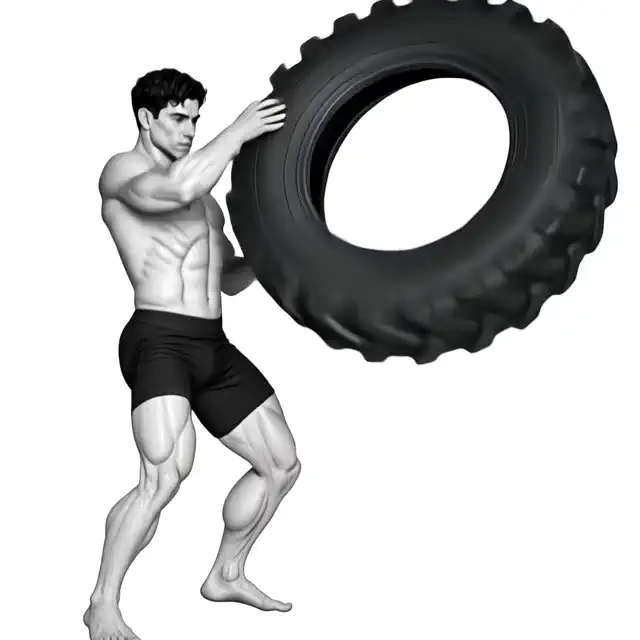
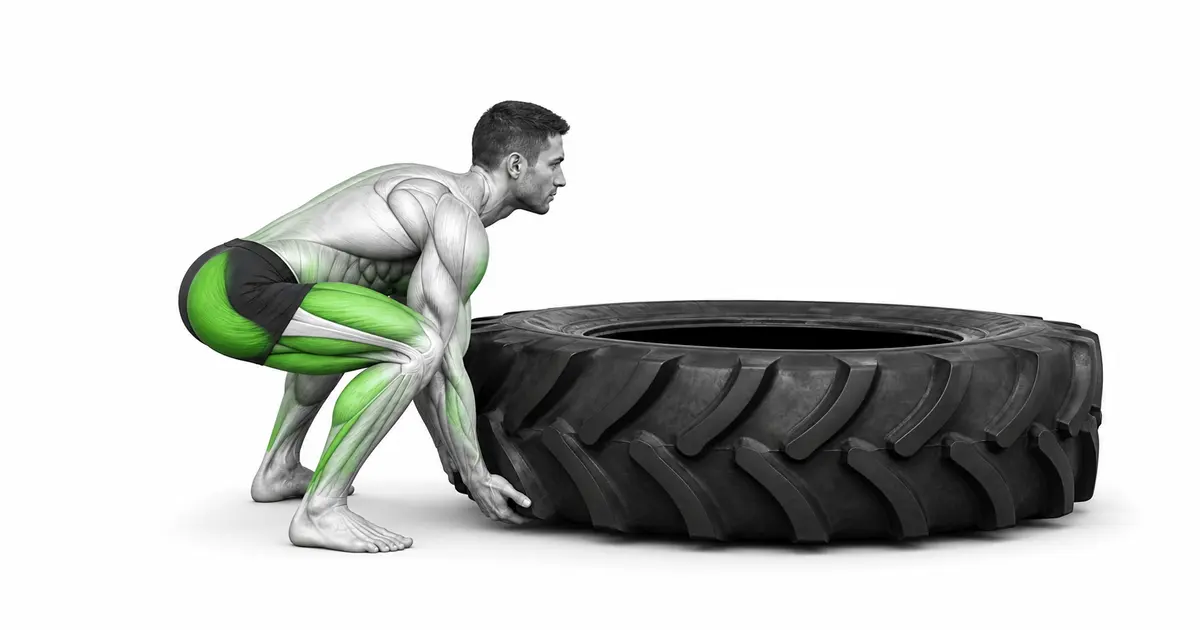
Tire flip is not an exercise where you curl a heavy rubber with your arms, but rather a full body lift where you attach your body to the tire, push it up with your legs, then change your hand position and fall down.
The movement of lifting a large tire off the floor and then flipping it over to the other side uses lower body propulsion, upper body pulling, and forward pushing in succession. If the tire is too heavy, you will only arch your back and fail the transition of pulling with your arms or catching it with your knees. Choose a lightweight, stationary training tire and plenty of space, and start by pressing your feet into the ground with your chest and shoulders against the tire.
- Primary muscles
- Gluteus maximus, quadriceps, hamstrings
- Secondary muscles
- Lats, Biceps, Forearms, Calves, Core
- Difficulty
- Advanced
- Movement type
- Forward push transition on floor lift
How heavy should the tires be?
2-5 controllable weights with chest-bound lower body drive and safe hand transitions are appropriate.
STEP BY STEP
4 Steps for One Complete Rep
- 1
Check tire weight and route
Make sure it is a training tire that you can control alone and clear people and objects in front of you. Use gloves and shoes with good grip.
- 2
Attach the chest and grab the bottom edge
Place your feet close to the tire and hold the bottom edge with your palms up or neutral. Keep your back long and your chest and shoulders pressed against the tire.
- 3
Push the ground with your legs to raise the tire
Push the floor back with your feet and drive your entire body forward. As the tire rises, do not curl with your arms, but continue to straighten your hips and knees.
- 4
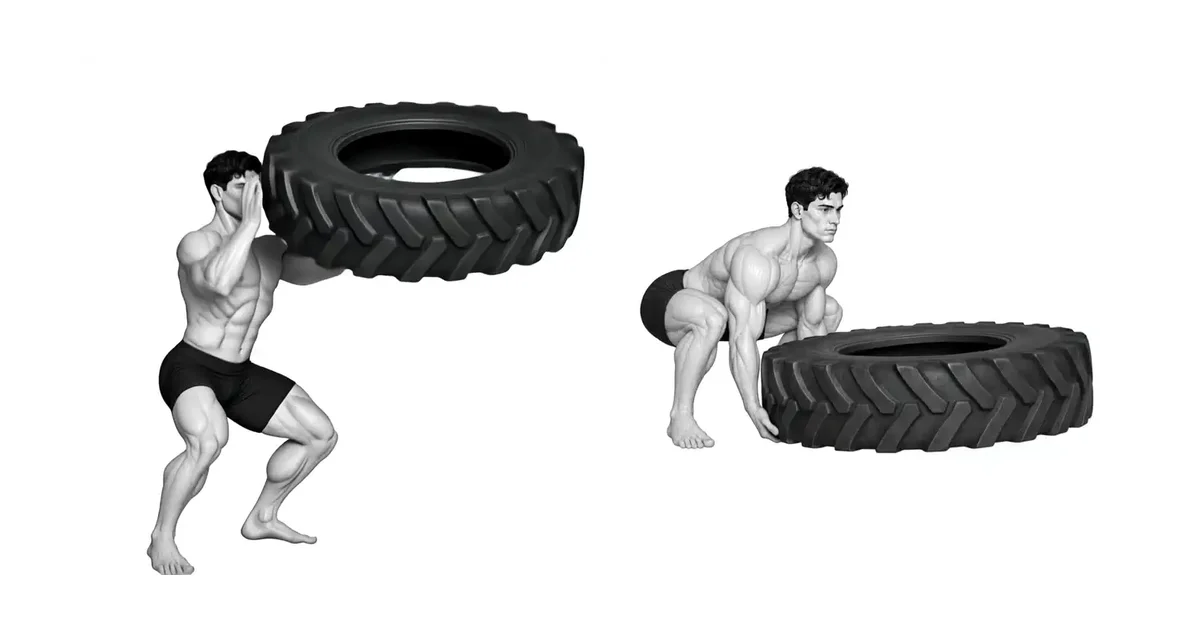
Support on your knees, switch hands and push
Once the tire is near waist height, briefly support it on one knee and move your hands from underneath to the front. Remove your fingers from the edge and slide it over with both hands.
DRIVE THROUGH THE TIRE
Push the tire forward rather than lifting it up.
Pulling like a vertical deadlift pulls the tires away from your body and puts more strain on your arms. Move forward at a low angle, keeping your chest close.
If your feet slip, the tire weight and floor are not suitable.
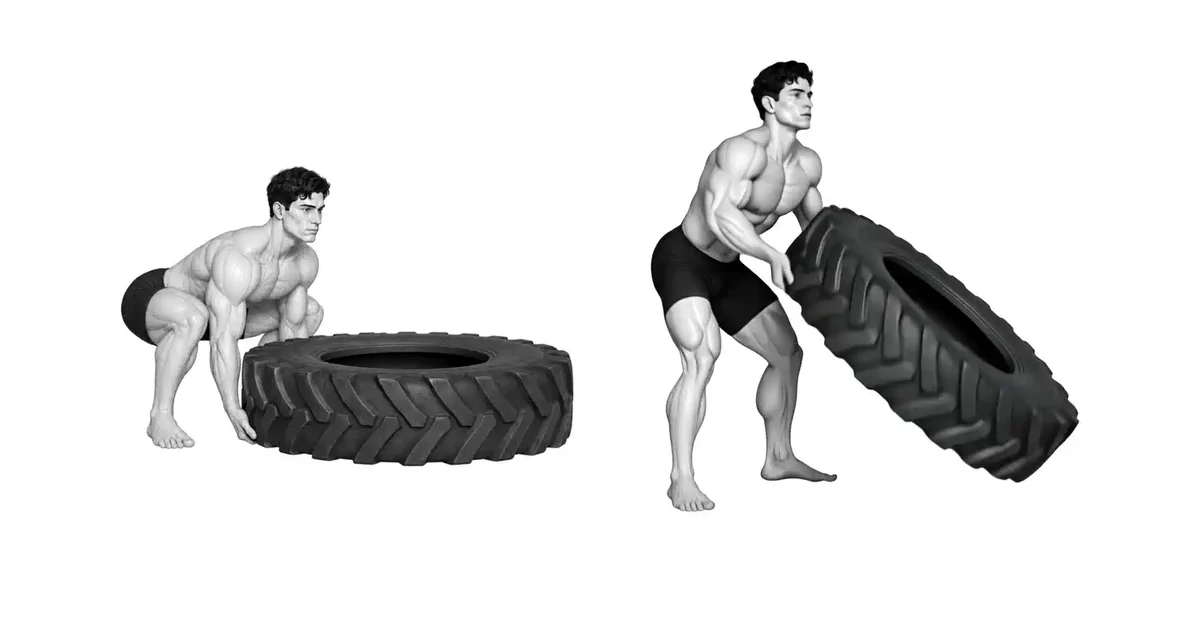
Key point: Cue to use right away: “Push your chest back and your feet against the ground.”
QUICK HAND TRANSITION
Do not leave your fingers under the edge when the tire rolls over
As soon as the tire approaches vertical, immediately move your hands to the front. Avoid the risk of your lower fingers being pressed.
If you can't control the transition, use lighter tires and partner assist.
TROUBLESHOOTING
Fix the cause of a mistake, not just its appearance
Curling the tire with the arm
- What you see
- Elbows bend quickly, biceps tire first, tires don't move.
- Likely cause
- Lacks chest tightness and lower body drive.
- How to correct it
- Start by standing closer to the tire, keeping your chest close, and pushing forward with your feet.
Round your back and lift.
- What you see
- Your hips are high and your chest is off the tire, putting a strain on your lower back.
- Likely cause
- Tires are overloaded or the starting position is far.
- How to correct it
- Use lighter tires and lower your hips to fit your entire body.
Fingers remain below when crossing over
- What you see
- Tire passes vertical without changing hand position.
- Likely cause
- Transition timing not practiced.
- How to correct it
- Stabilize with your knees, then move your hands fully to the front and push off.
REGRESSION & PROGRESSION
Match the difficulty before adding load
Increased weight and speed
Gradually increase the weight or increase the speed of the movement while maintaining correct posture.
Continuous execution (complex)
Combine with other movements to strengthen cardiorespiratory endurance and muscular endurance simultaneously.
BEGINNER PROGRAM
A practical starting framework
Use 2-5 flips or short distances without breaking the technique. Record tire weight and floor friction and do not attempt tires that do not move on their own.
Frequency
1-2 times a week
High nervous system fatigue, so allow ample recovery time.
Volume
3~5 sets, 3~6 times
Low reps are recommended to focus on maintaining quality movement and explosiveness.
- If you become tired and lose your posture, end the set immediately.
- Protect your spine by maintaining abdominal pressure with powerful breathing.
Frequently asked questions
Can I lift it like a deadlift?
The typical route is to attach tires to the body and drive them forward. Pulling it vertically increases the strain on your arms and lower back.
If I can’t turn it over on my own, can I get assistance?
Partner assistance is available, but if your weight significantly exceeds your skills, choosing lighter tires is a priority.